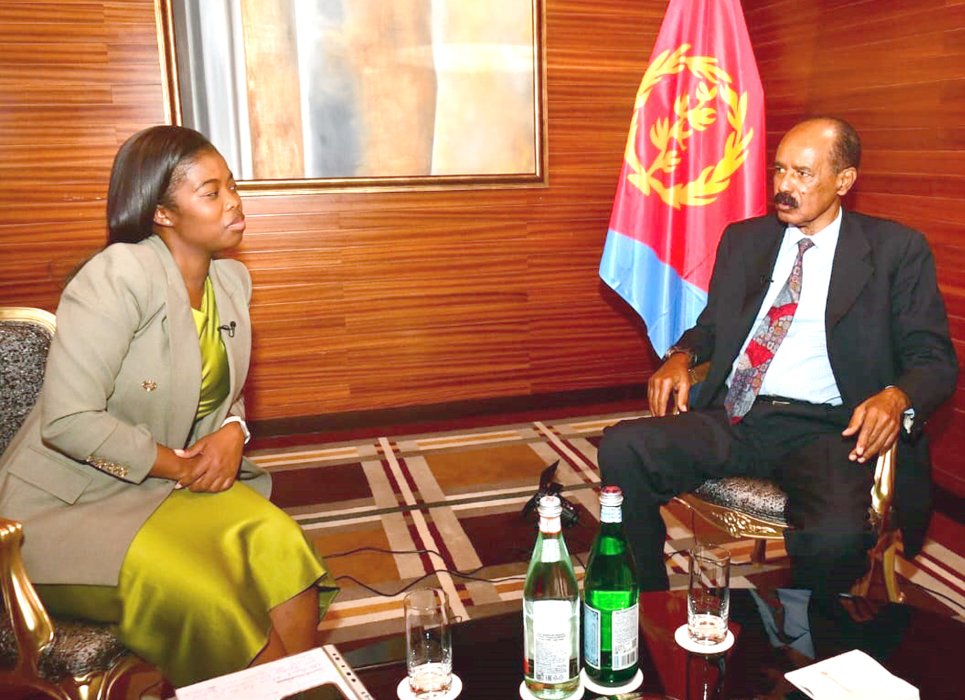
Eritrean President Isaias Afwerki has outlined his government's position on Sudan's ongoing conflict, Red Sea security and relations between Russia and African countries in an interview with Russian television network RT.
The interview took place in the context of Afwerki's visit to Moscow for the Third Russia–Africa Summit, held on October 28–29, 2026.
According to an Eritrean-language account of the interview, Afwerki argued that outside interference has played a major role in sustaining armed conflicts across Africa, particularly in Sudan.
He also emphasized that regional governments should take primary responsibility for peace and security rather than relying on external powers or international intervention mechanisms.
The remarks come amid continuing military conflict in Sudan and heightened diplomatic attention to developments along the Red Sea and in the Horn of Africa.
Afwerki Rejects the Description of Sudan's War as a Purely Internal Conflict
Asked about the situation in Sudan, Afwerki challenged the characterization of the fighting as a conflict rooted solely in domestic political divisions.
The Eritrean president argued that Sudan's war is being sustained by armed groups receiving support from foreign actors and does not reflect the wishes of the Sudanese population.
He maintained that the current Sudanese authorities should be understood as a transitional administration responsible for guiding the country toward a more stable political phase.
His position reflects Eritrea's continuing diplomatic engagement with Sudan's military leadership and the Transitional Sovereignty Council.
However, Sudan's conflict also has significant domestic origins.
The fighting began in April 2023 following escalating tensions between the Sudanese Armed Forces (SAF) and the paramilitary Rapid Support Forces (RSF), including disputes over political authority and the future integration of security forces.
Afwerki's rejection of the civil-war characterization therefore represents his government's interpretation of the conflict rather than an independently established description of its causes.
Foreign Military Support Comes Under Criticism
Afwerki accused outside actors of supporting armed factions and war leaders while exploiting religious, tribal, ethnic and other divisions.
He argued that these activities undermine regional peace and stability and called for foreign interference that fuels conflict to end.
The question of outside support in Sudan has also been examined by international investigators.
In September 2026, the United Nations Independent International Fact-Finding Mission for the Sudan reported that foreign weapons, military technology, personnel and logistical networks were helping sustain the conflict.
Investigators identified evidence concerning transnational networks associated with support to the RSF, including the movement of weapons, equipment and foreign personnel.
The mission also accused both principal warring parties of serious violations of international humanitarian and human rights law.
The United Arab Emirates, which has repeatedly been accused of supporting the RSF, has denied providing military, financial or logistical assistance to the paramilitary force.
Although the international findings support concerns about foreign involvement, they do not independently establish every aspect of Afwerki's broader political interpretation of Sudan's war.
Red Sea Security Should Be Led by Coastal States
The Eritrean president also addressed the security of the Red Sea, one of the world's important international maritime corridors.
Afwerki argued that responsibility for protecting the waterway should rest primarily with countries bordering it.
He said the coastal states should develop their own security capabilities and coordinate their efforts to maintain stability.
His position reflects Eritrea's longstanding opposition to external military arrangements that it considers inconsistent with the sovereignty of regional governments.
The Red Sea connects the Mediterranean and Indian Ocean maritime systems through the Suez Canal and the Bab el-Mandeb Strait.
Countries bordering the waterway include Eritrea, Sudan, Egypt, Djibouti, Saudi Arabia and Yemen.
Eritrea's coastline and proximity to Bab el-Mandeb give the country a significant geographic position in regional maritime security discussions.
Afwerki's comments emphasized the need for collective regional responsibility and cooperation among the states most directly affected by maritime insecurity.
Eritrean Leader Criticizes Intervention Through International Institutions
Afwerki extended his criticism of outside involvement to interventions carried out under the authority or name of international organizations.
He argued that some initiatives associated with the United Nations, the African Union and other institutions have created additional obstacles rather than helping resolve regional disputes.
The Eritrean president warned that intervention justified by armed conflict could produce greater destruction when external political interests take precedence over national sovereignty.
He maintained that international institutions should not be used as instruments for interference in the domestic affairs of sovereign states.
These remarks are consistent with Eritrea's emphasis on territorial integrity, non-interference and national independence in international relations.
However, Afwerki's criticism should be distinguished from the independently established humanitarian and diplomatic activities of the United Nations and African Union, whose mandates and operations differ across individual conflicts.
A Regional Approach Shared with Sudan, Somalia and Egypt
Afwerki's latest statements also echo positions expressed during recent high-level discussions between Eritrea and its regional partners.
On October 4, 2026, the leaders of Eritrea, Egypt, Somalia and Sudan held a quadrilateral summit in Egypt's New Alamein City.
The meeting brought together Afwerki, Egyptian President Abdel Fattah el-Sisi, Somali President Hassan Sheikh Mohamud and Sudan's Transitional Sovereignty Council Chairman Abdel Fattah al-Burhan.
The four leaders adopted a joint declaration emphasizing respect for sovereignty, independence and territorial integrity.
They also rejected interference in the internal affairs of regional states and supported the peaceful settlement of disputes.
The discussions covered Red Sea security, the safety of international navigation in the Gulf of Aden and Bab el-Mandeb Strait, and opportunities for regional economic integration.
Afwerki's RT interview reinforced several of the principles highlighted in those consultations, particularly the importance of regional ownership of security arrangements.
Russia's Role in Africa and the Limits of External Assistance
Turning to relations between Russia and Africa, Afwerki said Moscow should develop cooperative partnerships with African governments.
He characterized Russia's engagement with the continent as carrying a moral responsibility to contribute to cooperation and development.
At the same time, he cautioned that African countries should not expect solutions to all their difficulties to come from outside the continent.
According to Afwerki, African governments must build the institutional and political capacity required to address their own economic, security and development challenges.
His comments suggested that international partnerships should complement African-led efforts rather than substitute for them.
The Eritrean president expressed a related position in a separate interview with Sputnik Africa, published on October 29.
In that interview, he identified respect for independence, sovereignty and territorial integrity as fundamental conditions for strategic cooperation.
He also argued that obstacles in the international financial system, sanctions and political pressure could limit the effectiveness of economic partnerships.
The Sputnik interview was a separate engagement and should not be confused with his RT remarks.
Interview Follows Third Russia–Africa Summit in Moscow
Afwerki participated in the Third Russia–Africa Summit held in Moscow on October 28–29.
The summit addressed cooperation in trade, investment, energy, agriculture, food security and broader political and security matters.
During the summit period, Eritrea continued its diplomatic engagement with Russia while promoting positions focused on national sovereignty and regional stability.
The RT interview provided another opportunity for Afwerki to communicate his government's perspective on Sudan, the Red Sea and Africa's relationship with external powers.
His remarks emphasized opposition to foreign interference, support for a greater role for regional states in maritime security, and the responsibility of African governments to develop their own solutions.
No new binding regional security agreement or diplomatic initiative was announced in the interview summary.
Whether the proposals and positions outlined by the Eritrean president translate into additional diplomatic measures remains to be established through subsequent official developments.