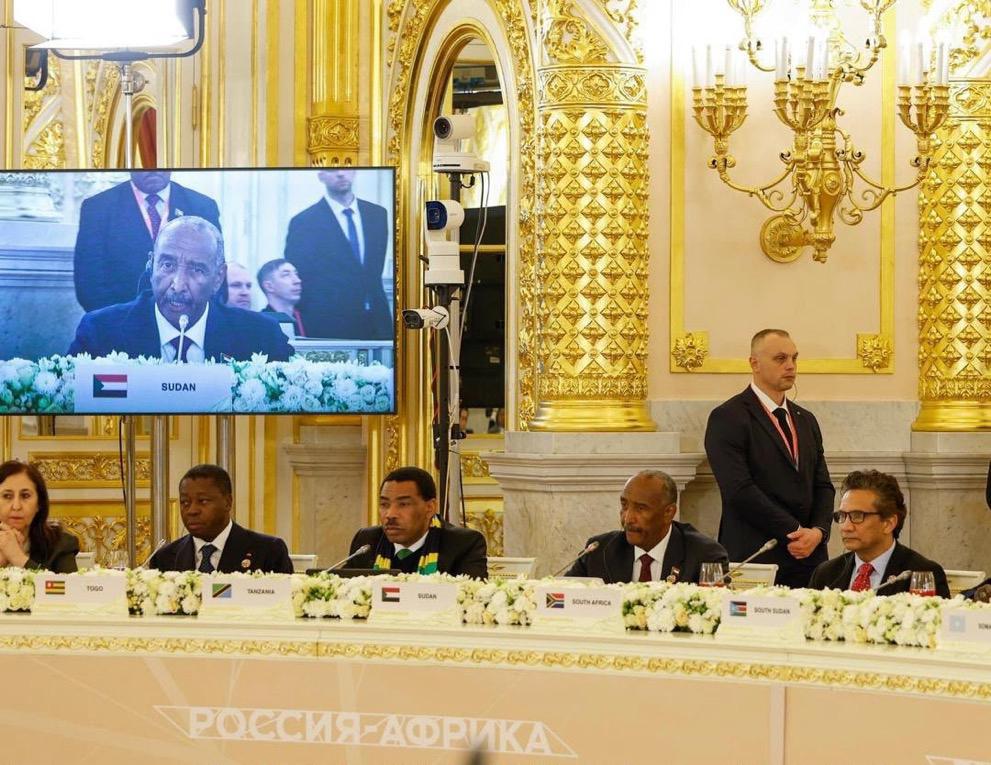
Sudan's Transitional Sovereignty Council Chairman and Commander-in-Chief of the Armed Forces, General Abdel Fattah al-Burhan, outlined his government's approach to ending the war and shaping the country's political future during an address to the third Russia–Africa Summit in Moscow.
According to the full speech published by the Sudan News Agency (SUNA) on October 29, 2026, Burhan said Sudan was seeking peace and stability while insisting that any political settlement must preserve national sovereignty, unity and dignity.
He argued that the country's future should be determined through dialogue among Sudanese parties rather than external political dictates or intervention.
Burhan insists peace must be Sudanese-led
Addressing African leaders and Russian officials in Moscow, Burhan reaffirmed that the Sudanese government was seeking an end to the conflict and a return to political stability.
However, he rejected the idea that a settlement should be imposed from outside the country.
Burhan said peace must preserve Sudan's sovereignty, unity and the aspirations of its people.
He stressed that political arrangements should emerge from decisions made by Sudanese stakeholders through a domestic dialogue process.
His remarks placed national sovereignty and opposition to external interference at the centre of the government's stated approach to resolving the war.
Commitment to a civilian democratic transition
A central element of Burhan's speech was his commitment to a future civilian democratic transition.
The Sudanese leader said sustainable political stability required a national dialogue among Sudanese parties.
According to the framework he outlined, such consultations would establish the foundations for a transitional period leading toward a new political order.
Burhan stated that the transitional process should ultimately lead to free and fair elections.
However, he did not specify how long the transition would last, when elections would take place or which political groups would participate in the proposed dialogue.
Regional and international election monitoring proposed
Burhan said future elections should be held under regional and international observation.
The proposal would provide for international monitoring of the electoral process while keeping the political transition itself under Sudanese ownership.
The Sovereignty Council Chairman reiterated the goal of establishing civilian democratic governance through elections.
Nevertheless, the speech did not announce a binding electoral timetable or a detailed roadmap for implementing the transition.
Accusations of foreign support for armed groups
Burhan also addressed the war that has continued in Sudan since April 2023.
He described the conflict as an assault by a rebellious armed militia receiving political and logistical assistance from regional and international actors.
The Sudanese government has repeatedly accused the Rapid Support Forces (RSF) of waging war against the country's state institutions.
Although Burhan did not name the RSF directly in this section of his speech, he characterized the opposing force as a rebel terrorist militia.
He did not identify specific foreign governments or present new evidence supporting the allegations of external assistance during the address.
The continuing conflict between the Sudanese Armed Forces and the RSF has displaced millions and severely damaged the country's economic and civilian infrastructure.
Sovereignty and non-interference emphasized in Moscow
Burhan said the Russia–Africa Summit was taking place at a time when equal sovereignty, non-interference and mutual respect were becoming increasingly important principles in international relations.
He argued that cooperation between Russia and African countries should rest on these foundations.
The Sudanese leader also expressed support for a multipolar international order in which states would have greater independence in managing their domestic affairs.
He praised Russia's diplomatic support for Sudan's sovereignty and territorial integrity.
Political future tied to national dialogue
Burhan's address presented a Sudanese-led peace process and a transition toward civilian rule as closely connected objectives.
The speech linked national dialogue, protection of state institutions, democratic governance and internationally monitored elections within the government's stated political vision.
However, the practical arrangements remain unresolved.
The participants in the proposed dialogue, the length of the transitional period and the election timetable have not yet been formally established.
Further political discussions and official decisions will determine how the commitments presented in Moscow are implemented.