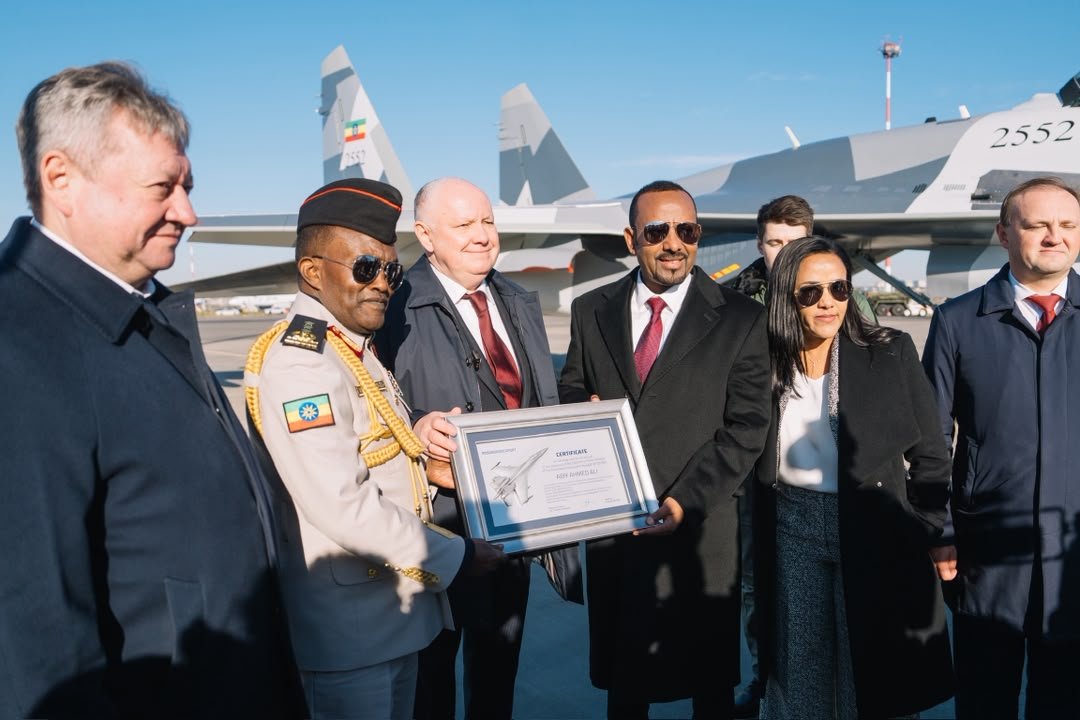
Ethiopia is moving forward with a long-term military aviation modernization program following the delivery of 12 Russian-built Su-35 fighter jets.
Prime Minister Abiy Ahmed confirmed the aircraft handover on October 28, 2026, under an existing defence agreement with Moscow.
The Ethiopian government also announced plans to receive four batteries of Russia's S-400 air defence system.
The latest development comes as Ethiopia pursues a broader strategy to expand its air force and develop more advanced military aviation capabilities by 2030.
Ethiopia targets a larger air force by 2030
Prime Minister Abiy outlined the country's long-term aviation ambitions during the Ethiopian Air Force's 90th anniversary celebrations on January 24, 2026.
At the event, he announced plans to double the country's combat aircraft fleet by 2030 and pursue a transition toward fifth-generation air power.
Abiy emphasized that the modernization program would require sustained investment in technology, infrastructure and personnel development.
The newly confirmed Su-35 delivery represents another step in that broader program.
However, the Su-35 is classified as a 4++ generation fighter aircraft. Its acquisition should therefore not be confused with the realization of Ethiopia's separate ambition to develop fifth-generation capabilities.
Su-35 aircraft expand Ethiopia's military aviation fleet
The Russian-built Su-35 is designed for air superiority and multirole combat operations.
Ethiopia has operated Russian-made Sukhoi aircraft for many years, making the latest acquisition part of an established military aviation relationship.
The new aircraft are intended to strengthen the country's existing combat aviation capabilities.
Alexander Mikheyev, Director-General of Russia's state arms exporter Rosoboronexport, separately confirmed the delivery of the first Su-35 batch to the Ethiopian Air Force.
Nevertheless, the Ethiopian and Russian authorities have not released detailed information on the aircraft's deployment locations, assigned units or operational readiness.
S-400 batteries represent the next stage
The planned delivery of four Russian S-400 air defence batteries represents another component of Ethiopia's proposed modernization program.
The S-400 is a long-range surface-to-air defence system incorporating radar, command-and-control equipment and missile units designed to detect and engage aerial threats.
While fighter jets provide an airborne military response capability, ground-based air defence systems offer a separate means of protecting airspace.
Ethiopia's planned acquisition of both platforms indicates an intention to develop different elements of its air defence capacity.
However, no detailed technical arrangements for integrating the Su-35 aircraft and future S-400 batteries have been publicly announced.
The delivery timetable for the S-400 systems also remains undisclosed.
The confirmed arrival of the fighter jets must therefore be distinguished from the future delivery of the ground-based air defence equipment.
Personnel training and technical support remain essential
During his January address, Abiy emphasized that advanced aircraft alone would not create a fully capable modern air force.
He highlighted the need to develop pilots, technical specialists and supporting military institutions.
That distinction remains relevant as Ethiopia acquires more sophisticated combat aircraft.
Training, aircraft maintenance, engineering support and logistics will be important elements of sustaining the new platforms over time.
However, no new details have been released concerning pilot training arrangements, maintenance facilities or technical support contracts associated with the latest delivery.
Financial terms and deployment locations undisclosed
The Ethiopian government has not disclosed the total value of its agreement with Russia.
Reuters reported on October 28 that the authorities had also not provided a delivery date for the S-400 systems or identified the military bases where the aircraft and air defence batteries would be stationed.
The public announcements did not include financial details concerning long-term maintenance, spare parts or training.
These outstanding questions will be important in assessing the full scale and implementation of Ethiopia's modernization program.
A broader transition toward technology-driven air power
Prime Minister Abiy has presented the military modernization program as part of Ethiopia's efforts to protect sovereignty and strengthen its capacity to deter potential threats.
He thanked Russian President Vladimir Putin for facilitating delivery of the Su-35 fighters one year ahead of the originally agreed schedule.
The government's broader ambitions extend beyond the current aircraft acquisition to include fleet expansion, personnel development and more advanced military technology.
The arrival of 12 Su-35 fighters represents a confirmed milestone in that process.
However, the wider modernization effort remains ongoing, with the S-400 delivery timetable and other technical and operational details yet to be announced.
Further official disclosures will determine how quickly Ethiopia's latest acquisitions are incorporated into its long-term air force development plans.