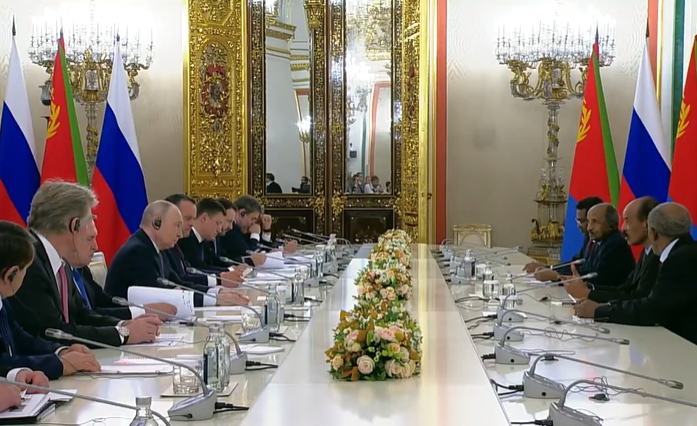
Russian President Vladimir Putin held bilateral talks with Eritrean President Isaias Afwerki in Moscow on Friday, October 30, 2026, following the conclusion of the Third Russia–Africa Summit.
The meeting took place at the Kremlin, where the two leaders were joined by senior members of their respective delegations.
The latest diplomatic engagement came during a particularly sensitive period for the Horn of Africa, with tensions between Eritrea and neighboring Ethiopia drawing international attention.
Moscow has maintained relations with both governments and recently expressed its willingness to provide a platform for direct dialogue between their leaders.
The Putin–Afwerki meeting therefore took place against a broader regional diplomatic backdrop, although the Kremlin has not publicly detailed whether Ethiopia–Eritrea relations were discussed during the talks.
Eritrea's President Holds High-Level Talks in Moscow
Afwerki travelled to the Russian capital to attend the Third Russia–Africa Summit, held on October 28–29.
His delegation included Eritrean Foreign Minister Osman Saleh, according to the country's Ministry of Information.
Before the visit, Eritrean authorities announced that Afwerki would meet Putin to discuss strengthening bilateral relations and addressing issues of mutual importance.
The talks formed part of a wider series of meetings between the Russian president and African leaders following the summit.
Moscow used the gathering to expand diplomatic engagement with African governments and explore opportunities for cooperation in political, economic and security-related fields.
The October 30 meeting marked another presidential-level contact between Russia and Eritrea, continuing a diplomatic relationship reinforced by previous visits in 2023.
Russia Offers a Platform for Ethiopia–Eritrea Dialogue
The Kremlin meeting followed a Russian diplomatic proposal aimed at encouraging negotiations between Ethiopia and Eritrea.
Russian Foreign Minister Sergey Lavrov said Moscow was prepared to facilitate direct contact between Ethiopian Prime Minister Abiy Ahmed and Eritrean President Afwerki if both governments expressed interest.
Lavrov's comments followed a similar proposal by Russian Deputy Foreign Minister Alexander Alimov on October 16.
Russian officials have indicated that diplomatic engagement could help the neighboring countries address their disagreements and reduce the risk of further instability.
However, the proposal remains conditional on the willingness of both governments to participate.
Neither Addis Ababa nor Asmara has publicly confirmed its acceptance of a Russian-mediated negotiation process.
There has also been no official confirmation of a direct meeting between Abiy Ahmed and Afwerki during the Moscow summit.
Putin Meets Ethiopian and Eritrean Leaders Separately
Russia's diplomatic engagement with both countries was reflected in two separate meetings held during the summit period.
On October 28, Putin received Ethiopian Prime Minister Abiy Ahmed for bilateral discussions.
According to the Ethiopian News Agency, the talks focused on cooperation in nuclear energy, health, trade and other areas of mutual interest.
Two days later, the Russian president met Eritrean President Afwerki at the Kremlin.
The separate engagements gave Moscow an opportunity to maintain direct communication with the leadership of both countries during the same week.
However, these meetings should not be interpreted as evidence that negotiations between Ethiopia and Eritrea have begun.
No jointly announced mediation framework, negotiation timetable or agreement between the two neighboring governments has emerged from the summit.
Red Sea Access Remains a Central Regional Dispute
Relations between Ethiopia and Eritrea have deteriorated amid disagreements concerning regional security, territorial sovereignty and access to the Red Sea.
Ethiopia, a landlocked country, has increasingly emphasized the importance of direct maritime access for its economic development and long-term strategic interests.
Eritrea, which has a coastline along the Red Sea, maintains that its sovereignty and territorial integrity must be respected.
The political relationship between the two countries weakened following the Pretoria Cessation of Hostilities Agreement in November 2022, which sought to end the conflict in Ethiopia's Tigray region.
Addis Ababa has accused Eritrea of supporting armed groups operating inside Ethiopia, allegations rejected by Asmara.
Eritrean officials, in turn, have raised concerns that Ethiopia's maritime ambitions could threaten Eritrean sovereignty.
The competing positions have intensified concerns about regional security at a time when the Horn of Africa is already facing multiple political and military challenges.
Economic Cooperation Adds Another Dimension to the Visit
Alongside the political discussions, Eritrea and Russia are exploring opportunities to deepen economic and infrastructure cooperation.
Eritrea's location along the Red Sea gives the country access to maritime trade routes through its principal ports of Massawa and Assab.
On October 30, Russia's Ministry of Transport announced that Transport Minister Dmitry Yadrov had held a separate working meeting with Afwerki.
The discussions covered possible cooperation in maritime infrastructure, railway development, road construction and transport connectivity.
Russian companies expressed interest in participating in port modernization and wider transportation projects.
The two sides also considered identifying potential freight routes and cargo volumes that could support future commercial exchanges.
No finalized investment package or construction timetable was announced.
The discussions nevertheless demonstrated Moscow's interest in developing practical economic cooperation with Eritrea alongside its political relations.
Longstanding Diplomatic Contacts Continue
Russia and Eritrea established diplomatic relations in May 1993, following Eritrea's independence.
In recent years, contacts between the two governments have continued through presidential visits, diplomatic exchanges and discussions on possible economic partnerships.
Afwerki visited Moscow in May 2023 and later met Putin during the Second Russia–Africa Summit in St. Petersburg in July of that year.
The October 2026 meeting continued that pattern of high-level engagement.
It also took place at a moment when Russia is seeking to expand its relationships across Africa through trade, investment, infrastructure cooperation and political dialogue.
For Eritrea, the visit provided another opportunity to discuss bilateral relations directly with Moscow while regional disagreements involving Ethiopia remain unresolved.
The immediate outcome of Russia's offer to facilitate Ethiopia–Eritrea dialogue is still uncertain.
Further official statements will be needed to determine whether the latest diplomatic contacts result in direct negotiations between the neighboring governments or new bilateral agreements between Moscow and Asmara.