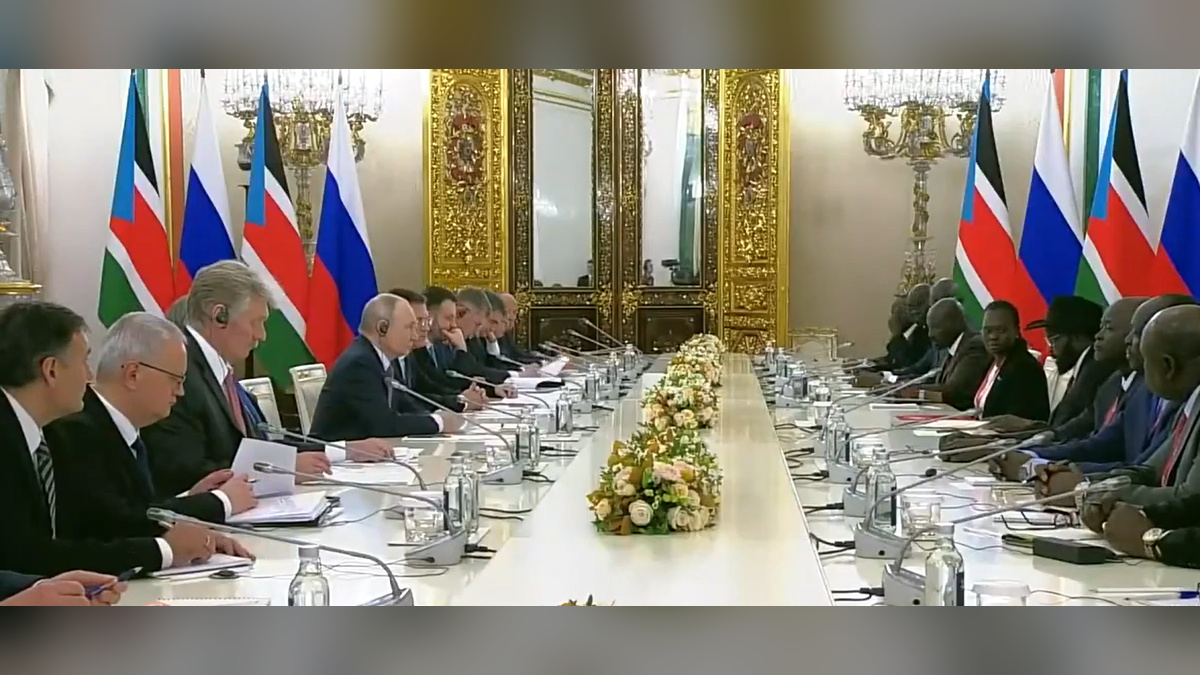
Russian President Vladimir Putin received South Sudanese President Salva Kiir Mayardit in Moscow on Friday, October 30, 2026, for bilateral talks following the Third Russia–Africa Summit.
The meeting took place at the Kremlin, where the two leaders reviewed bilateral relations and opportunities to expand economic cooperation.
Putin described relations between Moscow and Juba as friendly and acknowledged that their commercial potential had not yet been fully developed.
The talks came as the two countries marked 15 years since establishing diplomatic relations following South Sudan's independence in 2011.
South Sudan has identified petroleum, mining, agriculture, investment and technical cooperation among the sectors in which it seeks closer engagement with Russia.
The presidential meeting also followed significant discussions between the two governments' economic and energy officials.
Russia and South Sudan Establish Joint Economic Commission
One of the major developments surrounding the Moscow visit was the signing of an agreement to establish a Joint Intergovernmental Russian–South Sudanese Commission on Trade, Economic, Scientific and Technical Cooperation.
The agreement was signed by Russian Minister of Economic Development Maxim Reshetnikov and South Sudan's Caretaker Minister of Petroleum Awow Daniel Chuang Deng.
According to the Russian Embassy in Juba, the commission will provide an institutional framework for coordinating economic cooperation and identifying potential joint projects.
It is intended to facilitate investment discussions, support commercial initiatives and create a regular mechanism for cooperation between government institutions.
The arrangement also covers scientific and technical collaboration, extending the scope of bilateral engagement beyond traditional trade relations.
Russian officials described the commission as a means of improving the coordination of future economic activities.
However, detailed financing arrangements, the first meeting schedule and specific projects to be implemented under the new commission have not yet been announced.
Russian Oil Company Eyes Former Petronas Stakes
Energy cooperation represents another major component of the latest developments between Russia and South Sudan.
On October 29, Russian Energy Minister Sergey Tsivilev met South Sudan's Petroleum Minister Awow Daniel Chuang in Moscow to discuss possible cooperation in the oil and power sectors.
The discussions included a preliminary arrangement under which Russian state-owned oil company Zarubezhneft could acquire interests previously held by Malaysia's Petronas in two South Sudanese oil operating companies.
The companies concerned are Dar Petroleum Operating Company (DPOC) and Greater Pioneer Operating Company (GPOC).
Before leaving South Sudan in 2024, Petronas held a 40 percent interest in DPOC and a 30 percent stake in GPOC.
According to South Sudanese government statements, a Memorandum of Understanding and a Letter of Acceptance were signed during the Moscow discussions.
The proposed arrangement represents a step toward a potential ownership transfer, but it does not establish that Zarubezhneft has already completed the acquisition.
Financial terms, regulatory approvals and the final structure of the transaction remain undisclosed.
Zarubezhneft Could Expand Russia's Energy Presence
South Sudan's national oil company, Nile Petroleum Corporation (NilePet), has expressed support for the potential involvement of Zarubezhneft.
The company pointed to the Russian firm's experience in operating mature oilfields, improving production efficiency and supporting petroleum infrastructure development.
NilePet also identified technology transfer, environmental management and technical training as areas in which cooperation could be beneficial.
South Sudan is seeking investment and technical expertise to sustain and expand its petroleum sector.
The proposed involvement of Zarubezhneft could increase Russia's direct participation in the country's oil production industry.
Nevertheless, no final acquisition price, new production target or confirmed investment commitment has been publicly disclosed.
The proposal has also prompted political criticism within South Sudan.
Deng Bol Aruai Bol, leader of the opposition South Sudan People's Liberation Movement (SSPLM), called for transparency over the transaction and questioned its legal basis.
He urged the authorities to disclose financial details, liabilities and any obligations linked to future oil revenues.
The South Sudanese government, meanwhile, has presented the preliminary arrangement as an opportunity to strengthen economic and technical cooperation with Russia.
Putin Announces Expanded University Scholarships
Education was another focus of the Kremlin talks.
Putin announced that Russia had increased its allocation of university places for South Sudanese students to 40 for the 2026–2027 academic year.
The previous annual allocation had stood at approximately 25 places.
The increase is intended to support the training of South Sudanese students and contribute to the development of qualified professionals.
Russia has also provided diplomatic training opportunities and other educational assistance for South Sudanese personnel.
Moscow and Juba view educational exchanges and technical training as complementary elements of their broader bilateral relationship.
Russian Embassy in Juba Supports Diplomatic Relations
During the meeting, Putin recalled Kiir's previous visit to Moscow in September 2023.
That visit resulted in an agreement to establish a Russian embassy in Juba, an initiative intended to strengthen direct diplomatic communication between the two governments.
The embassy opened in 2025, and Russia's ambassador presented his credentials to President Kiir in January 2026.
Putin highlighted the significance of the diplomatic presence for future cooperation.
Russia and South Sudan established formal diplomatic relations shortly after South Sudan gained independence in July 2011.
The Russian president also expressed satisfaction with bilateral cooperation in international institutions, including the United Nations.
He said Moscow and Juba maintained similar positions on several international issues.
Justice Ministries Prepare Additional Legal Agreements
The Moscow visit also included discussions on legal cooperation.
Russian Justice Minister Konstantin Chuychenko met South Sudan's Minister of Justice and Constitutional Affairs, Wek Mamer Kuol, to examine possible bilateral legal arrangements.
According to Russia's Ministry of Justice, the talks focused on developing legal mechanisms to support investment, commercial relations and cooperation between the two countries.
The ministers agreed to begin expert-level preparations for potential new international agreements.
Both sides aim to prepare the documents for possible signing at the 15th St. Petersburg International Legal Forum, scheduled for May 20–22, 2027.
The proposed legal agreements remain under preparation and have not yet been signed.
Kiir Invites Investment in South Sudan's Key Sectors
President Kiir also used his participation in the Russia–Africa Summit to promote investment opportunities in South Sudan.
Addressing the gathering, he encouraged Russian and international investors to explore projects in agriculture, petroleum, mining and tourism.
Kiir said the responsible development of natural resources could contribute to economic growth and create opportunities for mutually beneficial partnerships.
The South Sudanese leader also expressed support for the Russia–Africa Partnership Forum Action Plan for 2027–2029.
The plan is intended to promote broader cooperation in trade, investment, technology, education and other areas of mutual interest.
His summit remarks were separate from the October 30 bilateral talks with Putin but reflected the economic priorities Juba brought to Moscow.
Together, the presidential meeting, the new intergovernmental commission agreement and the preliminary oil arrangement indicate an effort by Russia and South Sudan to move toward more structured economic cooperation.
The next steps will depend on the commission beginning its work, the completion of any necessary oil-sector approvals and the implementation of future agreements.