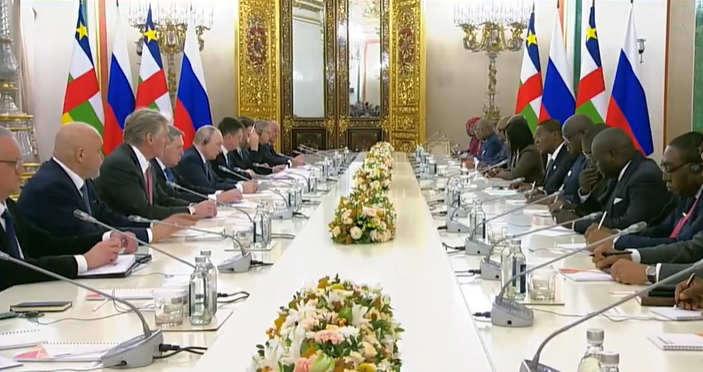
Russian President Vladimir Putin held bilateral talks with Central African Republic President Faustin-Archange Touadéra in Moscow on Friday, October 30, 2026, following the conclusion of the Third Russia–Africa Summit.
The Kremlin meeting focused on strengthening a relationship that has traditionally included substantial security cooperation while exploring opportunities for broader economic engagement.
Putin identified energy, geological exploration, transport and logistics as sectors offering considerable potential for future bilateral projects.
Touadéra highlighted the importance of Russian support for his country's security institutions and emphasized the need to transform diplomatic cooperation into practical development opportunities.
The talks coincided with new announcements concerning Russian geological activities in the Central African Republic.
Touadéra Praises Russian Security Assistance
Security cooperation remained an important component of the presidential meeting.
Touadéra expressed appreciation for Russia's assistance in strengthening the capabilities of the Central African Republic Armed Forces.
He recalled the deterioration of the country's security situation during previous years, when armed groups controlled significant areas and threatened state institutions.
According to Touadéra, Russian military instructors began arriving in Bangui in 2018 to provide training and other assistance to government forces.
He particularly highlighted their contribution during the crisis of late 2020 and early 2021, when armed groups launched operations threatening the capital.
Touadéra described the role of Russian specialists during that period as important to the government's ability to resist armed attacks.
The Russian security presence has also attracted international scrutiny.
United Nations experts have examined the operations of Russian personnel working alongside Central African government forces, including issues related to command arrangements and civilian protection.
The country's security environment continues to require international attention, particularly in areas close to its borders with Sudan and Chad.
Russian Geological Company Begins Gold Exploration
A separate economic development announced during the summit involved Russian state-owned geological company Rosgeo.
On October 28, the company confirmed that it had begun gold exploration activities in the Central African Republic.
Alexey Desyatkin, head of international operations at Rosgeo and general director of Zarubezhgeologia, explained that the new work followed earlier geological mapping carried out between 2021 and 2023.
Those studies identified areas considered promising for potential mineral resources.
The latest activities are intended to investigate those areas in greater detail and assess the prospects for future mineral development.
Gold is among the Central African Republic's important natural resources, and improved geological information could support future investment decisions.
However, the launch of exploration activities does not establish that a commercially viable gold deposit has been confirmed.
No final investment budget, production timetable or mining concession announcement was included in the company's latest statement.
Moscow Identifies Energy and Infrastructure Opportunities
During the Kremlin talks, Putin outlined opportunities to expand economic cooperation beyond the security sector.
Energy development, transportation, logistics and geological research were identified as areas where Russian companies could explore additional projects.
As a landlocked country, the Central African Republic faces significant infrastructure challenges affecting trade, regional connectivity and access to international markets.
Improved transport connections, reliable energy supplies and the development of domestic processing industries remain important economic objectives.
Touadéra has repeatedly called for foreign partnerships that contribute to local employment, infrastructure and productive capacity.
At the Russia–Africa Summit, he emphasized the importance of translating international cooperation into tangible development outcomes.
Nevertheless, no newly financed large-scale infrastructure project was confirmed in the public summary of the October 30 bilateral meeting.
Joint Economic Commission Begins Work
Russia and the Central African Republic have also taken steps to establish more structured economic cooperation.
Putin confirmed that the bilateral intergovernmental commission established during 2026 held its first meeting in Bangui in September.
The mechanism is intended to facilitate discussions on trade, investment and joint economic initiatives.
Its establishment provides the two governments with a regular institutional channel for identifying and coordinating potential projects.
In comments to RIA Novosti on October 30, Touadéra said the countries were preparing a package of intergovernmental agreements covering several sectors.
He emphasized that the proposed arrangements should contribute to job creation and strengthen the Central African Republic's economic independence.
However, the full package should not be described as signed or implemented without additional official confirmation.
Wheat, Fuel and Agricultural Support Discussed
Touadéra also identified the continued supply of Russian wheat and petroleum products as an issue he intended to discuss with Putin.
He said previous supplies had provided important support to the Central African Republic.
Fuel availability and food imports remain economically significant for a country facing transport and infrastructure constraints.
In separate comments published on October 31, Touadéra expressed interest in Russian agricultural technology, fertilizers and equipment.
He described agriculture as a central sector of the national economy and suggested that technical cooperation could help improve productivity.
The statements indicate that Bangui is seeking to diversify relations with Moscow into food security and agricultural development.
No newly finalized agricultural investment package was confirmed during the presidential meeting.
Russia Expands Scholarship Allocation
Education was another area highlighted by Putin.
The Russian president announced that Moscow had increased the number of state-funded university places allocated to students from the Central African Republic for the 2026–2027 academic year.
The allocation increased from 85 to 100 places.
Putin said interest in Russian higher education was growing among Central African students.
Bangui hosts an association of graduates of Soviet and Russian universities, a Russian House cultural centre and an educational facility providing access to Russian-language learning.
Moscow views these programmes as part of its wider educational and cultural relationship with the country.
Diplomatic Cooperation Continues
Putin also emphasized cooperation between Russia and the Central African Republic in international institutions, including the United Nations.
He expressed appreciation for Bangui's support for certain Russian initiatives in multilateral forums.
The meeting took place ahead of the 66th anniversary of diplomatic relations between the two countries, which falls in December 2026.
Touadéra has participated in all three Russia–Africa summits, including the earlier gatherings in Sochi and St. Petersburg.
The latest meeting demonstrated both governments' intention to continue their established security relationship while seeking additional economic and institutional cooperation.
The practical outcome will depend on the progress of planned agreements, the activities of the joint economic commission and the results of ongoing exploration and development projects.