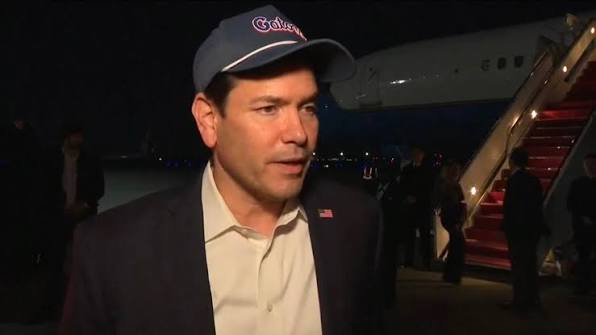
U.S. Secretary of State Marco Rubio outlined Washington's evolving diplomatic approach toward Eritrea during remarks to journalists at Joint Base Andrews, Maryland, on October 17, 2026.
The comments came as Ethiopia and Eritrea faced mounting tensions following renewed armed conflict in northern Ethiopia and accusations of military movements across their shared border.
Asked whether the removal of Ethiopia-related sanctions had been a mistake ahead of the latest violence, Rubio rejected the suggestion that the decision was responsible for the escalation.
Instead, he presented broader diplomatic engagement with Eritrea as an important component of American efforts to prevent a wider regional conflict.
Washington Acknowledges Growing Diplomatic Engagement with Asmara
Rubio acknowledged that the United States has historically maintained a difficult relationship with Eritrea.
However, he revealed that communication between Washington and Asmara had become more frequent over the previous several months.
The secretary of state indicated that maintaining diplomatic channels with opposing governments is important for any country seeking to facilitate negotiations or reduce tensions.
He also acknowledged that Washington remains considerably more engaged with Ethiopia than with Eritrea.
The remarks highlighted an effort to expand communication with Asmara without abandoning the longstanding diplomatic relationship between the United States and Addis Ababa.
US Removed Eritrea-Related Sanctions in September
The statements follow a significant change in American sanctions policy.
On September 18, 2026, the U.S. Treasury Department's Office of Foreign Assets Control announced that the national emergency declared under Executive Order 14046 had expired.
The order, introduced in September 2021, established sanctions authorities related to the humanitarian and human rights crisis in Ethiopia.
Following the expiration of those authorities, the Treasury Department removed several Eritrean individuals and organisations from its sanctions list.
The entities included the Eritrean Defense Forces, the ruling People's Front for Democracy and Justice, Hidri Trust and Red Sea Trading Corporation.
Two Eritrean individuals were also removed from the list under the same Ethiopia-related sanctions program.
The decision came shortly before renewed fighting in northern Ethiopia intensified diplomatic tensions between Addis Ababa and Asmara.
The expiration of the sanctions program did not, however, amount to American approval of subsequent military operations.
Rubio Rejects Link Between Sanctions Relief and Renewed Fighting
During his October 17 media appearance, Rubio argued that the sanctions involved were limited in scope and should not be regarded as a cause of the latest crisis.
He explained that improving diplomatic communication could help create conditions for future dialogue.
Rubio's remarks suggested that Washington viewed expanded access to Eritrean officials as potentially useful in efforts to prevent military escalation.
However, he did not announce a formal mediation process, a new peace agreement or a scheduled meeting between Ethiopian and Eritrean representatives.
US Maintains Closer Relations with Ethiopia
While discussing American outreach to Eritrea, Rubio also highlighted Washington's more established communication with Ethiopia.
He referred to his telephone conversation with Ethiopian Prime Minister Abiy Ahmed earlier in the week.
During that October 14 discussion, the two officials addressed the escalating tensions between Ethiopia and Eritrea.
The U.S. State Department subsequently emphasised the need for de-escalation, diplomatic engagement and respect for the sovereignty and territorial integrity of neighboring countries.
Washington also pointed to the 2018 Ethiopia-Eritrea peace framework as an important basis for addressing the crisis.
Tigray Conflict Complicates US Diplomatic Efforts
The latest tensions developed amid renewed military operations involving Ethiopian federal forces and opposition fighters led by the Tigray People's Liberation Front.
After the fighting intensified in late September, government-aligned troops regained control of several important areas of the Tigray region, including Mekelle.
Addis Ababa subsequently announced a temporary administration intended to govern the region for six months and prepare for regional elections.
The TPLF leadership rejected the new arrangement, leaving significant questions over Tigray's political future unresolved.
At the same time, Ethiopia accused Eritrea of supporting armed opposition forces and crossing into Ethiopian territory.
Eritrea denied the allegations and accused Ethiopia of threatening its national sovereignty.
Speaking on October 17, Rubio referred to attacks by separatist forces inside Ethiopia but did not explicitly name the TPLF in his remarks.
He acknowledged Ethiopia's security challenges while warning against a military response that could expand the fighting into a wider regional conflict.
Red Sea Dispute Adds to Regional Instability
The deteriorating relationship between Ethiopia and Eritrea has also been shaped by competing positions over access to the Red Sea.
Ethiopia has continued to emphasise the importance of direct maritime access for its economic development, while Eritrea maintains that its coastal territory and ports remain under its exclusive sovereignty.
The port of Assab has become a prominent focus of the dispute.
Combined with unresolved border tensions and renewed fighting in Tigray, the maritime disagreement has created additional obstacles to regional diplomacy.
Washington Faces a Test of Its Mediation Strategy
Rubio's disclosure of increased communication with Eritrea suggests that the United States is seeking to preserve diplomatic access to both governments at a time of mounting instability.
The September sanctions changes and the October discussions with Ethiopian officials form part of the broader diplomatic context.
Nevertheless, greater communication does not establish that a formal negotiation process has begun or that the two governments are prepared to accept American mediation.
The effectiveness of Washington's approach will depend on whether diplomatic engagement can help reduce military deployments, prevent further cross-border incidents and encourage renewed negotiations.
For now, Rubio's remarks underscore a central objective of American regional diplomacy: preventing the Ethiopia-Eritrea crisis from developing into another major war in the Horn of Africa.