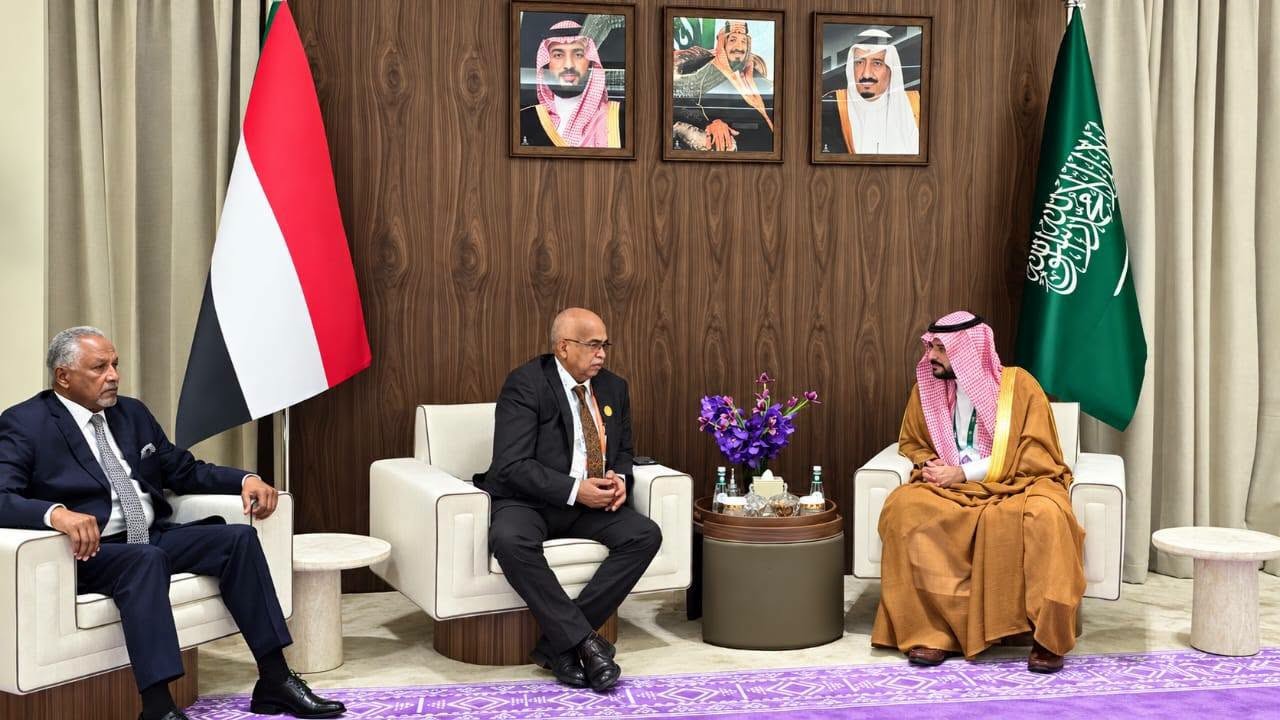
Sudan is exploring the expansion of its partnership with the Kingdom of Saudi Arabia in the energy sector through moves aimed at securing oil supplies and restoring production and refining capacities, alongside efforts to reconstruct vital facilities damaged by the war.
In this context, Sudan’s Minister of Energy and Oil, Eng. Consultant Al-Mutasim Ibrahim Ahmed Ali, held a meeting with Saudi Assistant Minister of Energy, Eng. Mohammed Abdulrahman Al-Ibrahim, and several ministry officials on the sidelines of the International Energy Forum and the World Petroleum Congress in Saudi Arabia.
Discussions focused on priority projects for Khartoum's energy sector amid the urgent need for investments and technical expertise to restore infrastructure efficiency and bolster the country's capacity to meet its fuel and electricity demands.
According to a statement obtained by the Washington-based specialized energy platform Attaqa, the agenda outlines four primary tracks of cooperation:
-
Importing petroleum products through a sustainable partnership with Saudi Aramco.
-
Developing oil blocks in the Red Sea.
-
Constructing an oil refinery in Port Sudan.
-
Rehabilitating and rebuilding the electricity sector's infrastructure.
Importing Petroleum Products
Securing fuel imports tops the list of files Sudan seeks to resolve in cooperation with Saudi Aramco, pursuing arrangements aimed at providing regular strategic supplies of oil derivatives to stabilize the domestic market through a sustainable corporate partnership.
This approach is not entirely new; bilateral efforts to cooperate on fuel supply date back to 2021, when understandings were introduced during the Sudanese-Saudi Investment Forum in Khartoum with aspirations to reach a long-term agreement ensuring stable supplies, though those efforts did not culminate in a final deal at the time.
In April 2026, Sudan revealed it had received a fuel supply offer from Saudi Aramco, which was placed under review by competent authorities.
Data from the Energy Research Unit illustrates Sudan's import volumes of Saudi petroleum products throughout 2025: imports stood at around 51.97 thousand barrels per day (bpd) in January and 33.29 thousand bpd in March, before dropping to zero in May, September, October, and December. Imports also recorded roughly 22.66 thousand bpd in July and 28.16 thousand bpd in November, reflecting marked volatility in supply levels across that year.
Red Sea Oil Blocks
Cooperation between Khartoum and Riyadh extends to the exploration and production sector by exploring opportunities to develop Red Sea oil blocks, alongside encouraging Saudi private sector investments to enter oil ventures in Sudan.
This track aims to capitalize on available investment opportunities, attracting the capital and technical expertise needed to develop upstream operations, support the sector’s recovery, and elevate its contribution to the Sudanese economy.
During the meeting, both sides discussed cooperation in exploration and production, as well as the potential to draw Saudi investors into oil projects as part of a broader push to strengthen bilateral energy partnerships.
Oil Refinery in Port Sudan
Building a new refinery in Port Sudan represents a key proposal to boost Sudan's refining capacity and supply part of the domestic market's fuel demands, potentially reducing import dependency if executed according to targeted plans.
The Sudanese Minister of Energy and Oil discussed technical and investment cooperation opportunities with the Saudi side to carry out the project, within the framework of developing downstream facilities and bolstering energy security.
On September 10, 2026, Khartoum signed a memorandum of understanding with Saudi Arabia's Twaik Group for refining sector cooperation, covering the rehabilitation of the Khartoum Refinery and the construction of the new refinery in Port Sudan.
Rehabilitating the Electricity Sector
Bilateral talks extend beyond oil to the electricity sector, which requires extensive rehabilitation of facilities and infrastructure devastated by the conflict.
The meeting addressed mechanisms to supply necessary equipment and hardware, exchange technical expertise, and build local capacity, in addition to leveraging Saudi Arabia's experience in advancing power systems and boosting operational efficiency.
This track forms a cornerstone of post-war reconstruction, as restoring sector efficiency relies heavily on securing hardware to repair damaged assets, reinforcing operation and maintenance capabilities, and training local technical personnel.
Following the meeting, the Sudanese Minister of Energy and Oil toured the accompanying exhibition, visiting the pavilions of the Saudi Ministry of Energy, Saudi Aramco, Alfanar, and SABIC to review the latest technologies and solutions in energy and allied industries, exploring avenues to apply them toward revitalizing Sudan's energy sector.
These diplomatic and commercial maneuvers reflect Khartoum's drive to cement ties with the Kingdom, drawing essential capital and technical know-how to rebuild its energy sector and foster economic recovery.