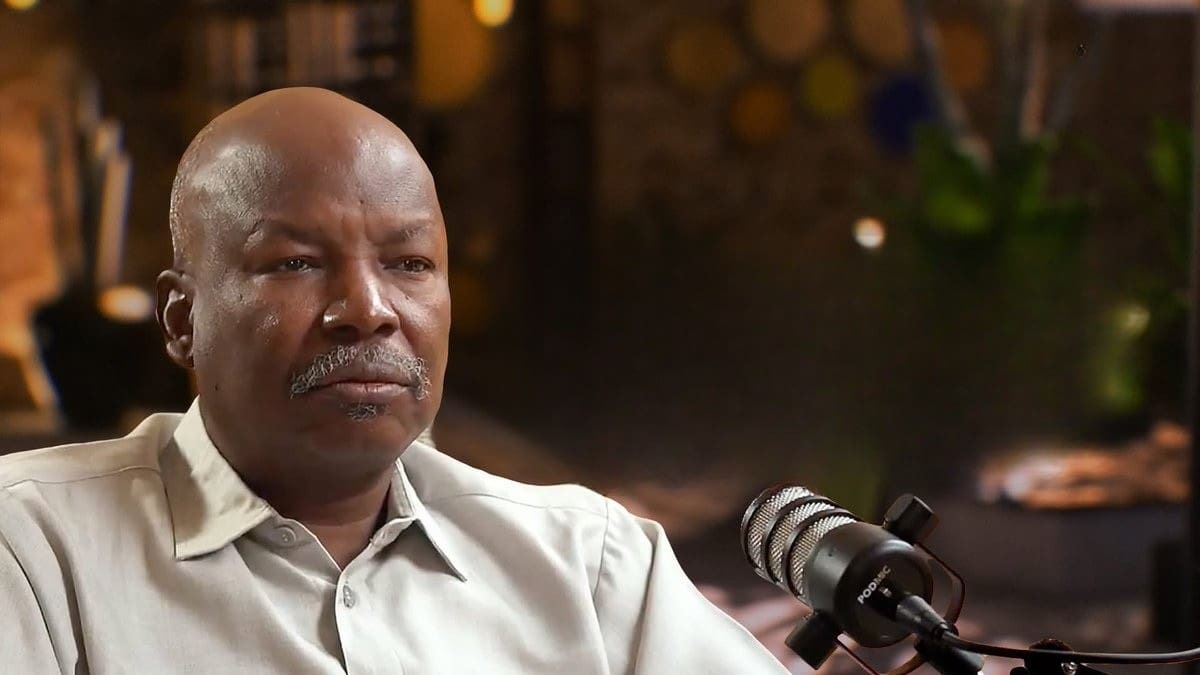
Ahmed Haroun, a leading figure of the Omar al-Bashir era and chairman of the National Congress Party (NCP), has appeared on camera for the first time since his arrest in 2019. Haroun served as State Minister of Interior and as governor in Kordofan under al-Bashir, and he is wanted by the International Criminal Court over Darfur. He spent about four years in Kober Prison and walked out when the war broke out in April 2023. In his first filmed interview, on the "Sudan Podcast", Haroun set out his views on Sudan's future after the war and answered contentious questions about the former regime.
"We have no organic relationship with al-Burhan"
One of the most notable parts of the interview concerned relations with Sovereignty Council chairman Abdel Fattah al-Burhan. "Al-Burhan is the president of the country, and we are a political force operating in the country," Haroun said. In normal times, he explained, parties are defined as either ruling or opposition. But because the country's very existence is now under threat, peacetime labels no longer apply.
"We are not a ruling party. We have no organic relationship of any kind with al-Burhan," Haroun said. His party's relationship with al-Burhan, he added, is the same as that of everyone else living in the country under his leadership. He dismissed claims that this is a "camouflage" hiding a secret "umbilical cord" between them as "not true." Haroun recalled what Hassan al-Turabi said he had told al-Bashir in 1989: "Go to the palace as president, and I will go to prison as a detainee." He stressed that no such scenario exists today.
Haroun described the relationship as one of "people united on the same battlefield." They do not have to agree on politics, governance or the economy, he said, but the moment of battle pushes other issues into the background. He compared the situation to passengers on a leaking boat who bail out water and row together to reach a safe shore.
Haroun said they hold no personal grievance against al-Burhan. In his account, April 11, 2019 was carried out by the security committee, and al-Burhan was not a member of it. He described al-Burhan as "a great officer of the armed forces and part of the command." He said that on the day of the coup, a message reached al-Bashir saying al-Burhan had been sent as an envoy on behalf of the security committee. Haroun took this to mean the committee members lacked the courage to deliver the news themselves. "Those who did this could not hold on for even 30 hours," Haroun said. Of al-Burhan, he said: "Whatever the case, this man is carrying responsibility at a difficult time."
Asked about al-Burhan's occasional harsh statements against Islamists, Haroun replied: "He is human too, and he is affected by propaganda." He said foreign intelligence services had run a powerful "color revolution" style propaganda campaign since December 2018. He added that international pressure may also push al-Burhan toward such statements. Haroun admitted these remarks are "certainly hurtful," but said they would not respond: "The president of the country is the commander of the army and of the battle. Let him focus on his battle. Let us not respond in ways that lower his morale or distract him. If he is distracted, the enemy wins."
"We are not a ruling party, but we are not an opposition party either; we are an influential party," Haroun said. He said they help the current authorities as a duty of citizenship, not as a ruling party, and added: "We have no connection with this government." Their contribution, he said, is limited to supporting the army: mobilization, opening camps and supporting the families of martyrs. Haroun said the confusion of the transitional period stemmed from the partnership between the army and the Forces of Freedom and Change, and noted that al-Burhan had pointed to this himself in a recent speech.
"Coexistence with the RSF is impossible"
Haroun described the Rapid Support Forces (RSF) as "an entity it is impossible to coexist with": "Wherever the RSF went, life ceased, and wherever the army came, life returned."
He said no war burns itself out like a fire. At some point there will be a negotiating table, and performance on the battlefield will decide each side's position at it. In his view, ending the war has two stages. First, the RSF and its sponsors must stop the aggression. Then they must become convinced that aggression will not achieve their political goals. "We will cross that bridge when we come to it," he said. He added that the RSF must be forced to implement what it signed in Jeddah. Otherwise, every truce would be "a postponement of an even bigger fire."
He described the RSF's allies as "an alliance built on interests and political bribery," made up of states, organizations and "unfortunately, some Sudanese parties." In his view they were hired for a job, and once the owner of the job is persuaded, they will withdraw. He called the Forces of Freedom and Change, Taqaddum and Sumud the political wing of the RSF. Individuals in these groups, he argued, should be held accountable before the courts, while their parties should be judged by the people at the ballot box.
"The war did not start on April 15"
According to Haroun, the war did not start on April 15, but on the evening of April 12 and on April 13 in Merowe. He called the claim that "the Islamists started the war" "a very silly ploy." "The Islamists have no army," he said. Islamists joined the armed forces in response to the commander-in-chief's call.
Haroun described the conflict as "an international war that lacks only a declaration." He claimed it is backed by a "Zionist-American alliance," with the UAE acting as a "functional state," combined with Hemedti's personal ambition. He alleged that Israel's "From the Nile to the Euphrates" vision aims to weaken Egypt by striking Sudan. For this purpose, he said, they found "a brutal tool" in the RSF and a state willing to take on the role in the UAE.
Haroun said the war had set nation-building in Sudan back "to before point one." He added that the economy has collapsed and families are starting from zero.
The army's place in politics: "Push it out the door and it comes back through the window"
Haroun also put forward a proposal for Sudan's political system after the war. Under his proposal, the armed forces leadership would nominate the head of state, and the people would approve the nominee by referendum. The presidency would not be ceremonial: the president would hold powers in national security matters and answer to parliament. Parliament would be elected by proportional representation, with all of Sudan treated as a single constituency. Arguing that a mixed presidential-parliamentary system suits Sudan best, Haroun cited de Gaulle's France as a model.
"If you push the army out the door, it comes back through the window," Haroun said. The army, he argued, must be part of the equation and take part in the dialogue that designs "the day after." Asked about Türkiye as an example of the army withdrawing from politics, he called the Turkish experience "excellent." But he noted that it took around a hundred years to develop. Sudan, he said, should develop its own experience rather than copy the final product of other countries.
He also said national security should not be treated as a technical matter left to the armed forces alone, but as a national constant defined by everyone together. He called for agreement on rules for managing political differences. Haroun claimed that security reform workshops had been led by "young women with no experience at all" and said Sudanese culture would not accept this. At the same time, he said he supports women's participation in public life.
He said the mistake of the post-2019 transition was the partnership between the army and the Forces of Freedom and Change, which produced "a distorted situation." He argued against new transitional periods that reset the counter every time and said power should be handed back to the people as soon as possible. Sudan's future, he said, requires "a grand historic compromise" among all political and social forces. Everyone must step out of their old trenches, and dialogue should start at the level of neighborhoods and villages and work its way up.
Haroun recalled that Sudan's first coup was carried out by the elected prime minister, Abdallah Khalil, and said the cycle of coups, uprisings and revolutions must be broken. He said carrying weapons in rural and nomadic communities is a social and cultural matter, so full disarmament is not feasible. Instead, he proposed a realistic, federal licensing system that varies by region.
The fall of the regime: "It was a coup, it was betrayal"
Haroun described the regime's fall in 2019 as a "coup" and a "betrayal." He said the security committee and Awad Ibn Auf betrayed the trust placed in them, and that the "engineer" of the process was former intelligence chief Salah Gosh. They themselves, he said, "did not cling to power amid waterfalls of blood." Of Ibn Auf, he said: "His comrade held it for thirty years; he could not hold it for even thirty hours." He added that no deal or bargain was offered to them before the coup.
Haroun described Salah Gosh as "reckless and someone who overestimates his own abilities" and said personal resentment may also have played a part. He said he could not claim there was foreign infiltration, but compared the situation to the US ambassador who, in his account, steered Saddam Hussein toward invading Kuwait.
Haroun claimed the 2019 protests were driven by a foreign intelligence "color revolution" propaganda campaign. He alleged that in January 2019, 230,000 posts came from Algeria in a single day, even though only around 47 Sudanese lived in Algeria at the time. He called the slogan "Tasgut bas" ("Just fall") nihilistic: "It fell, and it brought the country down with it. Nihilistic ideas do not build a nation." He also said the idea of al-Bashir running again in 2020 originated outside the party, and the nomination process was never opened.
According to Haroun, "The Ingaz regime fell tactically because of its own achievements, but it will win strategically." He said that during this period electricity generation rose from 400 MW to over 6,000 MW, paved roads grew from 410 km to 33,000 km, and Sudan produced 500,000 barrels of oil per day. He claimed the slogan "Every Kooz (Islamist), we will trample" has turned into "Every Kooz, we will kiss." He dismissed the "deep state" accusation as "a demonization campaign" and said his opponents have no program; all they say is "the Kizan."
Hemedti and the 2014 El Obeid crisis
Asked about Hemedti, Haroun replied: "The problem is not my problem with him, but his problem with me. To me, he has no value whatsoever." He recounted that in January 2014, as governor of North Kordofan, he expelled RSF forces from the state over their abuses in El Obeid, using a show of force and an ultimatum. "It was clear from then on: you cannot coexist with this force," he said. He said the RSF should have been placed under the army rather than the intelligence service, since only that would have ensured deterrence.
Haroun claimed the same circle was behind both Abdelaziz al-Hilu's 2011 rebellion in Kadugli and today's war. He named Yasir Arman, Khalid Omer Yousif (Silik) and the Forces of Freedom and Change.
Prison, accusations and release
Rejecting the accusations over the dispersal of the sit-in, Haroun asked: "Did I move divisions from Kober Prison?" He said the RSF documented its own actions. He claimed he spent four years in prison and that for three-quarters of that time there was no legal detention order against him. He called the claim that they started the war to get out of prison "flimsy." He said they left prison 13 days after the war began, in the middle of the fighting and under a judicial decision.
The army, the Juba signatories and Islamist groups
Haroun called the army the backbone of the state: "If the army is defeated, the Sudanese people are defeated, and there is no homeland left." Compared with this, he said, his own personal grievances are "marginal."
He called Jibril Ibrahim, Minni Minawi, Malik Agar and the other signatories of the Juba Agreement "patriots" and noted that they are fighting alongside the army. He said media rhetoric targeting Darfuris harms national unity.
Haroun argued that groups such as al-Baraa bin Malik are not military formations but bonds of comradeship. Their members may belong to the party, he said, but they take their operational orders from the army: "The dividing line is the gate of the military unit." Asked whether armed participation is a route back to power, he replied: "Never. For God and the homeland."
Foreign policy: the UAE, the US and Türkiye
Haroun said foreign policy should be shaped by how close or far countries stand from the interests of the Sudanese people. He named Saudi Arabia, Egypt, Türkiye and Qatar as the leading countries that stood by Sudan in its time of hardship and thanked them. He described the UAE's role as "negative."
On the UAE, he said: "The Sudanese built the UAE. The Sudanese wrote its constitution and built its army and its police." He said the UAE has no historical depth and that "money is not everything": it can buy some individuals, but it cannot buy Sudan's civilizational heritage.
On the US, he said: "They show you milk and give you water." He said the US is no longer a donor but a "levy-collecting" state, especially under Trump, and added: "They engineered this fire." Still, he said open hostility is unwise and the aim should be to limit the damage.
Asked whether they expect Türkiye to play a role in Sudan, Haroun replied: "We hope so," leaving the details to those running the country.
Darfur: "Not a geography, but something deeper"
Haroun argued that the former regime's record in Darfur had more positives than negatives. As examples, he cited the Western Salvation Highway, five universities and three international airports built in the region. "When Darfur is liberated, we will sit down and settle accounts, and we are ready for that reckoning," he said. He described calls for Darfur's separation as "despair and the enemy's plan," adding: "Darfur is not a geography; it is something deeper."
Internal party debate and self-review
Haroun described the National Congress Party and the Islamic Movement as "one body with different functions": the Movement is the intellectual and social foundation, and the NCP is its political arm. He said internal reviews are underway in the party, but added: "We are not schoolchildren handing in our notebooks to be corrected." The results may be shared with the public at the appropriate time, he said. He confirmed that restructuring the NCP is also on the agenda: "The NCP's jalabiya is white and comfortable, but it was suited to a particular time."
He declined to discuss in public the dispute over the party having two chairmen. He said the issue is procedural rather than intellectual or programmatic, and noted that the party has around one million members.
Criticism of the government
Haroun said the government's economic management needs review and greater transparency. He said Finance Minister Jibril Ibrahim is being made to carry more responsibility than he should. He argued that since Khartoum was retaken, the government's rhetoric has given the impression that "the danger has passed," and called for a return to mobilization rhetoric. He said campaigns built on citizens' hardships "serve the enemy's military effort."