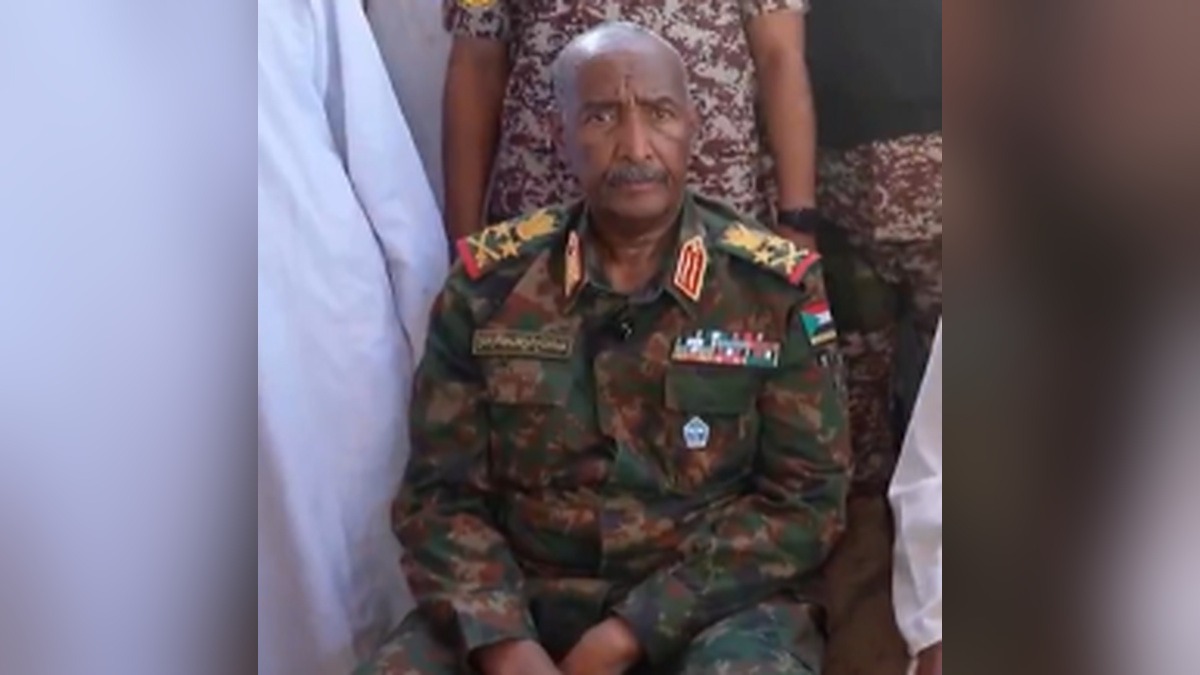
Sudan's military leader Abdel Fattah al-Burhan delivered a strongly worded speech on Sunday, November 22, 2026, during a condolence visit to the family of Lieutenant Colonel Osama al-Sadiq Abdelwakil in the Al-Mahas Kateranj area of East Nile, Khartoum State.
Burhan, who serves as Chairman of the Transitional Sovereignty Council and Commander-in-Chief of the Sudanese Armed Forces, addressed relatives, local residents and military personnel gathered to mourn the officer.
In a video released by the Sudanese Armed Forces, Burhan reaffirmed his commitment to continuing military operations against the Rapid Support Forces and emphasized that the sacrifices of soldiers killed during the conflict would not be forgotten.
The speech was repeatedly interrupted by chants from residents expressing support for the army, with Burhan responding by emphasizing unity and the responsibility of the military to defend the country.
Burhan rules out reconciliation with the RSF
One of the central messages of Burhan's address was his rejection of reconciliation or concessions to the Rapid Support Forces.
Speaking before the gathered crowd, he made clear that the army would not seek to appease the paramilitary organization.
Burhan linked his position to the losses suffered by soldiers and civilians throughout the conflict, describing the sacrifices of those killed as a responsibility that the army must uphold.
The Sudanese leader emphasized that the military would continue its campaign and would not abandon the families of fallen soldiers.
He also called for solidarity between the armed forces and the civilian population.
During the speech, members of the crowd repeatedly chanted "One army, one people," a slogan that featured prominently in the recorded gathering.
Fallen soldiers' sacrifices remain a responsibility
Burhan offered condolences to the family of Lieutenant Colonel Osama al-Sadiq and to other Sudanese families who have lost relatives during the war.
He described those killed in military operations as having sacrificed their lives in defense of Sudan and its people.
According to his remarks, honoring the dead requires continued commitment to the responsibilities undertaken by the army and the state.
Burhan also promised that the families of fallen soldiers would not be abandoned.
He acknowledged the suffering caused by the war while urging Sudanese citizens to remain united despite the country's difficult circumstances.
Lieutenant Colonel's death linked to Blue Nile fighting
The death of Lieutenant Colonel Osama al-Sadiq Abdelwakil has attracted attention amid reports concerning the treatment of Sudanese military prisoners during recent fighting in Blue Nile.
The Sudanese government accused the Rapid Support Forces of killing captured members of the Sudanese Armed Forces in the region.
Images circulated on social media reportedly showed Lieutenant Colonel Osama al-Sadiq after being taken prisoner, alongside other photographs described as having been taken following his death.
Radio Dabanga reported that it had been unable to independently establish the authenticity of the circulating photographs or the full circumstances surrounding the officer's death.
Sudanese authorities condemned the reported killing of military prisoners and called for accountability under international humanitarian law.
The case has intensified debate over the treatment of detainees and captured combatants during the conflict.
Sudan calls for international action over prisoners
Following the developments in Blue Nile, Sudan's government urged international and regional organizations to address the treatment of prisoners of war.
The appeal was directed to the United Nations, African Union, Intergovernmental Authority on Development and International Committee of the Red Cross.
Sudanese authorities stressed that the killing of captured combatants is prohibited under international humanitarian law and called for measures to protect those still in detention.
The Emergency Lawyers group, a Sudanese legal and human rights organization, said it was examining videos circulated on November 20 depicting reported killings of military prisoners.
The organization emphasized that individuals who have surrendered or are no longer participating in hostilities remain protected under international humanitarian law.
It also highlighted the importance of establishing the facts and ensuring accountability for any unlawful killings.
Fighting intensifies around Blue Nile
Burhan's speech came amid renewed fighting between the Sudanese Armed Forces and an alliance involving the Rapid Support Forces and the Sudan People's Liberation Movement-North faction led by Abdelaziz al-Hilu.
The RSF-aligned alliance announced advances in several locations in Blue Nile, including areas around Bau and Geissan.
The developments raised concerns about the security situation around Ad-Damazin, the regional capital.
Sudanese authorities responded by stating that the army maintained the initiative and was conducting operations to restore security in affected areas.
On November 21, the Blue Nile regional government's spokesperson acknowledged public concern over the fighting but maintained that military forces were taking necessary measures to defend the region.
The opposing accounts reflected the rapidly changing security situation in southeastern Sudan.
Previous remarks emphasized defense of Ad-Damazin
Burhan's latest speech followed another address delivered during condolences for the late religious and political leader Mohamed Osman al-Mirghani in Khartoum Bahri.
During that earlier gathering, Burhan discussed developments in Blue Nile and sought to reassure residents of Ad-Damazin.
He pointed to the army's previous recovery of Khartoum from RSF control as an example of its ability to regain territory.
Burhan also reaffirmed his commitment to defending Sudan's sovereignty, territorial integrity and national institutions.
His November 22 remarks placed greater emphasis on military losses, the families of fallen soldiers and the rejection of reconciliation with the RSF.
Sudan's civil war continues across multiple fronts
Sudan has remained engulfed in conflict since April 15, 2023, when fighting erupted between the Sudanese Armed Forces and the Rapid Support Forces.
The war has devastated civilian infrastructure, displaced millions of people and caused a severe humanitarian emergency.
Major military confrontations continue in Darfur, Kordofan and Blue Nile, while both sides maintain competing claims over territorial control and battlefield developments.
The Sudanese army says its objective is to end the RSF's military challenge and restore state authority across the country.
Burhan's remarks at the condolence gathering in East Nile underscore the military leadership's determination to continue operations while renewed fighting in Blue Nile raises further concerns over civilian protection, prisoners of war and prospects for ending the conflict.