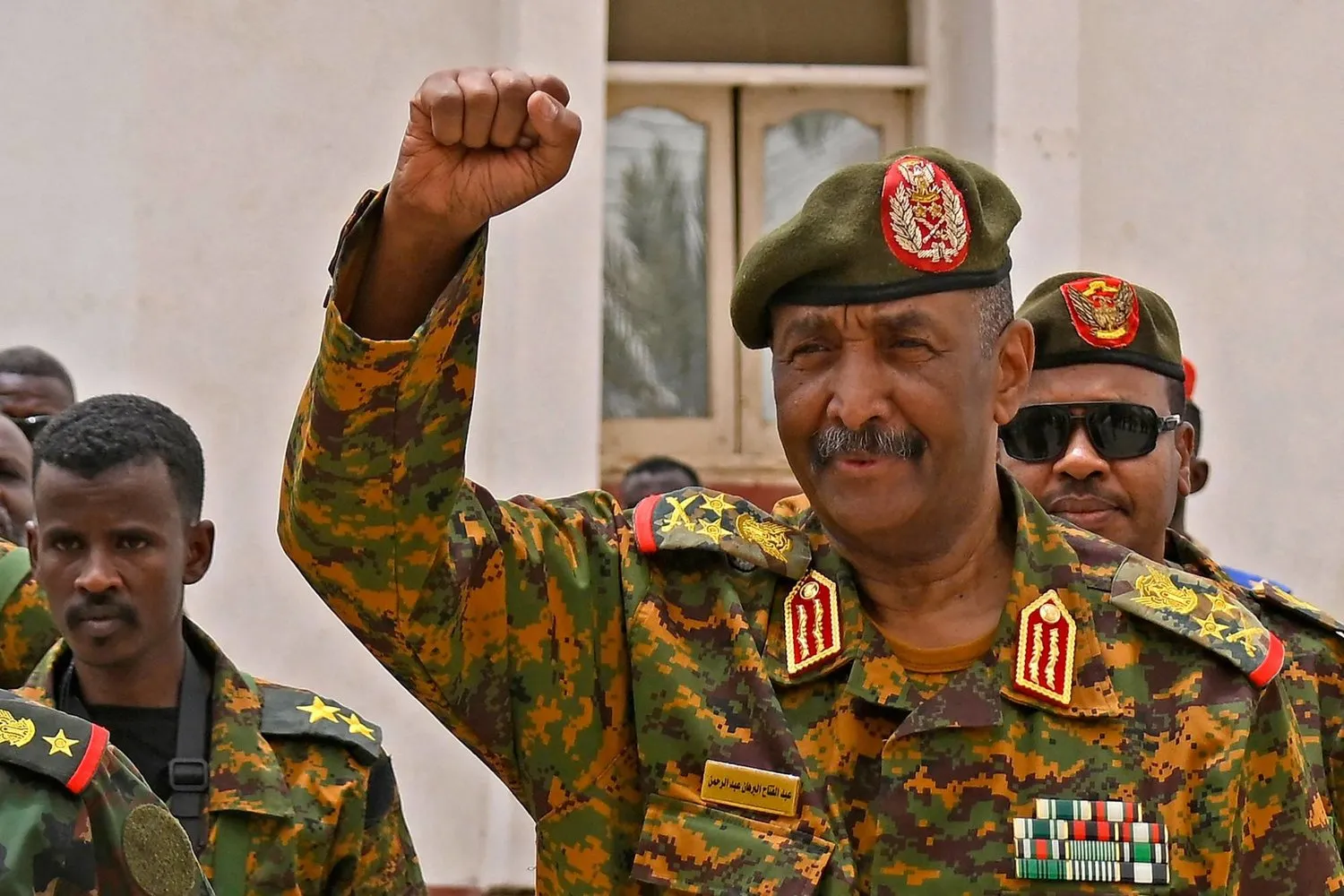
Sudan's Sovereign Council Chairman and Commander-in-Chief of the Armed Forces, General Abdel Fattah al-Burhan, has sought to reassure residents of Ed Damazin as fighting intensifies across the southeastern Blue Nile region.
His remarks followed a series of territorial advances announced by the Rapid Support Forces (RSF) and their allies in the Sudan People's Liberation Movement-North (SPLM-N), led by Abdelaziz al-Hilu.
According to a Sudan Tribune report published on November 21, 2026, Burhan addressed growing security concerns surrounding the Blue Nile regional capital during a condolence gathering in Khartoum North.
He said the Sudanese Armed Forces were capable of defending the city and would continue fighting to restore state control across the country.
Burhan warns RSF against further advances
Burhan delivered his remarks during a condolence gathering for Mohamed Osman al-Mirghani, the late leader of the Democratic Unionist Party and spiritual guide of the Khatmiyya Sufi order.
The gathering was held at the Sayyid Ali al-Mirghani Mosque in Bahri, north of Khartoum, on Friday evening, November 20.
Speaking about the military situation in Ed Damazin, Burhan urged residents not to be intimidated by the activities of the RSF and its allied forces.
He referred to the Sudanese army's earlier recovery of territory in Khartoum that had been controlled by the RSF.
Burhan said the paramilitary organization had previously occupied the very location where he was delivering his address, arguing that its movement into new territory would ultimately expose it to defeat.
He also reaffirmed the military's determination to continue operations throughout Sudan until the rebellion was brought to an end.
The army chief presented the conflict as a struggle to protect the country's sovereignty, territorial integrity and the right of civilians to live in security.
RSF alliance announces capture of Bau
The statements came amid major developments on the Blue Nile front.
On November 19, the RSF and SPLM-N alliance announced that its fighters had captured the headquarters of Bau locality, approximately 70 kilometres southwest of Ed Damazin.
Bau occupies an important position along routes linking the southern and western parts of Blue Nile to the regional capital.
The alliance had previously announced control over the locality headquarters of Kurmuk and Geissan.
The seizure of Bau was therefore described by the alliance as its third such territorial gain in the region.
Reports indicated that some government-aligned forces had withdrawn toward Ed Damazin as fighting spread across the area.
However, the announcement concerning Bau did not establish that the RSF had captured Ed Damazin itself.
Five additional settlements claimed near Geissan
On November 20, the RSF-led Founding Sudan Alliance, known as Tasis, announced that its forces had taken five additional locations in Geissan locality.
The areas named in the statement were Khor Mak, Al-Madina 10, Al-Madina 11, Singa Nabag and Al-Taqa.
These settlements lie approximately 40 kilometres southeast of Ed Damazin.
The alliance claimed that its offensive had inflicted extensive losses on Sudanese army forces.
It also reported capturing 27 combat vehicles, six tanks and two armoured vehicles, while destroying or burning more than 70 other vehicles.
The reported casualty and equipment figures have not been independently verified.
Rival military claims over Derang
Fighting around Derang, in Bau locality, has produced conflicting accounts from the Sudanese army and the RSF alliance.
On November 19, the Sudanese army's Fourth Infantry Division announced that its troops had ambushed RSF forces in the area.
The army said 28 combat vehicles were destroyed and another 18 captured during the operation.
Videos circulated through pro-army social media accounts appeared to show soldiers near Derang alongside destroyed military vehicles.
The RSF-led alliance issued a competing statement, claiming that its forces had taken Derang and Al-Madina 12 and pushed government troops toward the outskirts of Ed Damazin.
Derang is considered strategically important because it lies near routes connecting Bau with the regional capital.
Neither side's account of the fighting or military losses has been independently confirmed.
Blue Nile authorities mobilize reinforcements
The regional government responded to the deteriorating security situation by announcing plans to mobilize additional forces and military equipment.
Government spokesperson Saif al-Nasr Minallah said on November 20 that regional and central authorities were coordinating with the Sudanese army to respond to the offensive.
In a televised address, Minallah urged residents to remain calm and support the armed forces.
He acknowledged public concern over developments on the front lines but argued that battlefield movements and temporary withdrawals should not be interpreted as a complete loss of military control.
The spokesperson also rejected reports suggesting that RSF fighters were immediately approaching Ed Damazin.
According to Minallah, the army's Fourth Infantry Division continued conducting operations and coordinating with regional authorities.
The government said civilian protection remained among its principal priorities.
Fighting displaces hundreds of families
The military escalation has triggered additional displacement across Blue Nile.
According to a separate Sudan Tribune report published on November 20, local humanitarian sources recorded 1,409 families fleeing along several routes.
Approximately 600 families from Wad al-Mahi reached Al-Mahal, while another 500 fled Bau toward Balang, Shitio and Shitalwa.
An additional 309 families left areas around Al-Madina 12 in Geissan locality, heading toward Bakori, Yara and Bambadi.
The latest movements have placed additional pressure on communities already hosting displaced people.
Tens of thousands of civilians have previously been uprooted by fighting across the region.
Humanitarian organizations and local activists have warned that shortages of food, shelter, medical services and clean drinking water are complicating the response to the growing crisis.
Burhan addresses economic hardship
During his speech, Burhan also acknowledged the severe economic pressures facing Sudanese households.
He referred to electricity and water outages, shortages of basic necessities and increasingly difficult living conditions.
The army chief attributed part of the crisis to what he described as an economic campaign targeting Sudan.
He accused unnamed foreign countries of contributing to the conflict that began on April 15, 2023, and subsequently attempting to weaken the Sudanese state through economic pressure.
Burhan did not identify the countries in his address.
He acknowledged that significant state resources were currently being directed toward military operations, emphasizing that ending the conflict remained the government's central priority.
Political parties urged to prepare for elections
Burhan also addressed the country's political future.
He called on Sudanese political parties and other political actors to prepare for elections, arguing that political authority should be obtained through voting rather than military coups or force.
Sudan's transition following the overthrow of former President Omar al-Bashir in 2019 was interrupted by the military takeover in October 2021 and the outbreak of war in April 2023.
The continuing conflict has prevented the establishment of a nationally agreed electoral timetable.
Although Burhan called for electoral preparations, he did not announce a specific date for national elections.
Condolence gathering follows death of DUP leader
Burhan's address took place during a period of transition within one of Sudan's most influential religious and political movements.
Mohamed Osman al-Mirghani, the leader of the Democratic Unionist Party and the Khatmiyya Sufi order, died in Cairo on November 13, 2026, at approximately 90 years of age.
His body was returned to Sudan and buried in Khartoum North.
According to Sudan Tribune, the al-Mirghani family subsequently selected his eldest son, Ali al-Mirghani, as the new spiritual leader of the Khatmiyya order.
However, disagreements over the leadership of the Democratic Unionist Party remain unresolved.
Burhan used the condolence gathering to praise al-Mirghani's contribution to Sudanese political life and emphasize the importance of reconciliation, solidarity and national unity.
Blue Nile remains a critical military front
The latest developments underline the growing importance of Blue Nile in Sudan's civil war.
The RSF–SPLM-N alliance's reported advances around Bau and Geissan have intensified concerns about the security of Ed Damazin.
At the same time, Sudanese military officials insist that government forces remain capable of defending the regional capital and responding to the offensive.
Burhan's remarks represent an attempt to reassure civilians, maintain confidence in the army and emphasize the government's determination to continue military operations.
There is currently no independently verified confirmation that Ed Damazin has fallen to the RSF or is under a complete siege.
Further developments around Derang, Bau and Geissan will remain important to the military and humanitarian situation across southeastern Sudan.