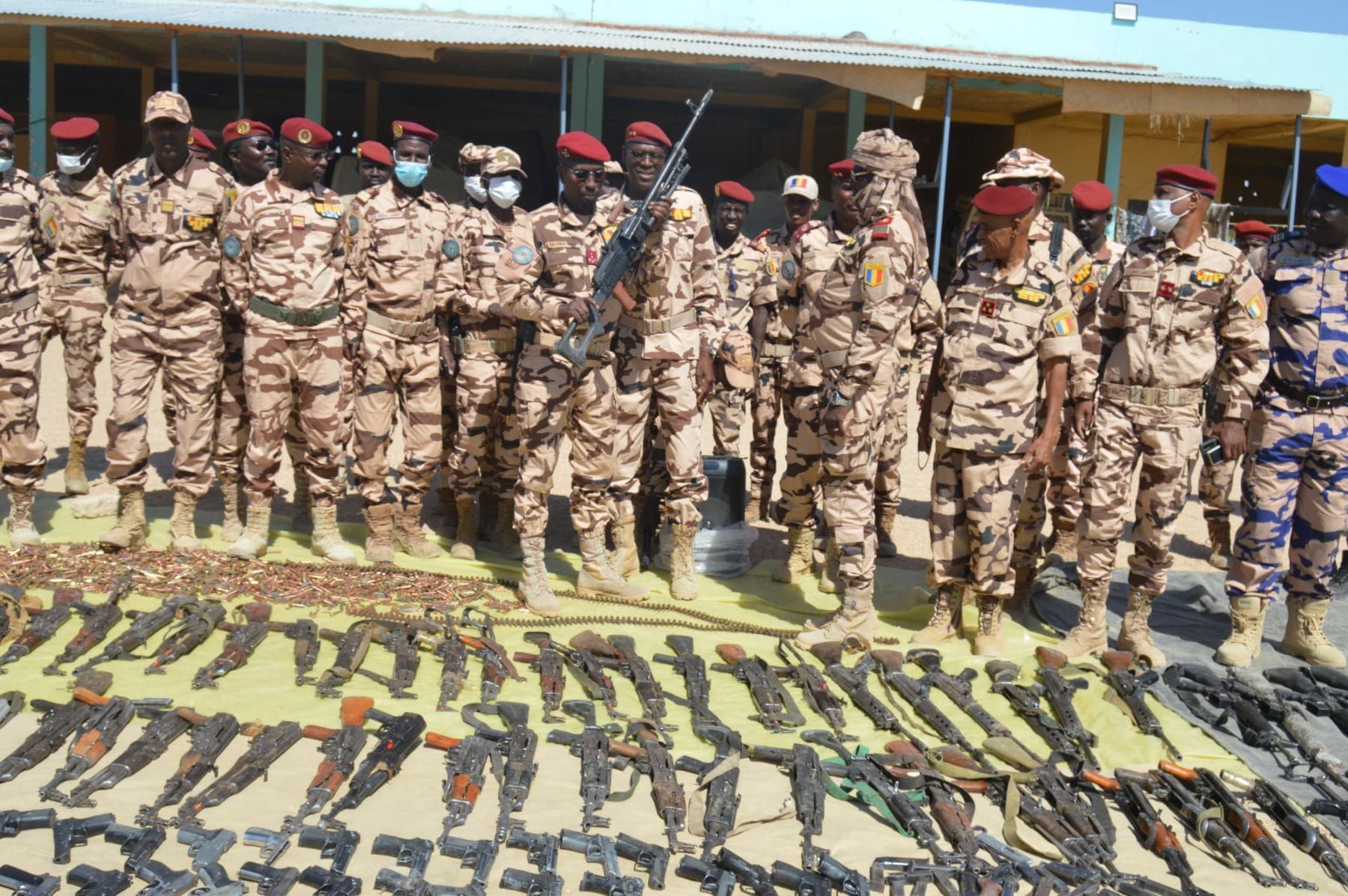
Security forces in eastern Chad have recovered hundreds of firearms and thousands of rounds of ammunition during operations aimed at combating illegal weapons possession and criminal activity.
According to information published by Chadian news outlet Alwihda Info on November 21, 2026, the operations resulted in the seizure of 450 weapons, 15,250 rounds of ammunition and 201 magazines.
The weapons and ammunition were presented in Abéché, the administrative capital of Ouaddaï Province, by the Coordination of Eastern Operational Zones.
Authorities described the seizures as part of efforts to strengthen security and combat criminality across eastern Chad.
The announcement did not provide a detailed breakdown of weapon types, the precise locations of the seizures or the number of suspects associated with the recovered equipment.
Disarmament campaigns cover four eastern provinces
Chadian security forces have carried out extensive disarmament operations throughout 2026, particularly in regions affected by the circulation of illegal weapons.
The campaigns have focused on Ouaddaï, Wadi Fira, Sila and Ennedi East provinces.
On September 17, authorities presented the results of a three-month disarmament campaign during a ceremony held at the headquarters of the Chad–Sudan Joint Force Command in Abéché.
General Ousmane Bahr Mahamat Itno, the official coordinating disarmament activities in eastern Chad, announced that 3,430 weapons had been recovered.
Security officials also reported confiscating substantial quantities of ammunition but did not provide a precise figure.
The operation focused on removing weapons held unlawfully by civilians and reducing the availability of firearms used in criminal activities and community disputes.
It remains unclear whether the 450 weapons announced on November 21 represent seizures additional to the September total or form part of a broader operational assessment.
Twenty suspects presented after security operation
The announcement follows another security operation conducted earlier in the week in Abéché.
On November 18, authorities presented 20 individuals suspected of involvement in criminal activities during a security meeting at the Ouaddaï provincial government delegation.
The meeting was chaired by Government General Delegate Ismaïl Yamouda Djorbo and attended by administrative authorities, security officials and the Sultan of Ouaddaï.
According to Alwihda Info, security forces displayed firearms, three motorcycles, mobile phones and an unspecified amount of money recovered during the operations.
Hissen Saleh Arbi, the public prosecutor at the Abéché court, announced that the suspects would face judicial proceedings.
Local authorities called for closer cooperation between security services, neighbourhood leaders, local officials and young people to improve public safety.
No official statement has established that the November 18 arrests were directly connected to the 450 weapons reported on November 21.
Previous operations recovered hundreds of firearms
The latest announcement follows earlier disarmament campaigns across eastern Chad.
On February 23, 2026, security officials in Abéché formally handed over 559 weapons recovered during an operation coordinated by eastern security authorities.
The operation was conducted under the supervision of General Ousmane Bahar Mahamat Itno as part of efforts to reduce the circulation of illegal firearms.
The confiscated weapons were transferred to the relevant authorities for legal processing.
Earlier in February, the National Gendarmerie, National Police and Chadian National and Nomadic Guard also participated in joint operations targeting security threats in Abéché.
Those activities resulted in the recovery of weapons and ammunition, as well as vehicles without proper registration documents and other items associated with suspected illegal activities.
The repeated operations illustrate the scale of the authorities' efforts to address armed criminality in eastern Chad.
Security concerns along the Sudan border
Eastern Chad remains strategically important because of its proximity to Sudan's Darfur region, where fighting has continued since April 2023.
Ouaddaï, Wadi Fira and Sila are among the provinces affected by regional security pressures and cross-border population movements.
The conflict in neighbouring Sudan has increased attention to border security, the movement of armed groups and the risks associated with illicit weapons trafficking.
Chadian authorities have therefore continued efforts to recover illegally possessed firearms and strengthen security across vulnerable border regions.
However, no official evidence has been released establishing that the weapons announced on November 21 originated in Sudan or belonged to a particular armed organization.
The seizures should be understood within the wider disarmament campaign rather than as proof of a specific cross-border smuggling operation.
Authorities face challenges in tracing illegal weapons
Chadian legislation restricts civilian possession of military weapons and requires authorization for the possession and carrying of permitted civilian firearms.
A September 2026 investigation by Studio Hirondelle Tchad documented the growing number of weapons recovered during security operations across the country.
The report highlighted the involvement of firearms in armed robbery, community disputes and other forms of violence.
It also noted that weapons recovered by security services are transferred to competent authorities when required for judicial or security proceedings.
In January 2026, more than two tonnes of ammunition were destroyed in Abéché as part of efforts to reduce risks associated with recovered military equipment.
Publicly available information remains limited concerning the proportion of seized firearms that are destroyed, retained as evidence or transferred through other legal procedures.
The November 21 figures underscore the continuing scale of weapons recovery efforts in eastern Chad.
Further details are awaited on the origin of the recovered firearms, any associated investigations and the next steps planned by security authorities.