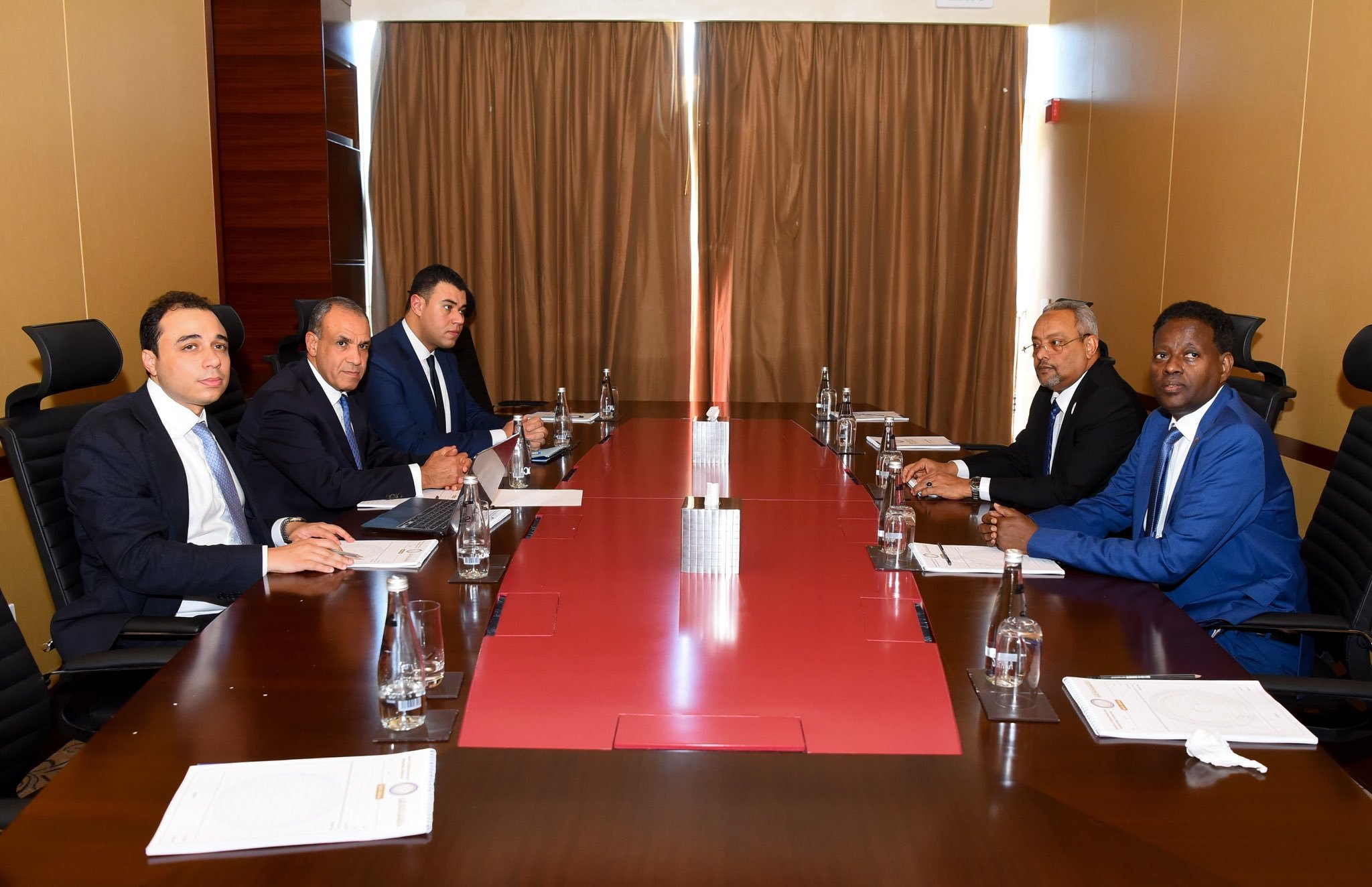
Djibouti and Egypt have renewed their commitment to strengthening diplomatic coordination and economic cooperation amid growing concerns over regional security in the Horn of Africa and the Red Sea.
On Saturday, November 7, Djibouti's Minister of Foreign Affairs and International Cooperation and Government Spokesperson, Abdoulkader Houssein Omar, met Egyptian Minister of Foreign Affairs, International Cooperation and Egyptian Expatriates Badr Abdelatty in the Libyan capital, Tripoli.
The meeting took place on the sidelines of the 22nd Ordinary Session of the Executive Council of the Community of Sahel-Saharan States (CEN-SAD).
The two ministers reviewed bilateral relations and exchanged views on political and security developments affecting the region.
Egyptian Foreign Ministry spokesperson Nader Zaki said the discussions focused on strengthening political, economic and investment cooperation, particularly in energy, logistics, ports, maritime connectivity and infrastructure.
Regional developments in Sudan and Somalia, as well as the security of the Red Sea, were among the key issues addressed.
Red Sea Security and Freedom of Navigation
Maritime security featured prominently in the discussions between the two foreign ministers.
Abdelatty emphasized the importance of maintaining security in the Red Sea and ensuring the safety and freedom of international maritime navigation.
He also called for stronger coordination among the countries bordering the Red Sea, emphasizing their role in managing the strategic waterway's security.
Djibouti and Egypt occupy critical positions along one of the world's most important maritime transport routes.
Egypt controls the Suez Canal, linking the Mediterranean and Red Seas, while Djibouti is situated near the Bab el-Mandeb Strait, connecting the Red Sea with the Gulf of Aden.
Disruptions affecting this corridor can have consequences for international shipping, regional trade and the movement of goods between Europe, Asia and Africa.
Both countries have therefore placed maritime stability and the protection of commercial navigation at the center of their regional diplomatic engagement.
Somalia and Sudan Feature in Regional Discussions
The foreign ministers also exchanged views on political and security developments across the Horn of Africa, with particular attention to Sudan and Somalia.
Abdelatty reiterated Egypt's position on the importance of protecting national institutions and preserving the sovereignty, unity and territorial integrity of states in the region.
Egypt has repeatedly expressed support for Somalia's sovereignty and territorial integrity.
Djibouti maintains close relations with Somalia and participates in regional diplomatic and security initiatives aimed at supporting stability in the Horn of Africa.
The ongoing conflict in Sudan remains another source of concern for regional governments.
Since April 2023, the war between the Sudanese Armed Forces and the Rapid Support Forces has contributed to instability, displacement and humanitarian pressures across the region.
Egypt continues to support the preservation of Sudan's state institutions and territorial integrity.
The Tripoli discussions considered how regional diplomatic efforts could contribute to stability and strengthen peace and security across the Horn of Africa.
Trade and Investment Cooperation to Expand
Economic cooperation was another major focus of the meeting.
Abdelatty welcomed the two countries' commitment to strengthening bilateral relations, particularly through investment and commercial partnerships.
The Egyptian minister highlighted opportunities in infrastructure, renewable energy, port development, logistics and maritime transport.
Both governments are seeking to increase bilateral trade and encourage greater participation by Egyptian companies in development projects in Djibouti.
Djibouti's strategic location, extensive port infrastructure and links to Ethiopia make it an important commercial gateway for East Africa.
Egyptian companies have been exploring opportunities to participate in major transport, energy and logistics projects in the country.
The ministers also emphasized the importance of technical cooperation and capacity-building programmes organized by Egyptian institutions.
Major Port and Logistics Projects Under Development
Egypt and Djibouti have already established a framework for closer cooperation in maritime transport and logistics.
Following Egyptian President Abdel Fattah El-Sisi's visit to Djibouti on April 23, 2025, both governments accelerated discussions on infrastructure and investment projects.
In December 2025, Egypt's Deputy Prime Minister for Industrial Development and Minister of Industry and Transport, Kamel El-Wazir, visited Djibouti for talks and the signing of agreements involving ports, logistics and renewable energy.
The agreements included cooperation on the development of a new container terminal, a logistics zone for Egyptian products and a renewable energy project supporting port operations.
Djibouti's Ports and Free Zones Authority outlined plans for a new terminal with a proposed quay length of 1,450 metres and a capacity target of five million twenty-foot equivalent units (TEUs).
The logistics agreement also provided for the initial development of a 10-hectare site intended to support the storage, processing and movement of Egyptian products through Djibouti's free trade infrastructure.
These projects are intended to strengthen commercial links between North Africa, the Horn of Africa and surrounding markets.
Renewable Energy Remains a Priority
Renewable energy has become an important component of Egypt–Djibouti cooperation.
Egyptian companies have been working with Djiboutian institutions on projects involving solar energy, wind power and electricity infrastructure.
One of the initiatives concerns the development of solar generation and energy storage facilities to support operations at the Doraleh Container Terminal.
In December 2025, agreements involving Egypt's Elsewedy Electric and Djiboutian authorities established a framework for developing renewable power infrastructure at the port.
Egypt has also supported a solar power project in the Omar Kajaa area of Djibouti's Arta region.
The facility, inaugurated in late 2025, forms part of efforts to expand access to electricity and strengthen local development.
The two countries have also considered additional opportunities in wind energy, electricity network development and sustainable infrastructure.
No new energy agreement was announced during the November 7 meeting, but the sector remained central to their economic discussions.
Egyptian-Djiboutian Business Council Supports Investment
The Egyptian-Djiboutian Joint Business Council has emerged as another mechanism supporting bilateral economic relations.
The council aims to encourage business partnerships, facilitate investment discussions and strengthen cooperation between private-sector representatives.
During their previous meeting in Baghdad on October 17, Abdelatty and Omar discussed the importance of building on the council's activities and expanding the participation of Egyptian companies in Djibouti's development projects.
Financial cooperation has also developed in recent years.
Banque Misr Djibouti officially began operations in November 2025, expanding the presence of Egyptian banking institutions in the country.
The development provides an additional financial connection between businesses operating in Egypt and Djibouti.
Technical Training and Institutional Cooperation
The Tripoli meeting also addressed technical cooperation and professional capacity-building.
Abdelatty emphasized the importance of training programmes offered by Egyptian institutions as a means of supporting cooperation with Djibouti.
Such initiatives are intended to strengthen professional expertise, improve institutional capacity and facilitate the exchange of technical knowledge.
The emphasis on training reflects the wider relationship between the two governments, which includes both major development projects and cooperation between public institutions.
Diplomatic Engagement at CEN-SAD Meeting
The talks took place during the 22nd Executive Council session of the Community of Sahel-Saharan States in Tripoli.
The gathering brought together foreign ministers and senior representatives from African countries to consider regional security, economic integration and efforts to revitalize the organization's institutions.
Both Egypt and Djibouti participate in CEN-SAD, which seeks to strengthen cooperation among member states across the Sahel, Sahara and other parts of Africa.
The ministerial meeting provided an opportunity for the two governments to discuss bilateral relations alongside broader African regional priorities.
Djibouti and Egypt Maintain Close Regional Coordination
The November 7 meeting reinforced the importance of cooperation between Djibouti and Egypt on economic development and regional security.
Their discussions covered investment, trade, ports, maritime transport, infrastructure and technical cooperation, alongside developments in Somalia, Sudan and the Red Sea.
Egypt reiterated its emphasis on maritime security, freedom of navigation and respect for national sovereignty and territorial integrity.
No new bilateral treaty or joint maritime security mechanism was announced following the meeting.
Nevertheless, the discussions reflected the continuing diplomatic engagement between two countries with important positions along the Red Sea and a shared interest in strengthening economic connections across Africa.