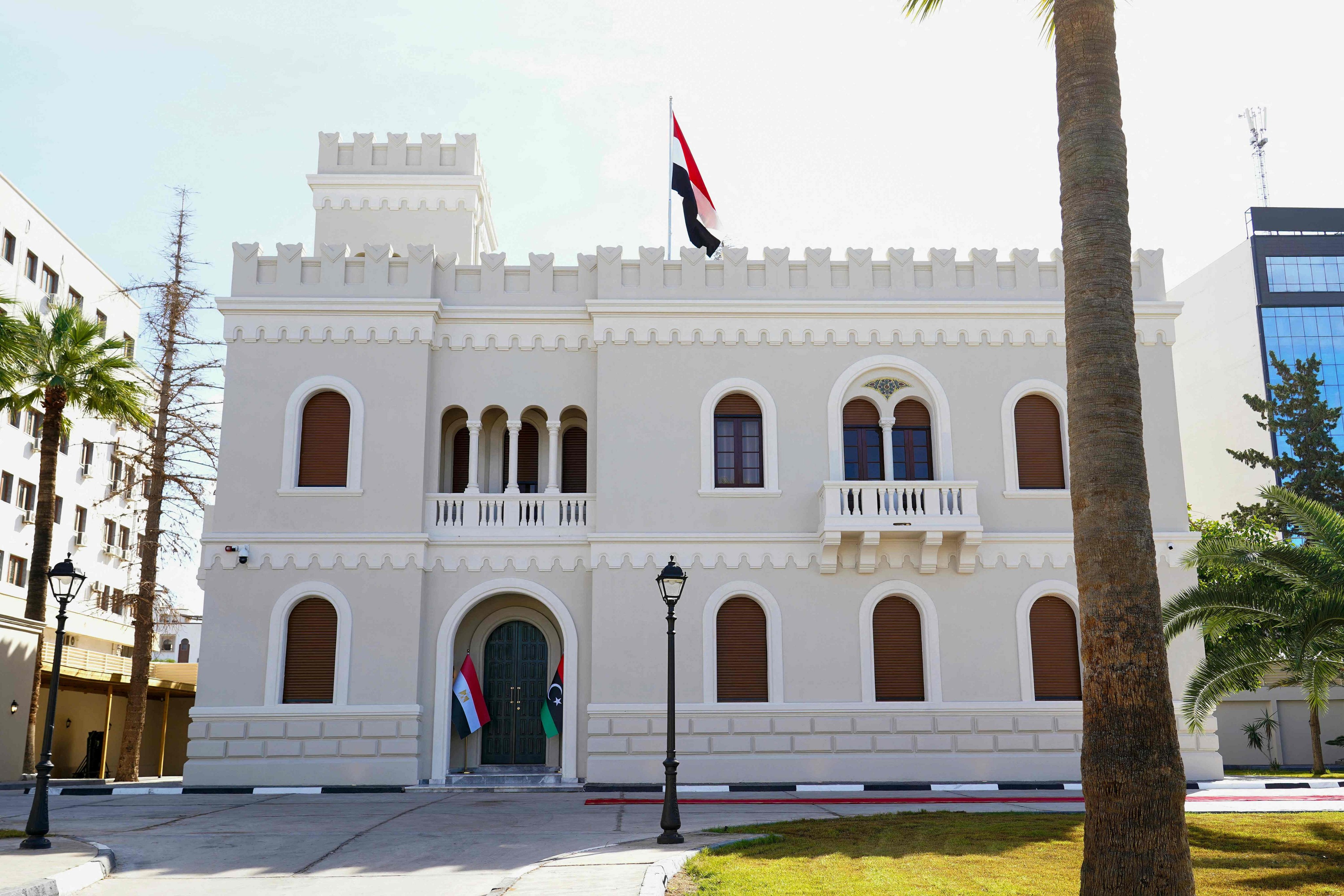
Egypt reopened its historic embassy premises in the Libyan capital on Saturday, November 7, restoring a diplomatic building that had remained closed since the security crisis of 2014.
Egyptian Foreign Minister Badr Abdelatty attended the reopening ceremony alongside Libya's Acting Foreign Minister Taher Al-Baour.
The event formed part of a wider diplomatic visit that included meetings with Prime Minister Abdulhamid Dbeibeh, Presidential Council Chairman Mohamed Al-Menfi and senior Libyan officials.
The reopening reflects Cairo's efforts to expand direct engagement with Tripoli and strengthen institutional cooperation across Libya.
It also comes at a time when Egypt is pursuing major economic projects involving both western and eastern Libyan institutions, including roads, energy infrastructure and reconstruction.
Historic Embassy Building Returns to Diplomatic Service
Egypt's embassy in Tripoli was closed in 2014 as escalating armed conflict and political instability forced several foreign diplomatic missions to suspend operations.
The closure occurred during a period when rival political authorities emerged in different parts of Libya.
On November 7, Abdelatty officially reopened the embassy's historic headquarters following renovation and maintenance work.
During the ceremony, he emphasized the importance of the building as part of Tripoli's diplomatic and cultural history.
The Egyptian minister described the reopening as a reflection of longstanding ties between the Egyptian and Libyan peoples, including shared history, family connections and economic interests.
He also thanked Libyan authorities for supporting the restoration of the premises.
The renewed use of the embassy building provides Egypt with a stronger institutional presence in western Libya and supports direct diplomatic and consular engagement.
Abdelatty Holds Talks With Prime Minister Dbeibeh
The diplomatic reopening was accompanied by a meeting between Abdelatty and Libyan Prime Minister Abdulhamid Dbeibeh.
The discussions addressed political relations, economic cooperation, investment opportunities and Libya's reconstruction.
The Egyptian foreign minister reaffirmed Cairo's support for Libya's unity, sovereignty, stability and territorial integrity.
He also emphasized the importance of reducing barriers to bilateral trade and encouraging Egyptian businesses to participate in infrastructure and development projects.
Dbeibeh welcomed closer cooperation with Cairo and described the embassy's reopening as a positive development.
Both sides expressed an interest in advancing economic relations through direct dialogue and existing bilateral mechanisms.
Preparations for the next meeting of the Egyptian-Libyan Higher Joint Committee were also discussed.
Libya Says Maritime Talks Should Protect Shared Interests
Maritime boundaries in the Eastern Mediterranean were among the most closely watched issues during the Tripoli visit.
Egypt reiterated its legal concerns regarding existing maritime boundary arrangements affecting the region.
Abdelatty stressed that Egypt's interests and maritime rights should be taken into account in accordance with international law and relevant principles governing maritime delimitation.
Prime Minister Dbeibeh responded by emphasizing Libya's intention to maintain dialogue with Egypt and avoid outcomes that could harm the interests of either country.
He said maritime arrangements should be examined through consultation rather than unilateral decisions.
The Libyan prime minister also underlined the importance of maintaining positive relations between Cairo and Tripoli despite differences concerning maritime boundaries.
The discussions did not result in a new maritime delimitation agreement.
Joint Committee to Review Maritime Maps
Dbeibeh said the Egyptian-Libyan joint committee would continue examining the outstanding maritime issues.
Its next meeting could take place in either Cairo or Tripoli, depending on arrangements agreed by both governments.
The committee is expected to review technical maps, legal positions and other relevant information as part of the consultation process.
The Libyan prime minister emphasized that direct negotiations offer a practical means of addressing differences between neighboring countries.
His remarks indicated a willingness to continue discussions rather than allow maritime disagreements to undermine broader diplomatic relations.
However, neither government announced an agreed maritime boundary map or a timetable for completing the negotiations.
Cairo Expands Engagement Across Divided Libya
The reopening of the embassy has wider political significance because of Libya's continuing institutional divisions.
In western Libya, the internationally recognized Government of National Unity operates from Tripoli under Prime Minister Abdulhamid Dbeibeh.
In the east, the House of Representatives, the administration headed by Osama Hammad and military forces under Khalifa Haftar maintain separate centers of authority.
Egypt has long maintained close political and security relationships with eastern Libyan actors.
Its renewed diplomatic presence in Tripoli represents an expansion of engagement with the western administration rather than an announced termination of its relationships in the east.
The approach allows Cairo to maintain communication with different Libyan institutions while pursuing bilateral economic interests.
It also provides additional opportunities to engage in discussions concerning political reconciliation and the future of Libya's state institutions.
Belqasem Haftar Previously Signed Highway Agreement
Egypt's economic relationship with eastern Libya includes a major transport infrastructure initiative.
On September 7, 2024, Belqasem Haftar, head of the Libyan Development and Reconstruction Fund and son of Khalifa Haftar, signed a memorandum of understanding with Egypt's Arab Contractors company.
The agreement concerned preliminary studies and design work for the Libyan section of an international road connecting Egypt, Libya and Chad.
The proposed section extends approximately 390 kilometres from the Al-Awainat area near the Egyptian border toward Libya's southern frontier with Chad.
The memorandum provided for surveying, environmental assessments and preliminary engineering design.
Further approvals and agreements between the relevant authorities would be required before the complete project could be implemented.
The agreement demonstrates that eastern Libyan development institutions had previously participated in planning the same international transport corridor.
It does not establish that construction of the entire Libyan section has been completed.
Egypt Plans New Trade Route Toward Central Africa
The Egypt–Libya–Chad highway is part of a larger transport strategy intended to connect Egypt's Red Sea ports with landlocked African markets.
The planned corridor begins at Berenice Port and continues through Aswan, Toshka and East Oweinat before crossing into Libya toward Kufra and Chad.
Egyptian Transport Minister Kamel El-Wazir said on November 5 that work was proceeding on an approximately 370-kilometre road section extending from East Oweinat toward the Libyan border.
The wider corridor is intended to facilitate trade between North and Central Africa and improve access to international ports.
Cairo sees the project as an opportunity to expand exports, strengthen logistics connections and support the movement of agricultural products, livestock and industrial goods.
The proposed international route extends approximately 2,570 kilometres when its wider connections are included.
However, different sections remain at varying stages of development, including construction, preliminary studies and technical planning.
Security conditions in southern Libya and neighboring areas remain important considerations for the project's implementation.
Sirte's Proposed Trade Corridor Raises Economic Questions
Egypt's proposed route has attracted attention in Libya because of separate plans to develop international transit corridors from Mediterranean ports toward the African interior.
One major project is the Sirte–Sokna–Sebha highway, a roughly 1,000-kilometre transport corridor under development in Libya.
Its longer-term objectives include extending road connections toward Chad and Niger.
The project is designed to strengthen Sirte's role as a commercial and logistics center linking Mediterranean maritime trade with landlocked African markets.
Some Libyan commentators have raised concerns that a transport route directing freight toward Egypt's Berenice Port could compete with plans to channel trade through Sirte and other Libyan Mediterranean facilities.
The issue concerns potential competition over transit revenues, logistics services and regional commercial connections.
However, the routes are not necessarily mutually exclusive, and no comprehensive economic assessment has established that one would eliminate the commercial viability of the other.
Reports of Opposition From Haftar-Linked Circles
The highway debate has also generated political commentary concerning Khalifa Haftar's eastern military command.
Libyan commentator Khalil Al-Hassi publicly questioned the potential impact of Egypt's East Oweinat–Kufra route on Sirte's transport and trade ambitions.
Other regional reports attributed criticism of the proposed highway to sources close to eastern Libyan military structures.
Those reports have not been accompanied by an official decision from Haftar's command rejecting or suspending the project.
The distinction is important because Belqasem Haftar's development fund signed an agreement with an Egyptian company in September 2024 to advance preliminary work on the Libyan section.
The contrast between earlier development agreements and more recent political criticism highlights the complexity of Libya's infrastructure planning.
The future of the road will depend on financing, technical approvals, security guarantees and coordination among Egypt, Libya and Chad.
Gas Pipelines and Electricity Links Discussed
Energy cooperation was another important component of Abdelatty's visit.
The Egyptian foreign minister met Libya's Acting Minister of Oil and Gas, Khalifa Abdulsadek, to review several joint projects.
Their discussions included developing gas pipeline connections, expanding cooperation in petroleum products and refining Libyan crude oil in Egypt for re-export.
They also examined the rehabilitation of Libyan refineries and the completion of electricity interconnection projects.
Abdelatty called for faster progress on existing initiatives.
The Libyan minister expressed support for continued technical cooperation and indicated that he intended to visit Cairo for further discussions with Egyptian officials responsible for petroleum and electricity.
No new comprehensive investment budget or final completion schedule was announced during the meeting.
Egyptian Workers and Students Also on the Agenda
The reopening of the embassy has practical significance for Egyptians living and working in Libya.
During his meetings, Abdelatty requested improvements to administrative procedures affecting the Egyptian community.
The issues raised included residency arrangements, additional time to complete official procedures and the possible cancellation of accumulated administrative fines.
The Egyptian minister also discussed difficulties faced by Egyptian students attending institutions in Libya.
Improved diplomatic and consular services could support the handling of these issues through more direct institutional coordination.
The talks also highlighted the role of Egyptian workers and companies in Libya's reconstruction and economic activity.
Egypt Supports a Libyan-Led Political Settlement
Abdelatty used his visit to reaffirm Egypt's support for a political settlement to Libya's prolonged institutional crisis.
Cairo emphasized the importance of preserving Libya's unity and territorial integrity while supporting dialogue among Libyan political and social actors.
Egypt also called for stronger national institutions and progress toward resolving the political divisions that have persisted since the country's post-2011 transition.
The foreign minister discussed these issues with Presidential Council Chairman Mohamed Al-Menfi.
The meetings placed Libya's political stability alongside economic cooperation as a major priority for Egypt's renewed diplomatic engagement.
Embassy Reopening Marks a New Stage in Relations
Egypt's decision to reopen its historic embassy headquarters in Tripoli after 12 years marks an important development in the relationship between Cairo and western Libya.
The visit combined diplomatic symbolism with substantive discussions involving maritime boundaries, reconstruction, investment and infrastructure.
At the same time, Egypt's existing relationships with eastern Libyan institutions remain relevant to major transport and development projects.
The proposed highway linking Egypt to Chad through Libya, the development of Mediterranean transit routes and planned energy connections illustrate the economic interests shared across different parts of the country.
The discussions did not resolve Libya's internal political divisions or produce a new maritime boundary agreement.
Nevertheless, the reopening of the embassy and the series of high-level meetings demonstrate Egypt's intention to maintain a more active diplomatic presence in Tripoli while continuing its broader engagement with Libya.