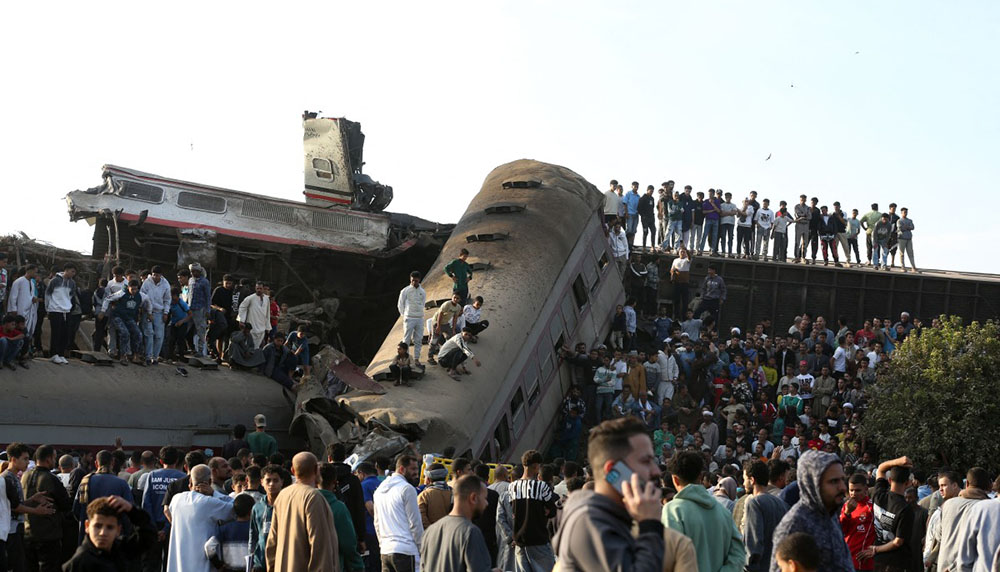
Egyptian authorities are investigating a deadly railway collision south of Cairo that killed seven people and injured 125 others, raising renewed concerns about safety across the country's rail network.
The accident occurred on Sunday, November 8, in El-Ayyat, Giza governorate, between Kafr Ammar and Al-Raqqa railway stations near the Gerza junction.
According to Egyptian National Railways, train No. 134, operating a Tahya Misr passenger service between Giza and Fayoum, struck the rear carriage of train No. 2010, travelling from Cairo to Aswan.
The impact caused several carriages to leave the tracks, with some overturning and trapping passengers.
Emergency responders, medical teams and railway engineers were deployed as authorities worked to rescue the injured and clear the damaged railway line.
The accident disrupted services connecting Cairo with southern Egypt and prompted a criminal and technical investigation.
Death Toll Reaches Seven as Injuries Rise to 125
Egypt's Ministry of Health and Population revised the casualty figures several times as rescue teams completed their initial work and hospitals received additional patients.
Early statements reported four fatalities and 88 injuries.
The figures were subsequently revised to seven deaths and 112 injuries.
In a later update on November 8, the ministry confirmed that hospitals had received 132 cases, including seven fatalities and 125 injured passengers.
The ministry said 72 ambulances participated in transporting casualties from the crash site.
Medical officials reported that injuries ranged from bruises and abrasions to fractures involving the limbs, pelvis and vertebrae.
Other patients were treated for head and facial wounds and injuries affecting the chest and ribs.
The health authorities continued monitoring the condition of patients admitted after the collision.
Hospitals Receive More Than 130 Casualties
The injured and deceased were transferred to several medical facilities in Giza and neighboring Beni Suef governorate.
According to the ministry's detailed figures, Al-Wasta Central Hospital received 87 cases, including three fatalities.
El-Ayyat Central Hospital received 34 injured passengers.
Atfih Central Hospital received 11 cases, including four fatalities.
The ministry said 71 injured people had been discharged following treatment and improvements in their condition.
Another 11 patients were transferred to Beni Suef University Hospital and Beni Suef Specialized Hospital for further medical care.
At the time of the detailed report, 43 patients remained hospitalized under medical observation.
Health Minister Khaled Abdel-Ghaffar ordered hospitals in Giza and Beni Suef to increase their emergency preparedness and provide all necessary services to those affected.
Deputy Health Minister Amr Kandil was assigned to visit medical facilities and monitor the treatment of injured passengers.
Initial Investigation Finds Rear-End Collision
The Egyptian Public Prosecution launched an investigation immediately after the accident.
Prosecutors and forensic teams examined the collision site and questioned witnesses to establish how the two passenger trains came to occupy the same section of track.
Initial findings indicated that the Cairo–Aswan service, train No. 2010, was stationary when it was struck from behind by train No. 134.
The collision caused several carriages to derail and overturn.
Prosecutors also confirmed that the driver of train No. 134 was among those killed.
However, investigators have not yet established why the moving train approached the stationary service or whether signaling failures, operating errors or other technical factors contributed to the crash.
Authorities have emphasized that the definitive cause will depend on the results of the technical investigation.
Prosecutors Form Specialized Technical Committee
Egypt's Public Prosecution ordered the formation of a specialized committee to examine the damaged trains, railway infrastructure and operational procedures.
The investigation will assess the mechanical and technical circumstances of the collision and determine why several carriages left the tracks.
Investigators are also examining whether railway personnel complied with applicable operating instructions and safety requirements.
Prosecution teams visited El-Ayyat, Atfih and Al-Wasta hospitals to interview survivors and examine the bodies of those who died.
The investigation includes the collection of witness statements, inspection of the accident site and assessment of material damage.
No final technical report or conclusive determination of criminal responsibility has yet been announced.
The authorities are expected to determine whether any negligence or procedural failure contributed to the accident.
President El-Sisi Orders Accountability
Egyptian President Abdel Fattah El-Sisi expressed condolences to the families of those killed and wished the injured a speedy recovery.
The president instructed state institutions to provide the necessary medical assistance and support for the victims and their families.
He also ordered a swift investigation into the circumstances of the collision.
El-Sisi directed the authorities to hold anyone found responsible for negligence accountable under the law.
The presidential instructions placed the investigation and medical response among the immediate priorities of the relevant government institutions.
Egyptian transport and railway officials continued coordinating with emergency teams to restore services and assess the condition of the affected line.
Residents Join Rescue Efforts
Residents of communities near the crash site helped rescue passengers in the immediate aftermath of the collision.
Witnesses described hearing a loud impact before seeing damaged carriages and people attempting to escape from the trains.
Some local residents reached the wreckage before emergency personnel arrived and assisted injured passengers.
Ambulance crews, firefighters, civil protection teams and police officers subsequently joined the rescue operation.
Heavy machinery and cranes were brought to the scene to move derailed carriages and remove debris from the tracks.
Egyptian Red Crescent teams also provided assistance to people affected by the accident.
The response involved medical evacuations, rescue operations and the restoration of railway infrastructure.
Railway Services Disrupted Across Upper Egypt Routes
The collision forced Egyptian National Railways to suspend and reorganize some passenger services along the Cairo–Upper Egypt corridor.
Engineering teams worked to remove damaged carriages and inspect the railway line.
While clearance operations continued, some services between Al-Wasta and Aswan were diverted.
The Ministry of Transport arranged buses for passengers stranded by the disruption.
Railway authorities also offered refunds to passengers who decided to cancel their journeys because of the delays.
Egyptian National Railways apologized for the inconvenience and said it was working to restore normal operations as quickly as possible.
The disruption affected an important transport route serving communities between Cairo and southern Egypt.
Cairo–High Dam Railway Services Restored
On Monday, November 9, Egyptian National Railways announced that services had resumed on the Cairo–High Dam railway line.
The announcement followed the removal of damaged carriages and the repair of sections of track affected by the collision.
Engineering teams completed the necessary work to reopen the route following the disruption on Sunday.
The railway authority extended condolences to the families of those killed and expressed sympathy for the injured.
The resumption of train services represents an important operational development, although the investigation into the accident remains ongoing.
No final public finding has yet established the technical reason for the rear-end collision.
Parliament Demands Answers Over Railway Safety
The crash has also generated criticism and demands for accountability from Egyptian lawmakers.
Member of Parliament Ehab Mansour submitted an urgent statement calling for a review of railway accidents and the effectiveness of government spending on safety improvements.
MP Hussein Haridy called on Transport Minister Kamel Al-Wazir to accept political responsibility for the incident and urged his resignation.
Senator Mahmoud Mosallam requested parliamentary questioning about the operation of the railway system.
Lawmakers raised concerns about signaling procedures, maintenance standards, driver training and the measures intended to prevent two trains from occupying the same section of track.
Some questioned whether the financial resources allocated to major transport projects were delivering sufficient improvements to conventional railway services.
The demands have placed the government's railway modernization programme under renewed public and parliamentary scrutiny.
Railway Modernization Faces Renewed Questions
Egypt has undertaken major investments to modernize its railway network, including upgrades to signaling systems, stations, tracks and rolling stock.
However, the continued occurrence of serious accidents has generated concern about the safety of existing passenger services.
Data from Egypt's Central Agency for Public Mobilization and Statistics show that 170 railway accidents were recorded in 2025.
That represented a 22.7 percent reduction from the 220 incidents recorded in 2024.
Despite the decrease, the El-Ayyat collision has renewed questions about operational safety and the effectiveness of railway supervision.
The area experienced another collision on September 10, 2026, when two freight trains crashed near Al-Balyada station, injuring a driver and his assistant.
The occurrence of two separate railway collisions in the same district within two months has intensified calls for a detailed review of local operating conditions and safety procedures.
Investigation Continues After Services Resume
The November 8 collision has become one of Egypt's most serious recent railway incidents, leaving seven dead and 125 injured.
While medical teams continue treating patients, prosecutors are examining the technical and operational circumstances that caused the crash.
President El-Sisi has ordered the investigation to proceed without delay and demanded accountability for any proven negligence.
Railway services resumed on November 9 following the removal of wreckage and track repairs.
Nevertheless, the reopening of the line does not resolve the questions surrounding the collision.
The investigation's findings will be important in determining whether additional safety measures, operating reforms or legal action are required.
The accident has also intensified a broader national debate over railway safety, infrastructure investment and the protection of passengers travelling on Egypt's extensive rail network.