Suspected Emirati drone discovered in central Sudan
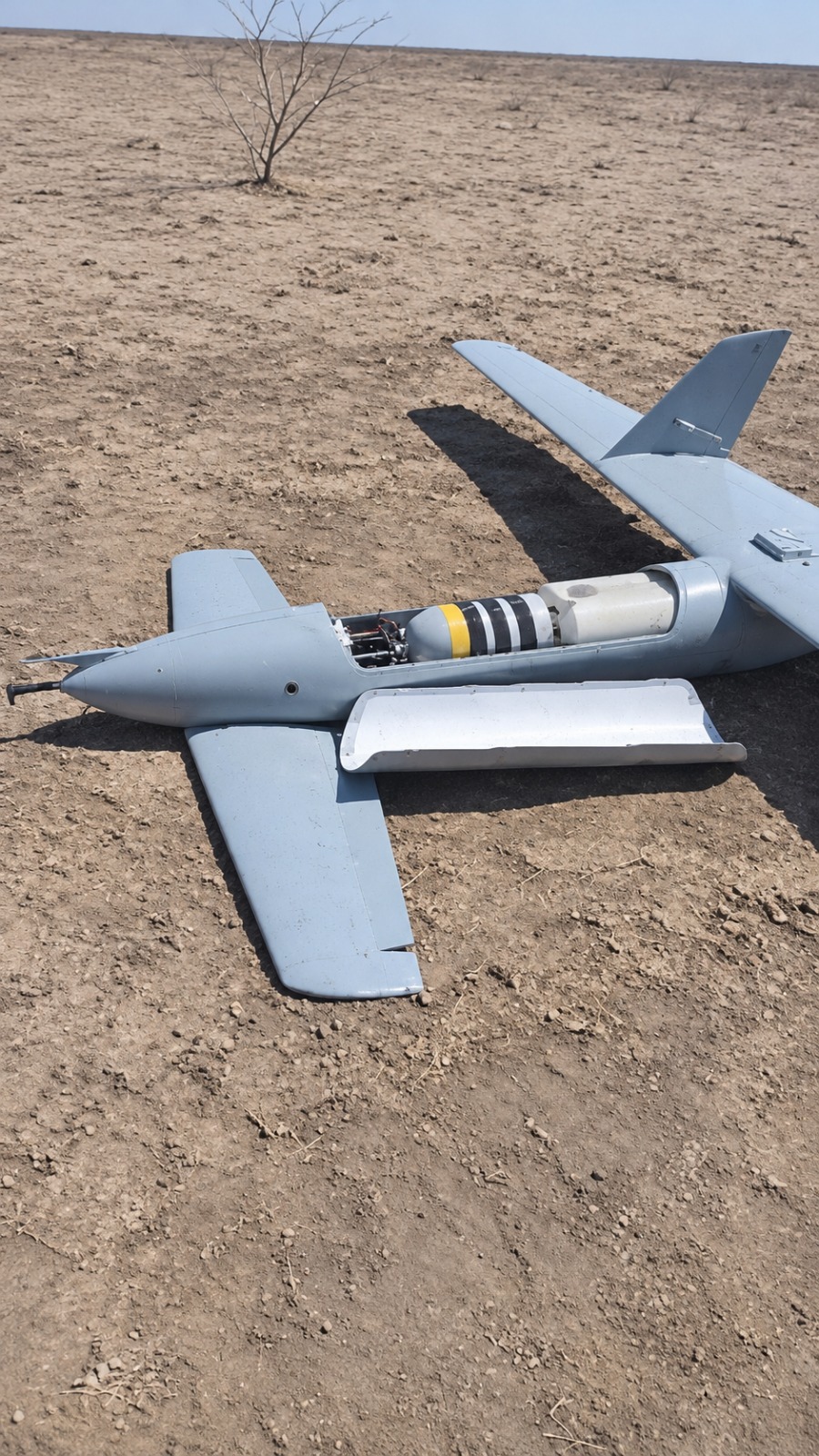
A one-way attack unmanned aerial vehicle believed to be of United Arab Emirates origin has reportedly been recovered largely intact in Kab al-Jidad, a locality in Sudan's central Al Jazirah state.
Open-source intelligence researcher Rich Tedd, operating the @AfriMEOSINT account, published photographs showing the aircraft lying on dry ground.
The images show a fixed-wing drone with much of its airframe apparently intact.
According to Tedd, the aircraft belongs to a model provisionally designated TMID-0014 by Armament Research Services (ARES).
The researcher said it was carrying Emirati-made MODAMER warheads and may have experienced a technical malfunction while travelling toward Khartoum.
The proposed destination and explanation for the aircraft's descent remain assessments rather than independently established findings.
No flight logs or verified technical examination of the newly recovered aircraft have been made publicly available.
Weapons researchers previously identified TMID-0014
The reported discovery has attracted attention because TMID-0014 is a previously documented one-way attack UAV model associated with the Rapid Support Forces (RSF).
In a technical investigation published on September 5, 2026, Armament Research Services assessed that the aircraft was of Emirati origin.
The organization assigned it the temporary identifier TMID-0014 because its official model name had not been publicly established.
ARES documented similarities between the aircraft and other one-way attack systems linked to the UAE's defense industry.
The analysis also identified TMID-0013, another model previously used in Sudan.
Both models were displayed during Desert Tiger 7, a joint military exercise conducted by the United Arab Emirates and Malaysia in February 2023.
ARES assessed with moderate-to-high confidence that the Emirati state-owned EDGE Group and its subsidiaries were involved in manufacturing these systems.
MODAMER warhead linked to UAE defense manufacturer
A central element of the identification is the MODAMER warhead reportedly carried by the recovered drone.
MODAMER is a high-explosive fragmentation warhead produced by HALCON, a subsidiary of the UAE's EDGE Group.
According to technical specifications reviewed by ARES, the warhead weighs approximately 34.5 kilograms, measures 377.5 millimeters in length and has a diameter of 202 millimeters.
Manufacturer documentation describes a design incorporating approximately 69,000 fragments.
The weapon is designed to function as the explosive payload of an attack system rather than as an independently guided aircraft.
ARES previously documented MODAMER warheads installed in TMID-0014 drones recovered in Sudan.
Some examples were fitted with Serbian-manufactured UT M18 fuzes, according to the organization's findings.
However, the configuration of the specific warhead shown in the latest Kab al-Jidad photographs requires further examination.
Similar unexploded munition documented earlier in November
The discovery follows earlier investigations into unexploded drone-delivered munitions found in Sudan.
On November 15, Arabic-language open-source investigation platform Eekad published a report examining footage of an unexploded munition circulated earlier that month.
Its researchers compared the visible components with documented weapons systems and identified characteristics consistent with the Emirati MODAMER warhead.
The investigation linked the munition to a family of one-way attack UAVs previously recorded in Sudan.
Eekad also cited ARES research connecting the TMID-0014 aircraft with the use of MODAMER fragmentation warheads.
The findings form part of a growing body of open-source documentation concerning foreign-manufactured drone systems appearing in Sudan's conflict.
Deadly drone strikes hit Khartoum on November 22
The newly circulated photographs emerged shortly after a major wave of drone attacks hit Sudan's capital.
On November 22, drones struck residential areas in Khartoum and Omdurman, killing at least four civilians and injuring several others.
A United Nations facility in a residential neighborhood was damaged while humanitarian personnel were inside.
Witnesses reported explosions and anti-aircraft fire as Sudanese military air defenses engaged incoming drones.
Activity was reported around Burri, Al-Riyadh and Arkawit, with particular concern over approaches to Khartoum International Airport.
In Arkawit, one drone reportedly crashed into a street without detonating before security personnel secured the area.
The Sudanese military has accused the RSF of conducting repeated drone attacks and has claimed that some aircraft were launched from Ethiopian territory.
Ethiopia has denied facilitating military operations against Sudan from its territory.
There is no independently established connection between the drone reportedly recovered in Kab al-Jidad and the aircraft used in the November 22 attacks.
UAE's role in Sudan's conflict remains disputed
The discovery has renewed attention to allegations that the UAE has supplied advanced military equipment to the RSF.
Sudanese authorities have repeatedly accused Abu Dhabi of providing the paramilitary group with weapons, drones and logistical support.
Amnesty International has documented foreign-manufactured weapons and UAVs used by the RSF and identified evidence linking certain equipment transfers to the UAE.
ARES has also assessed that TMID-0013 and TMID-0014 aircraft were likely supplied to RSF forces directly by the Emirates.
The UAE government rejects allegations that it has armed or supported the RSF.
In a September 2026 statement, Abu Dhabi maintained that it had supplied no weapons or related military equipment to any Sudanese faction since the conflict began in April 2023.
It also called for an end to foreign military support, an immediate ceasefire and a civilian-led political transition.
Washington calls for an end to drone supplies
The latest developments coincide with growing international concern over the use of foreign-supplied drones in Sudan.
On November 23, US Senior Advisor for Arab and African Affairs Massad Boulos called for an end to weapons flows into the country.
Responding to the latest attacks in Khartoum, he said the use of drones was endangering civilians and humanitarian personnel while prolonging the conflict.
Boulos urged the warring parties to agree rapidly to a humanitarian truce capable of opening the way toward a lasting cessation of hostilities.
According to United Nations figures, more than 1,630 civilians were killed in drone attacks across Sudan between January and October 2026.
New discovery highlights expanding drone warfare
If the aircraft is independently confirmed as a TMID-0014 model, its recovery could contribute additional information about the types of weapons being used in Sudan's increasingly drone-intensive war.
The apparently intact condition of the aircraft may allow qualified specialists to examine its components and identify previously undocumented features.
Nevertheless, establishing the precise supply route, operator, launch location and intended target would require evidence beyond the photographs currently available.
The latest images underscore the growing importance of one-way attack drones in Sudan's conflict and the continuing international debate over the external supply of military technology to the warring sides.