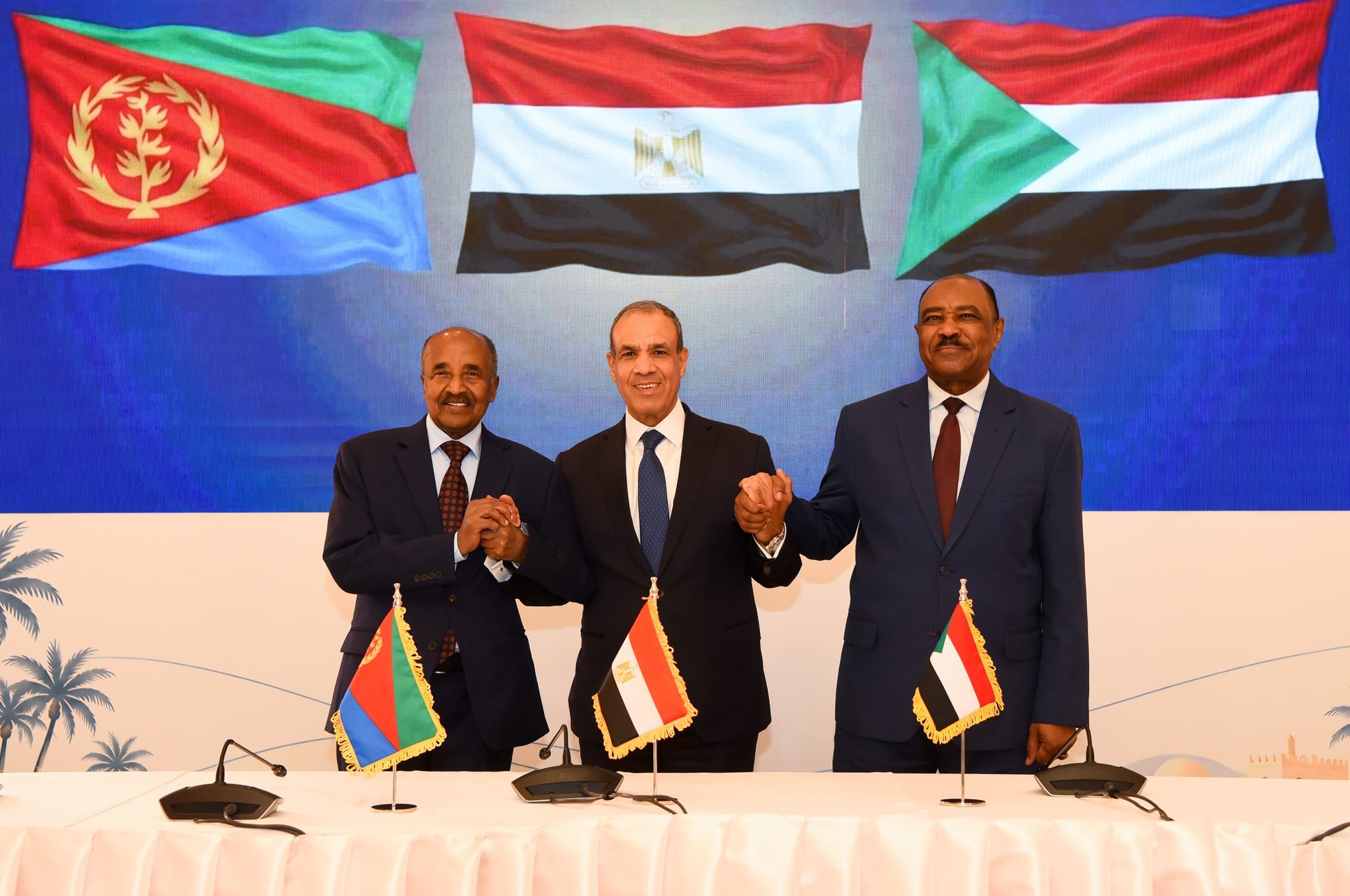
Eritrea is continuing to strengthen its diplomatic and economic relationships with Egypt while coordinating with Sudan and other regional partners on security challenges affecting the Red Sea and the Horn of Africa.
A photograph featuring the flags of Eritrea, Egypt and Sudan has brought renewed attention to the growing diplomatic engagement among the three countries.
The regional relationship has developed through a series of bilateral consultations, economic discussions and multilateral meetings during 2026.
For Eritrea, the main priorities include protecting its territorial sovereignty, developing maritime infrastructure, strengthening economic connectivity and addressing security challenges associated with the war in neighbouring Sudan.
The latest Egyptian–Sudanese consultations, held during the Aswan Forum on November 21, add to the broader diplomatic activity taking place across the region.
However, no newly signed trilateral agreement involving Eritrea has been independently confirmed in connection with the photograph.
Eritrea joins regional declaration on sovereignty
One of the most significant developments in regional cooperation occurred on October 4, 2026, when Eritrea participated in a quadrilateral summit hosted by Egypt in New Alamein.
The meeting brought together Eritrean President Isaias Afwerki, Egyptian President Abdel Fattah el-Sisi, Sudan's Transitional Sovereignty Council Chairman Abdel Fattah al-Burhan and Somali President Hassan Sheikh Mohamud.
The leaders adopted the El Alamein Joint Declaration, outlining shared principles concerning regional security, national sovereignty, territorial integrity and political cooperation.
The declaration emphasized respect for international law, rejection of foreign interference and the importance of preserving national institutions.
It also encouraged political and peaceful solutions to conflicts and called for stronger cooperation among the participating countries.
The four governments agreed to establish a mechanism for monitoring implementation of the summit's conclusions and continuing diplomatic consultations.
For Asmara, the declaration provides a formal framework for engagement with other governments sharing concerns about regional security and maritime sovereignty.
Red Sea governance remains central to Eritrean policy
The future of Red Sea security has become a major focus of Eritrea's diplomatic relations with Egypt.
Eritrean Foreign Minister Osman Saleh and Egyptian Foreign Minister Badr Abdelatty discussed maritime security during a meeting on the sidelines of the UN General Assembly in September.
Both ministers stated that the governance and security of the Red Sea should remain the responsibility of countries bordering the waterway.
They also emphasized the importance of respecting national sovereignty and maintaining security arrangements consistent with international law.
The same principle was incorporated into the October El Alamein Joint Declaration.
Eritrea's coastline occupies a strategically important position along the Red Sea, connecting the country's maritime interests with shipping routes serving the Suez Canal, the Gulf of Aden and the Bab el-Mandeb Strait.
The ports of Assab and Massawa are central to Eritrea's long-term plans for economic development and regional trade connectivity.
Eritrea and Egypt have consequently identified maritime transport, port development and infrastructure cooperation as potential areas for expanding their partnership.
Port development and economic investment
Economic relations between Asmara and Cairo have also received increasing diplomatic attention.
In June 2026, the two countries announced cooperation covering mining, infrastructure, housing, pharmaceuticals, maritime transportation and transport connectivity.
The discussions specifically addressed the development of Eritrea's Assab, Massawa and Marsa Fatima port facilities.
According to Eritrea's Ministry of Information, the two governments also agreed to strengthen land, air and maritime connections and continue consultations between relevant institutions.
Further progress was discussed during an October 1 visit to Cairo by a senior Eritrean economic delegation.
The delegation included Hagos Gebrehiwet, Eritrea's head of economic affairs, and Minister of Trade and Industry Nesredin Mohammed Saleh.
They met Egyptian Foreign Minister Badr Abdelatty and Transport Minister Kamel el-Wazir.
The talks covered trade and investment opportunities in construction materials, pharmaceuticals, agriculture, marine resources and maritime transport.
The expansion of these areas could support Eritrea's efforts to increase trade and develop commercial infrastructure.
However, the governments have not announced final investment budgets or confirmed completion timetables for the proposed port developments.
Sudan's war shapes regional diplomatic priorities
Sudan's continuing civil war remains a major factor influencing Eritrea's security environment and relations with neighbouring states.
Eritrea shares a border with Sudan, making developments in eastern Sudan particularly relevant to Asmara's security and diplomatic interests.
The October quadrilateral declaration included explicit support for Sudan's sovereignty, unity and territorial integrity.
The participating leaders rejected the establishment of parallel governing institutions and called for an inclusive, Sudanese-owned political process.
They also opposed foreign assistance to mercenaries involved in the conflict.
These commitments reflect concerns about the wider effects of Sudan's war, including cross-border instability, population displacement and the disruption of regional transport networks.
In September, Foreign Minister Osman Saleh held diplomatic engagements with representatives of both Egypt and Sudan during the UN General Assembly.
The meetings formed part of Eritrea's continuing consultations with regional and international partners on political and security developments.
Egypt and Sudan expand reconstruction cooperation
Diplomatic engagement involving Sudan continued on November 21 during the sixth Aswan Forum for Sustainable Peace and Development.
Egyptian Foreign Minister Badr Abdelatty met Sudanese Foreign Minister Mohieldin Salem to discuss reconstruction, regional stability and the recovery of Sudanese institutions.
Egypt reaffirmed its interest in supporting infrastructure rehabilitation, energy development, roads and port-related projects in Sudan.
The two countries also announced a memorandum of understanding concerning training, institutional capacity building and human resource development.
The agreement is intended to support Sudanese national institutions affected by the conflict.
Eritrea is not listed as a signatory to the announced bilateral training memorandum.
Nevertheless, progress toward restoring stability and economic activity in Sudan has significant implications for Eritrea because of their shared border and wider Red Sea connections.
Ethiopian maritime ambitions remain a source of tension
Eritrea's diplomatic engagement with Egypt and Sudan is taking place against a background of rising tensions between Asmara and Addis Ababa.
Eritrean officials have repeatedly criticized Ethiopian statements concerning sovereign access to the Red Sea, describing them as challenges to Eritrea's territorial integrity.
On November 19, Eritrea's Ministry of Foreign Affairs published another statement criticizing the Ethiopian government's approach to maritime access and regional sovereignty.
Asmara maintains that commercial access to ports can be negotiated between sovereign states but that territorial sovereignty cannot be transferred through unilateral demands.
Ethiopia, meanwhile, argues that reliable access to maritime routes is essential for its long-term economic development and national security.
The disagreement has heightened the importance of maritime sovereignty in Eritrea's regional diplomatic relationships.
Egypt and Eritrea have repeatedly emphasized that Red Sea security arrangements must respect the rights of coastal states.
Nevertheless, their diplomatic coordination should not be treated as confirmation of a newly established military alliance.
Eritrea seeks a broader regional role
The combination of economic cooperation with Egypt, diplomatic coordination over Sudan and participation in regional consultations involving Somalia reflects Eritrea's effort to maintain a stronger role in Horn of Africa affairs.
The El Alamein Joint Declaration remains an important framework for that engagement, particularly on questions of state sovereignty, maritime governance and regional security.
At the same time, the bilateral economic agreements under discussion with Egypt could create opportunities for infrastructure development, maritime transport and commercial connectivity.
The continuing conflict in Sudan and Eritrea's tense relationship with Ethiopia make regional diplomatic coordination particularly significant.
For Asmara, the next important developments will include the implementation of existing economic commitments, further consultations on Red Sea governance and regional efforts to limit the security effects of neighbouring conflicts.