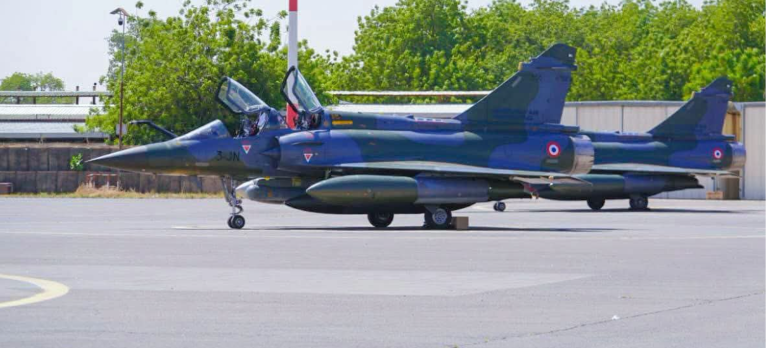
French military aircraft returned to Chad on Thursday, November 19, 2026, marking a significant development in relations between Paris and N'Djamena nearly two years after the termination of their longstanding defence cooperation agreement.
Two French Air Force Mirage 2000 fighter jets and a Hercules C-130 military transport aircraft landed at the Adji Kosseï air base, located within N'Djamena International Airport, at approximately 10:00 a.m. local time.
According to Radio France Internationale (RFI), the aircraft were accompanied by around 20 French military personnel.
The deployment originated from Gabon and formed part of a wider regional military training programme involving French forces operating in Central and West Africa.
Aircraft-tracking information identified a French KC-130J Super Hercules tanker-transport aircraft carrying tail number 61-PQ among the movements associated with the visit.
The arrival represents a notable return of French military aviation activity to Chad following the withdrawal of French combat aircraft and military personnel in late 2024 and January 2025.
Chadian authorities highlight counterterrorism cooperation
The Chadian Air Force presented the French aircraft's arrival as part of renewed joint military activities between the two countries.
According to Chadian officials cited by RFI, the cooperation focuses on counterterrorism operations and security challenges in Lac Province, where Boko Haram remains an important threat.
The Lake Chad Basin has experienced years of attacks and cross-border operations by Boko Haram and Islamic State West Africa Province (ISWAP).
Armed groups have exploited remote islands, difficult terrain and porous borders connecting Chad, Nigeria, Niger and Cameroon.
The renewed military engagement is intended to strengthen operational coordination between Chadian and French personnel, improve tactical training and support the development of aerial intelligence capabilities.
Chadian authorities consider improved air surveillance and cooperation between air and ground forces important tools for monitoring militant movements and responding to security threats.
There has been no announcement that the French aircraft conducted combat strikes against Boko Haram or other armed groups during the visit.
Paris describes mission as temporary stopover
Although Chadian officials characterized the deployment as a step toward renewed joint military cooperation, France adopted a more cautious description.
On October 29, Colonel Xavier Rival, spokesperson for the French Chief of Defence Staff, announced that two Mirage 2000 fighter jets and a military transport aircraft would make a short technical stopover in Chad.
He said the visit would include training activities aimed at improving cooperation and supporting the capabilities of the Chadian Air Force.
The mission was linked to the GEX regional military exercise scheduled from November 8 to 30 in Côte d'Ivoire and Gabon.
According to French sources, the aircraft were expected to remain in N'Djamena for only a few hours, primarily to refuel and conduct related activities before continuing their mission.
Paris emphasized that the deployment did not represent the reopening of permanent French military bases in Chad.
French officials said any future activities would be conducted with Chadian approval and in full respect of the country's sovereignty.
Chad terminated defence agreement in November 2024
Relations between France and Chad deteriorated sharply on November 28, 2024, when the Chadian government announced the termination of its military cooperation agreement with Paris.
The decision ended a defence relationship established under arrangements dating back to 1976.
President Mahamat Idriss Déby Itno's government said the move was intended to strengthen national sovereignty and redefine Chad's relationships with foreign security partners.
Following the announcement, France began withdrawing approximately 1,000 troops and military equipment from the country.
On December 10, 2024, two French Mirage fighter jets departed N'Djamena, marking one of the first visible stages of the military withdrawal.
The remaining French military personnel and installations were withdrawn or transferred to Chadian authorities by the end of January 2025.
The departure ended decades of permanent French military presence in Chad, which had previously served as a major base for French operations across the Sahel.
Macron and Déby reopen defence dialogue
Diplomatic efforts to rebuild the relationship gained momentum during 2026.
Chadian President Mahamat Idriss Déby Itno met French President Emmanuel Macron in Paris on January 29 to discuss a renewed political, economic and security partnership.
The two leaders held further talks at the Élysée Palace on October 13, when France and Chad agreed to establish a new framework for defence cooperation.
Their defence officials signed a declaration of intent covering military training, technical expertise, defence industry cooperation and emerging technologies.
The declaration was intended to structure future cooperation under revised arrangements rather than automatically restore the previous defence agreement.
French officials emphasized that military activities would be conducted in accordance with Chad's sovereign decisions and operational requirements.
The November aircraft visit is among the most visible developments following the October declaration.
Aerial intelligence emerges as a priority
A Chadian government source quoted by RFI described the arrival of French aircraft as a symbol of the renewal of relations between the two countries.
The official suggested that further joint training activities could follow, identifying aerial intelligence as an important area for future cooperation.
Chad faces multiple security challenges along its borders with Sudan, Libya, the Central African Republic, Niger and Nigeria.
The country's western Lake Chad region remains affected by militant activity, while instability in neighbouring Sudan has created additional humanitarian and security pressures.
Air surveillance, military training and improved coordination between aerial and ground units are therefore among the capabilities Chadian authorities may seek to strengthen through international partnerships.
French combat aircraft and military aviation expertise could provide additional training opportunities, although no permanent deployment or extended basing arrangement has been announced.
Chad maintains diversified defence partnerships
The renewed engagement with France comes as Chad continues to diversify its security relationships.
Following the withdrawal of French forces, N'Djamena sought to strengthen cooperation with other international partners, including Türkiye, Russia and China.
Chadian authorities have emphasized that renewed cooperation with Paris does not necessarily require a return to the previous model of permanent foreign military installations.
Instead, the emerging approach appears focused on targeted training missions, technical support, intelligence cooperation and short-term deployments.
The November 19 arrival of French combat aircraft therefore represents an important development in the gradual normalization of bilateral military relations.
However, the extent of future cooperation, including the possibility of additional joint exercises or longer-term French deployments, remains to be determined through subsequent discussions between the two governments.