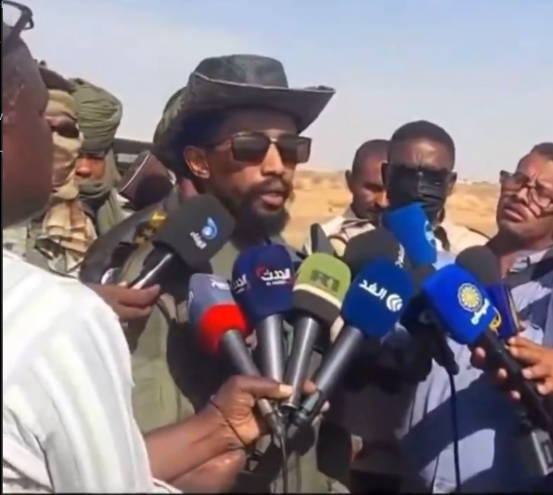
A senior field commander of Sudan's Rapid Support Forces (RSF) has announced his defection to the Sudanese Armed Forces (SAF), joining the regular military alongside hundreds of fighters under his command.
According to the Sudan News Agency (SUNA), Mishal Abdelrahman al-Nour, who commanded the RSF's 27th and 28th groups, formally announced the move on Wednesday, November 18, 2026, in the presence of senior army and General Intelligence Service officials.
Sudanese media outlets, including Al Hadath, reported that the commander was accompanied by 317 personnel and 16 military vehicles.
Abdelrahman said the officers and troops who joined him had made their decision voluntarily and were prepared to participate in military operations alongside the Sudanese Armed Forces.
The announcement marks another significant departure from the paramilitary organization during a period of intensifying fighting in western Sudan.
Commander accuses RSF leadership of consolidating family control
Explaining his decision to leave the RSF, Abdelrahman criticized the group's senior leadership and its internal command arrangements.
He said the decision was made in response to an appeal from Sudanese army commander General Abdel Fattah al-Burhan.
Abdelrahman accused the RSF leadership of removing certain commanders to create conditions for the family of RSF leader Mohamed Hamdan Dagalo, widely known as Hemedti, to strengthen its control over the organization.
He announced a complete break with the RSF and expressed his willingness to cooperate with the Sudanese army, intelligence services and allied military formations.
The commander also addressed civilians in Darfur and Kordofan, saying the military activities of the Sudanese army and allied forces were not directed against any particular tribe or social community.
He urged other RSF members to leave the paramilitary group and join the regular armed forces.
Latest defection follows departure of several commanders
Abdelrahman's announcement comes amid a series of departures involving senior RSF field commanders and political figures during 2026.
On November 15, Ahmed Hasab al-Rasoul, an RSF commander operating in North Darfur, announced that he was leaving the paramilitary organization and joining the Sudanese army.
His departure followed the October 31 announcement by senior commander Siddiq Ander, who accused the RSF leadership of nepotism and concentrating military and financial power within Hemedti's family.
Ander said members of the Dagalo family exercised extensive influence over the organization's finances, weapons, troop movements and military promotions.
Other senior figures who previously broke with the RSF include Major General al-Nour Ahmed Adam, also known as al-Nour al-Qubba, and field commander Ali Rizqallah, widely known as al-Savana.
On November 2, the Sudanese army also announced that a group of RSF personnel led by Jado Mohammed Hamed Shawqar had surrendered to its 4th Infantry Division in Damazin, the capital of Blue Nile state.
The series of departures has brought renewed attention to disagreements over military appointments, leadership authority and the distribution of resources within the RSF.
Internal arrests reported in West Kordofan
Abdelrahman's defection coincided with reports of arrests involving RSF officials in West Kordofan state.
According to Al Hadath, the RSF detained several figures associated with its civilian administration and military structures in the Gubeish locality on November 18.
Those named included Suleiman al-Sadiq, a former executive official in the civilian administration, and Moataz al-Maassal, alongside other military personnel.
The developments came as the Sudanese army and allied formations expanded operations across several fronts in West Kordofan, including areas around Al-Khuwai, Al-Nuhud and Abu Zabad.
Army-aligned Special Operations Forces separately announced that 126 RSF fighters had surrendered in West Kordofan.
That announcement concerned a separate group from the 317 personnel who reportedly joined the army alongside Abdelrahman.
West Kordofan remains strategically important because its roads link government-held areas of central Sudan with RSF positions in Darfur.
Control over these routes affects the movement of fighters, military equipment and supplies between major operational areas.
Military implications of the latest defections
The departure of commanders alongside their fighters and vehicles has drawn attention to the potential consequences for the RSF's field organization.
The Sudanese army has combined battlefield operations with appeals encouraging RSF personnel to abandon the paramilitary organization and join state forces.
Abdelrahman's announcement is significant because it involves not only a senior commander but also a substantial number of personnel and military vehicles.
However, the RSF continues to maintain extensive military positions across Darfur and remains engaged in fighting against Sudanese government forces in Kordofan.
The overall military consequences of the defections therefore depend on the operational importance of the departing units, their equipment and the RSF's ability to reorganize its remaining forces.
Sudan's conflict continues to devastate the country
Sudan's war began on April 15, 2023, following a power struggle between the Sudanese Armed Forces and the RSF, including disagreements over plans to integrate the paramilitary organization into the national military.
The fighting has killed tens of thousands of people, displaced approximately 13 million and severely damaged hospitals, schools and other essential civilian infrastructure.
Darfur and Kordofan remain among the most heavily affected regions, with continued fighting, drone attacks and humanitarian displacement placing further pressure on civilians.
International humanitarian organizations continue to warn of deteriorating conditions and the urgent need to protect civilians and facilitate humanitarian assistance.
The latest defection led by Mishal Abdelrahman al-Nour adds to the series of changes affecting the RSF's military leadership as the conflict continues across western Sudan.