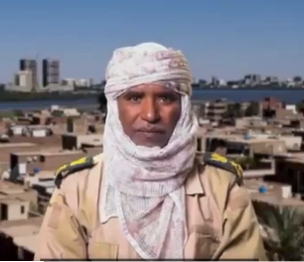
A Sudanese paramilitary commander has reportedly broken ranks with the Rapid Support Forces (RSF), adding another name to a series of public departures from the organization during 2026.
Brigadier General Hamdan Osman Mohamed, identified as commander of the RSF's Group 45 Protection Units, announced that he had decided to join the Sudanese Armed Forces (SAF), according to a report published by Sudanese Echo on November 13.
In a video statement lasting approximately one minute and 45 seconds, Hamdan criticized the RSF leadership and accused the family of its commander, Mohamed Hamdan Dagalo, widely known as Hemedti, of placing foreign interests ahead of Sudan's national interests.
He argued that the continuing war was being driven by outside actors seeking to weaken Sudan and damage its national institutions.
The claims were presented as Hamdan's assessment of the conflict. No independent evidence establishing the existence of the specific alleged plan was provided in the available account.
The RSF had not issued a verified response to his latest allegations.
Former commander accuses Dagalo family
The allegations directed at the Dagalo family were a central feature of Hamdan's announcement.
He accused members of the family of cooperating with unidentified regional actors and helping advance what he characterized as a broader project aimed at fragmenting Sudan.
Hamdan argued that the country's war had gone beyond a dispute over military authority and had increasingly become a conflict serving external interests.
He also attributed responsibility for killings, displacement, widespread looting and the destruction of towns and villages to the RSF leadership and those supporting it.
His statement echoed complaints made by several former RSF commanders concerning decision-making within the organization.
However, the available report did not identify specific documentary evidence supporting all of Hamdan's allegations.
Apology to Sudanese civilians
In the same video, Hamdan expressed regret over the suffering caused by the war and apologized to the Sudanese population.
He addressed former colleagues who remained with the RSF and urged them to reconsider their positions.
The commander warned that continued participation in the conflict would bring further civilian suffering and destruction.
He encouraged other RSF officers and fighters to leave the organization rather than continue supporting its leadership.
His appeal followed several similar messages delivered by defecting commanders during the past year.
While some departures have involved public expressions of regret, international human rights organizations have emphasized that defecting from an armed group does not remove responsibility for any crimes committed while serving within it.
No independently verified judicial finding concerning Hamdan personally was identified in the available reporting.
Allegiance declared to Burhan
Toward the end of his statement, Hamdan addressed General Abdel Fattah al-Burhan, Chairman of Sudan's Transitional Sovereignty Council and commander-in-chief of the SAF.
He declared that his forces were now under Burhan's command and available to participate in military operations against the RSF.
Hamdan specifically mentioned Kordofan and Darfur as areas where his men were prepared to support the army.
However, he did not disclose the number of soldiers involved in the reported defection.
The announcement also did not establish whether military vehicles, weapons or equipment had been transferred to government-controlled areas.
There was no independently confirmed account of where the personnel were located or which army formation would receive them.
The operational significance of the reported defection therefore remains uncertain.
October defection exposed complaints over family control
Hamdan's announcement follows another prominent departure from the RSF in late October.
On October 30, senior commander Siddiq Abdelrahman Ander publicly announced his defection in a video obtained by Al Jazeera.
Ander accused Hemedti's relatives of exercising control over the group's finances, weapons, troop movements and military promotions.
He alleged that commanders who challenged internal decisions risked punishment or detention.
His comments raised questions about the distribution of authority within the organization and the role of Hemedti's inner circle in military decision-making.
Hamdan's latest statement similarly placed the Dagalo family at the center of his explanation for leaving the RSF.
Although the two men emphasized related grievances, the consequences of their individual departures cannot be assessed without establishing the number of fighters and resources that moved with them.
Major defections reported across Darfur
Earlier in 2026, two senior commanders publicly left the RSF and joined the Sudanese army.
Major General Al-Nour Ahmed Adam, known as Al-Nour Al-Qubba, defected in April and was subsequently received by Burhan.
Al-Qubba had held an important position within the RSF's military operations in Darfur.
His departure followed reported disagreements over command appointments and internal leadership decisions.
In May, field commander Ali Rizqallah, known as Al-Savanna, also broke with the organization and joined the army.
Al-Savanna had been associated with operations in Darfur and Kordofan.
The defections drew attention because of the commanders' previous roles within the RSF and their connections to local armed networks.
However, human rights advocates also raised concerns about possible responsibility for abuses committed while those commanders served with the paramilitary force.
Groups of fighters also reported to have switched sides
The pattern has not been limited to senior officers.
On August 13, Sudanese authorities announced that 21 commanders and 270 RSF personnel had joined the army with 37 military vehicles.
Another announcement on August 19 described the defection of four commanders and 318 fighters, along with 50 vehicles.
In October, Lieutenant Colonel Mohammed Azraq al-Fanjari reportedly left the RSF with approximately 300 personnel and 30 military vehicles.
Another commander, Jiddo Mohammed Adam, associated with Group 135 and the South Nyala sector, announced his departure later that month.
On November 2, the Sudanese army said an additional group of RSF members had surrendered to its 4th Infantry Division in Damazin, Blue Nile state.
These announcements illustrate the recurring nature of reported defections, although several personnel and equipment figures remain based on statements from the military authorities or the defectors themselves.
Some November defection reports remain disputed
Not every reported change of allegiance has been independently confirmed.
On November 10, Major General Hamdan Bashir Hamid and Colonel Omar Awad Haroun publicly announced that they were leaving the RSF alliance and joining the SAF.
The two men were described in initial reports as commanders associated with the Third Front–Tamazuj movement.
However, Tamazuj's official leadership subsequently denied that either held positions within the movement and reaffirmed its alliance with the RSF.
Another report on November 10 claimed that Lieutenant General Khalid Nour al-Daim Bireish had left the RSF after approximately 13 years.
That claim was disputed by the RSF, and Sudanese Echo later issued a clarification acknowledging that it could not confirm the reported defection.
These cases demonstrate the need to distinguish public declarations, verified troop movements and contested claims during the ongoing conflict.
Hamdan Osman Mohamed's November 13 announcement will similarly require further confirmation concerning his personnel and their actual integration into the army.
Foreign support remains a major issue in Sudan's war
Hamdan's allegations about external influence arise against a background of international investigations into foreign involvement in Sudan's conflict.
Sudanese officials have repeatedly accused the United Arab Emirates of providing military and logistical assistance to the RSF.
The UAE has consistently denied providing support to the organization.
In September 2026, an independent fact-finding mission established by the United Nations Human Rights Council reported evidence of networks involving individuals and entities linked to the UAE that had facilitated foreign military personnel, logistical assistance and equipment benefiting the RSF.
Human Rights Watch also published findings concerning the recruitment and deployment of Colombian private military contractors through a company based in Abu Dhabi.
The evidence has intensified international scrutiny of foreign assistance to parties in Sudan's war.
However, these findings do not independently establish every element of the political conspiracy alleged in Hamdan's statement.
Why Kordofan and Darfur matter
Hamdan's stated intention to participate in operations in Kordofan and Darfur is important because the two regions remain major theaters of the war.
The RSF maintains a significant military presence across Darfur, while fighting with the Sudanese army continues in the Kordofan states.
Control of towns, transport corridors and supply routes is central to the conflict.
Commanders who leave armed organizations may carry operational experience, knowledge of supply networks or relationships with local fighters.
Nevertheless, the effect of a reported defection depends on the forces and assets that actually transfer allegiance.
Without confirmation of how many personnel accompanied Hamdan, it is not possible to determine whether his departure will materially change military operations in either region.
Questions over accountability remain
The growing number of commanders leaving the RSF has raised questions about the treatment of former combatants and accountability for violations committed during the war.
In June, Human Rights Watch urged the Sudanese authorities to investigate defecting commanders who may have been implicated in serious abuses.
The organization warned that joining the army should not provide immunity from prosecution for war crimes or other grave violations.
Its statement focused particularly on commanders previously involved in operations in Darfur.
For Hamdan Osman Mohamed, the available information concerns his reported departure, his apology and his declared intention to serve under Burhan.
No independent evidence has yet established the number of fighters who accompanied him or confirmed his subsequent military deployment.
His November 13 announcement nevertheless adds to a broader series of declarations reflecting disputes within the RSF and the political alliances surrounding Sudan's prolonged conflict.