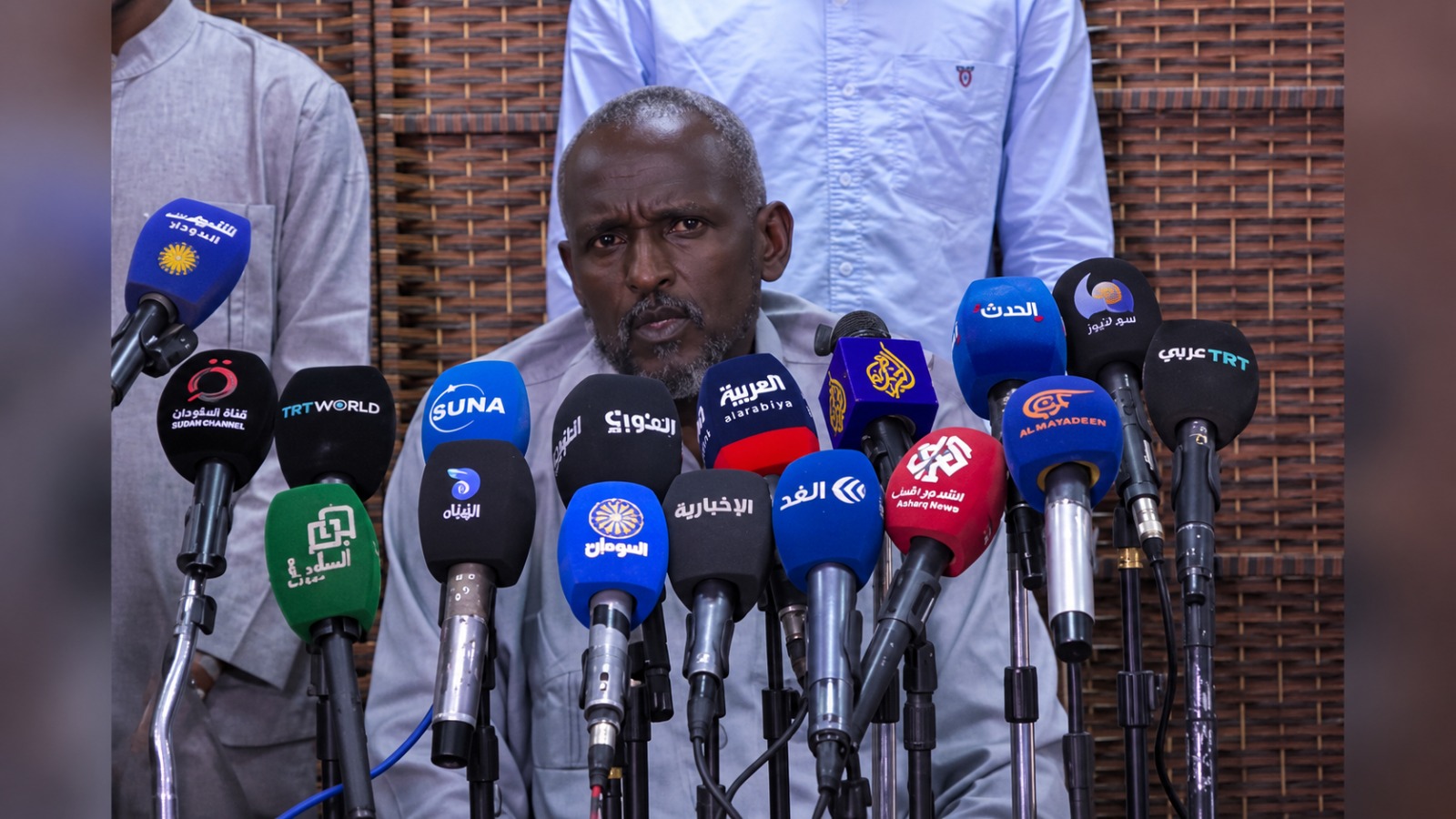
Senior RSF officers announce defection in Khartoum
A new group of military commanders from Sudan's Rapid Support Forces has announced its decision to abandon the paramilitary organization and join the Sudanese Armed Forces (SAF).
Images released on November 23, 2026, show a press conference at Khartoum International Airport, where commanders led by Major General Ammar Mohamed Zain Rabih declared their alignment with the national army.
The accompanying media graphic described eight field commanders as having defected.
A separate report published by Sudanese outlet Nabd Sudan stated that Rabih arrived at the airport aboard a private aircraft accompanied by eight RSF commanders and members.
The available accounts therefore differ slightly in their descriptions of the group's composition.
Former logistics commander joins the army
According to the Sudanese report, Rabih had served as deputy logistics and supply official within the RSF structure in Nyala, the capital of South Darfur state.
He was also identified as commander of Support Group 143, a position associated with the organization's military support arrangements.
His reported departure adds a senior logistics figure to the growing number of personnel publicly breaking with the RSF.
The decision is notable because logistics and supply officers play a role in sustaining military operations beyond direct battlefield command.
However, the extent of the personnel, equipment or supply assets that may have accompanied Rabih into Sudanese army ranks has not been independently established.
Defectors condemn violence against civilians
During the announcement, the defecting commanders criticized the RSF's conduct toward Sudanese civilians.
They described attacks on noncombatants, looting and massacres as principal reasons for rejecting the organization's activities.
The group accused the RSF of abandoning any meaningful national cause and focusing instead on plunder and attacks against unarmed civilians.
The commanders also apologized to Sudanese Armed Forces chief General Abdel Fattah al-Burhan, the military establishment and the Sudanese people.
Their statements reflect a broader pattern in which former RSF officers have publicly attributed their defections to disagreements over the group's leadership and conduct during the civil war.
Allegations of foreign support
Rabih also addressed the issue of external involvement in Sudan's war.
According to a November 23 report by Nabd Sudan, the former commander accused Israel, South Sudan and Chad of providing direct support to the RSF.
The report did not provide independent documentary evidence establishing those specific allegations.
The responses of the governments named in Rabih's remarks were not available in the initial reporting.
Claims concerning international assistance to Sudan's opposing military factions have remained a major diplomatic issue throughout the conflict, with several neighboring and regional countries facing competing accusations of involvement.
A succession of defections in November
The latest development follows several significant departures from the RSF's military ranks.
On November 8, Sudanese political and community representatives announced that more than 30 military and field commanders who had broken with the RSF had arrived in Khartoum.
Another senior departure was announced on November 19, when Mishal Abdelrahman, commander of the RSF's 27th and 28th groups, joined the Sudanese army alongside officers and soldiers under his command.
On November 22, Colonel Adam Mohamed Adam Abu Dagam, who commanded the RSF's Group 600 and headed its recruitment committee, also announced his defection.
Abu Dagam apologized to the Sudanese public and accused the paramilitary leadership of serious abuses, including killings, looting, sexual violence and the recruitment of foreign fighters.
Earlier defections included Mohammed Azraq al-Fanjari, whose departure was accompanied by statements concerning hundreds of officers and soldiers.
The growing number of such announcements has raised questions about the stability of the RSF's command and recruitment structures.
Military implications remain uncertain
The departure of officers responsible for field operations, recruitment and supply functions could affect the RSF's organizational cohesion.
Such personnel may possess operational knowledge of command procedures, logistics networks and the deployment of military units.
Nevertheless, publicly announced defections do not necessarily establish that every soldier previously under a commander's authority has also switched sides.
The number of troops and the quantity of equipment transferred during the latest defection remain unclear.
The RSF's overall military capabilities and the impact of these departures will depend on subsequent battlefield developments.
Khartoum airport announcement follows drone attacks
The announcement at Khartoum International Airport came amid renewed aerial attacks on the Sudanese capital.
On November 22, drone strikes hit residential areas in Khartoum and Omdurman, killing at least four civilians and injuring others, according to local reports.
A United Nations facility was also damaged during the strikes.
The Sudan Doctors Network subsequently reported that three UN employees had been injured in the attack on the facility.
Witnesses said Sudanese air-defense systems engaged drones near Khartoum airport and other locations around the capital.
The incidents underscored the continuing security threats facing Khartoum even as the Sudanese army seeks to consolidate its military position.
Sudan's conflict enters another phase
Sudan's war began in April 2023 following escalating tensions between the national army and the RSF over military integration and political power.
The conflict has devastated major urban areas, displaced millions of civilians and produced a prolonged humanitarian emergency.
Recent military operations in Kordofan and developments in Darfur and Blue Nile have intensified pressure on the opposing forces.
For the Sudanese army, the arrival of former RSF officers offers an opportunity to incorporate additional personnel and potentially valuable operational knowledge.
For the RSF, the continued departure of commanders raises questions about internal cohesion and the sustainability of its military structure.
The longer-term consequences of Rabih's defection will become clearer as information emerges about the group's strength, future assignments and involvement in ongoing operations.