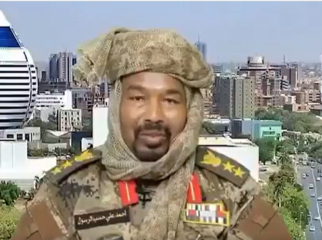
A senior field commander from Sudan's Rapid Support Forces (RSF) has publicly announced his departure from the paramilitary organization and his decision to join the Sudanese Armed Forces (SAF).
Colonel Ahmed Ali Hasab Al-Rasoul, also known as Rifa, made the announcement in a video statement circulated on Sunday, November 15, 2026.
Hasab Al-Rasoul identified himself as commander of the RSF's First Group in Saraf Omra, North Darfur state.
He accused the organization's leadership of abandoning national interests and allowing external actors to influence its military and political decisions.
Sudanese media outlets, including reports citing Al Arabiya and Al Hadath sources, said the commander had reached Khartoum and surrendered to the Sudanese army.
However, the number of fighters accompanying him and the status of his former unit remain unconfirmed.
Former command responsibilities in North Darfur
Hasab Al-Rasoul held a field command position associated with the RSF's First Group in the Saraf Omra area.
In his public statement, he described his responsibilities as including the regulation and collection of military vehicles and operations aimed at addressing security violations.
The role placed him within the organization's field-level security and operational structure in North Darfur.
The region remains one of the principal areas affected by Sudan's continuing armed conflict.
Military activities there are shaped by competing armed groups, local communities, transportation routes and control over strategic locations.
His departure attracted attention because he had reportedly exercised responsibilities extending beyond a single local military position.
Operational role in Kordofan also reported
According to Sudanese media reports citing military sources, Hasab Al-Rasoul had also supervised RSF operations in parts of the Kordofan region.
His reported areas of responsibility included Kazqil, Abu Sunun and Hammadi.
The locations have featured in fighting between the Sudanese army and the RSF during the continuing conflict.
Kordofan is strategically important because its roads and supply corridors connect military positions across central and western Sudan.
A commander with experience in those areas could possess knowledge of local routes, military positions and operational procedures.
Nevertheless, there is no verified evidence that Hasab Al-Rasoul's defection has immediately changed territorial control or resulted in the transfer of a specific RSF military position to the army.
The significance of the reported departure will depend in part on whether personnel or equipment followed him.
Dagalo brothers accused of serving outside interests
Hasab Al-Rasoul directed some of his strongest criticism at RSF commander Mohamed Hamdan Dagalo, widely known as Hemedti, and his brother Abdel Rahim Hamdan Dagalo.
Abdel Rahim serves as the RSF's deputy commander.
The defecting officer accused the two men of acting on behalf of external interests rather than protecting Sudan's sovereignty and national institutions.
He described the organization as lacking a genuine national cause and argued that its leadership was participating in a foreign-driven project.
The commander further alleged that the war had become a means of weakening Sudan's institutions and harming its population.
His statements resembled accusations made by several other officers who have announced their departures from the RSF during 2026.
However, the existence and precise nature of the alleged foreign plan have not been independently established through evidence presented in his announcement.
United Arab Emirates named in the allegations
Hasab Al-Rasoul also accused the United Arab Emirates of financing and directing the war in Sudan.
He alleged that foreign fighters had been brought into the country from neighboring states and other locations to support the conflict.
According to his statement, these activities contributed to the destruction of Sudanese institutions and the continuation of fighting.
Allegations concerning UAE support for the RSF have been raised repeatedly by the Sudanese government and international organizations.
In May 2026, Human Rights Watch published an investigation concerning the deployment of Colombian military personnel through a company based in Abu Dhabi.
International investigations have also examined networks allegedly involved in providing equipment, training, logistical assistance and foreign personnel to armed groups in Sudan.
The UAE has consistently denied providing military or logistical support to the RSF and has rejected accusations of involvement in the conflict.
The former commander's claims therefore form part of a wider dispute involving Sudanese authorities, the RSF, the UAE and international investigations.
Allegations of favoritism and discrimination
The commander said internal disagreements had contributed to his decision to leave the RSF.
He accused the organization's leadership of lacking a unified command structure and allowing favoritism, tribalism and racism to influence military affairs.
Hasab Al-Rasoul argued that the leadership's internal practices had undermined trust among fighters and officers.
He also referred to civilian killings, looting and destruction of public infrastructure during the war.
The former commander said the RSF's conduct had caused severe damage to Sudan and its population.
His remarks added to continuing criticism of the organization's internal leadership and command arrangements.
However, the allegations in his video do not independently establish responsibility for specific crimes or the conduct of every RSF unit.
Commander urges fighters to accept amnesty
Hasab Al-Rasoul called on officers, noncommissioned officers and soldiers still serving with the RSF to abandon the organization.
He urged them to take advantage of the general amnesty announced by Sudanese military leader Abdel Fattah al-Burhan.
According to the defecting commander, RSF members who surrender should return to civilian life or join national institutions rather than continue fighting.
He also rejected reports suggesting that individuals who defect and surrender routinely face harassment or restrictions.
Those assurances reflect Hasab Al-Rasoul's own account and do not independently establish the circumstances of every surrender or the legal status of former combatants.
Questions concerning possible war crimes and serious human rights violations remain subject to separate legal and investigative processes.
A change of military allegiance does not itself remove individual responsibility for unlawful acts.
Earlier commander criticized RSF leadership
The latest announcement follows a public defection by senior RSF commander Siddiq Abdelrahman Ander in late October.
In a video released on October 30, Ander accused Hemedti's family of controlling finances, weapons, troop movements and military promotions.
He alleged that dissenting officers faced threats, punishment or exclusion from command structures.
Ander's departure received international attention because of his senior position and his accusations against the RSF's internal leadership.
Hasab Al-Rasoul's November 15 remarks echoed some of those grievances.
Both former commanders criticized the influence of the Dagalo family and questioned the purpose of the continuing conflict.
However, their statements do not establish that the entire RSF command structure has collapsed or that all remaining officers share the same concerns.
Months of reported defections
A series of commanders and armed groups announced departures from the RSF earlier in 2026.
Major General Al-Nour Ahmed Adam, known as Al-Nour Al-Qubba, joined the Sudanese army in April.
Brigadier Ali Rizqallah, known as Al-Savanna, announced his defection in May.
In August, Sudanese authorities reported that 21 commanders and 270 fighters had surrendered with 37 military vehicles.
Later that month, another group comprising four commanders and 318 fighters reportedly joined the army with 50 vehicles.
On August 31, approximately 200 fighters led by former RSF intelligence commander Abubakr Hamouda Dahloub arrived in Omdurman, according to Sudanese state media.
Additional defections were reported in September and October, including those involving Al-Tayeb Al-Wahidu and Mohammed Azraq Al-Fanjari.
The announcements indicate a continuing series of departures at different levels of the RSF's military organization.
However, not all published troop and equipment figures have been independently verified.
Further announcements in November
The Sudanese army reported another defection on November 2, when a group of RSF members surrendered to its 4th Infantry Division in Damazin, Blue Nile state.
The group was reportedly led by Jado Mohammed Hamed Shawqar.
On November 13, Brigadier General Hamdan Osman Mohamed, identified as commander of the RSF's Group 45 Protection Units, also announced that he was joining the army.
His statement included accusations against the Dagalo family and an apology to Sudanese civilians for the suffering caused by the conflict.
Two days later, Hasab Al-Rasoul announced his own decision to leave the RSF.
The succession of public statements has increased attention to disagreements within the organization and the political alliances surrounding the war.
However, there is no confirmation that the recent defections were coordinated as part of a single military operation.
Questions remain about the scale of the latest defection
Sudanese media reported that Hasab Al-Rasoul had arrived in Khartoum and surrendered to army authorities.
Nevertheless, publicly available reporting has not established how many soldiers, military vehicles or weapons accompanied him.
Some local reports claimed that thousands of fighters had defected alongside the commander, but the figures have not been corroborated by reliable independent evidence.
The RSF had not issued a verified response to his announcement in the reporting reviewed.
The military consequences of the latest development therefore remain uncertain.
Sudan's army and the RSF continue to fight across Darfur and Kordofan, while the wider conflict continues to affect millions of civilians.
Although individual defections can influence military networks and local alliances, assessing their operational impact requires confirmation of troop movements, equipment transfers and changes in territorial control.
For now, the confirmed public development is that Ahmed Ali Hasab Al-Rasoul announced his departure from the RSF and declared allegiance to the Sudanese army on November 15, adding another senior field commander to the list of reported defections in 2026.