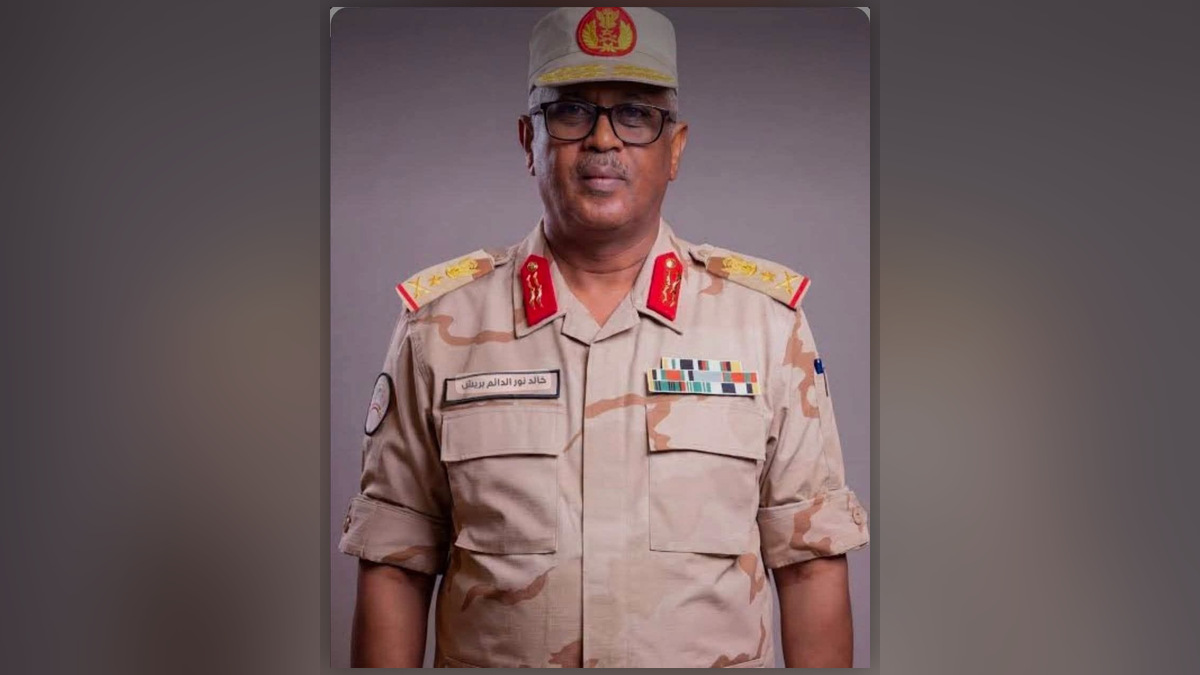
A reported defection involving Lieutenant General Khalid Nour al-Daim Buraish has drawn attention to the leadership structure of Sudan’s Rapid Support Forces and the continuing movement of military personnel between the country’s rival armed formations.
According to the latest information circulating about the Sudanese officer, Buraish has decided to leave the RSF and align himself with the Sudanese Armed Forces.
His military background makes the reported development noteworthy because he previously served in the regular Sudanese army before joining the RSF during its early organizational period.
Buraish subsequently held administrative and military responsibilities within the paramilitary group, including a documented position overseeing its Requirements Department.
However, as of November 10, 2026, the reported defection has not been independently confirmed through a formal Sudanese Armed Forces announcement or a fully authenticated public statement from Buraish.
The number of personnel, if any, accompanying him and the circumstances of his reported transition remain unclear.
Who is Lieutenant General Khalid Nour al-Daim Buraish?
Khalid Nour al-Daim Omar, widely known as Khalid Buraish, originates from the Jalas area of Merowe in Sudan’s Northern State.
He graduated from the 37th class of Sudan’s Military College and subsequently pursued a career in the Sudanese Armed Forces.
Biographical information published by Sudanese media in January 2024 identifies several military institutions and operational departments in which he served.
These included the Bahr el-Ghazal Military Area, the Transport and Repair Department, the Administrative Affairs Institute, the Military Operations Department and the Border Guard Forces.
He also reportedly served as office director to the Deputy Chief of Staff for Operations.
His military education included training at the Command and Staff College and the Nimeiri Military Academy.
Buraish also attended advanced administrative training in Egypt and an advanced mobilization course in Jordan.
This background placed him among military officers with experience in operational planning, personnel administration and institutional coordination.
A senior officer involved in the RSF’s early development
Buraish joined the Rapid Support Forces in 2013, according to Sudanese biographical reports.
The year marked an important period in the development of the RSF as an organized paramilitary force.
Following his transfer from the regular army, Buraish became involved in the military and administrative activities of the expanding organization.
His experience in army operations and administrative institutions provided a background for his subsequent responsibilities.
Reports concerning his career describe his involvement in organizational structures, military administration and activities related to Sudan’s western border regions.
However, the complete scope of his authority over particular field operations or security files has not been independently established.
His documented senior position within the organization nevertheless indicates that he operated beyond the level of an ordinary field commander.
RSF records confirm senior administrative role
One of the clearest documented records of Buraish’s position dates to December 6, 2023.
In an official announcement, the Rapid Support Forces identified Major General Khalid Nour al-Daim Buraish as head of its Requirements Department.
The announcement described a visit by an RSF leadership delegation to units in El Fasher, the capital of North Darfur.
Buraish headed the delegation, accompanied by Major General Osman Mohamed Hamid, who was identified as head of the RSF Operations Department.
The officers addressed RSF personnel and received briefings concerning military readiness and activities in the area.
The visit provided direct documentary evidence of Buraish’s position within the organization’s senior administrative leadership.
The Requirements Department’s responsibilities are associated with the management of military needs and support arrangements.
Buraish’s role therefore suggests familiarity with elements of the RSF’s administrative and logistical systems.
However, no verified information currently establishes that he personally directed particular weapons transfers or specific military operations.
Buraish accompanied Hemedti during Uganda talks
Buraish also appeared in media reporting concerning international diplomatic engagement by RSF leader Mohamed Hamdan Dagalo, commonly known as Hemedti.
On January 18, 2024, Dagalo met European Union Special Representative for the Horn of Africa Annette Weber in Kampala, Uganda.
Sudanese media reported that Buraish accompanied the RSF commander during the diplomatic engagement.
The discussions addressed Sudan’s ongoing conflict and efforts to explore political solutions.
His presence alongside Dagalo demonstrated his participation in engagements involving the organization’s senior leadership.
The Kampala appearance is particularly relevant to his reported departure because it establishes that his activities extended beyond internal military administration.
Buraish had also participated in high-level interactions linked to the RSF leadership.
Promoted by Hemedti in June 2026
Another important development in Buraish’s career occurred on June 11, 2026.
According to a report published by the Tasis news platform, Mohamed Hamdan Dagalo issued a decision promoting Buraish from major general to lieutenant general.
The decision was presented as part of changes within the military leadership and organizational structure of the RSF-aligned administration.
No detailed explanation was provided concerning any new position or responsibilities assigned to Buraish following his promotion.
The announcement nevertheless confirmed that he had received one of the organization’s senior military ranks only months before the latest reported defection.
A separate promotion involving RSF operations chief Osman Mohamed Hamid was also reported in June.
If Buraish’s departure is formally confirmed, the timing will raise questions about changes within the senior leadership structure of the paramilitary organization.
At present, however, the motivations behind the reported move are unknown.
No official details on his integration into the army
The reported decision to join the Sudanese Armed Forces has not yet been accompanied by confirmation of Buraish’s future position.
It remains unclear whether he has physically entered SAF-controlled territory, completed administrative procedures or received an official military assignment.
His previous rank within the RSF does not automatically establish the rank he would hold in the regular army.
Sudan’s military has previously introduced procedures for processing personnel who defect from the RSF.
In August 2026, the army announced that it had completed the first phase of regularizing the status of several groups of former RSF members.
The procedures involved administrative reviews, military assignments and security screening.
Whether Buraish will undergo similar procedures has not been disclosed.
There is also no verified information indicating that he arrived with troops, combat vehicles or military documents.
A series of defections throughout 2026
The reported development follows a series of departures from the Rapid Support Forces during 2026.
In April, Major General Al-Nour Ahmed Adam, known as Al-Nour Al-Qubba, defected from the RSF and joined the Sudanese army.
In May, senior field commander Ali Rizqallah Al-Safana was also reported to have abandoned the paramilitary organization.
On August 13, Sudanese authorities announced that 21 RSF commanders and 270 fighters had joined the army, bringing 37 military vehicles.
Another group of 318 personnel, including four commanders, reportedly surrendered later that month with approximately 50 combat vehicles.
Further defections were announced in October.
On October 24, a senior RSF commander in Nyala, South Darfur, identified as Lieutenant Colonel Jiddo Mohamed Adam, announced his departure alongside six other officers.
On November 2, Sudan’s Fourth Infantry Division reported that another group of RSF personnel had surrendered in Damazin, the capital of Blue Nile State.
These cases demonstrate a continuing pattern of defections involving military commanders and groups of fighters.
However, the precise impact of these departures on the RSF’s overall operational strength remains difficult to determine.
More than 30 commanders reportedly arrived in Khartoum
Further developments emerged on November 8, when political, government and community figures from Darfur and Kordofan reported that more than 30 former RSF military and field commanders had recently arrived in Khartoum.
According to Al Jazeera, the information was disclosed during a meeting in Omdurman focused on the implications of defections for Sudan’s ongoing conflict.
Participants said the identities of the newly arrived commanders would be announced in the coming days.
Among those attending the discussions was Lieutenant Colonel Mohamed Al-Azraq Al-Fanjari, a former RSF special operations commander who had previously announced his departure.
Speakers at the meeting described ongoing contacts with additional RSF personnel considering leaving the organization.
However, there is no confirmed evidence linking Buraish to the group of commanders mentioned during the Omdurman meeting.
His reported defection must therefore be treated as a separate development until further information becomes available.
Potential significance for the RSF’s command structure
Buraish’s military background may be particularly relevant because of his experience in both the Sudanese Armed Forces and the Rapid Support Forces.
His previous responsibilities in the RSF Requirements Department suggest that he may possess knowledge of administrative procedures, organizational relationships and military support arrangements.
Such experience could become relevant if he enters formal cooperation with Sudanese military authorities.
However, there is no independently confirmed evidence that Buraish has transferred intelligence materials, operational documents or information about RSF military movements to the army.
His reported departure also cannot yet be linked to measurable changes on the battlefield.
The potential institutional significance of a senior officer changing sides must therefore be distinguished from any unverified claim of an immediate military advantage.
The reasons behind his reported decision remain equally uncertain.
No verified public statement has established whether the move resulted from leadership disagreements, concerns about the conflict, personal considerations or another cause.
Sudan’s military landscape continues to shift
Sudan’s war between the regular army and the Rapid Support Forces began on April 15, 2023, following escalating tensions between the rival military leaderships.
The conflict has since expanded across multiple regions, including Darfur, Kordofan and Blue Nile, causing mass displacement and a severe humanitarian crisis.
Alongside military confrontations, the war has produced shifting alliances and repeated defections involving armed groups and individual commanders.
Throughout 2026, the Sudanese army has publicly encouraged RSF members to abandon the paramilitary organization and enter procedures for joining the regular armed forces.
The reported departure of Khalid Nour al-Daim Buraish is being discussed against this wider background.
His documented career within the RSF, including his administrative responsibilities and recent promotion, gives the allegation particular significance.
Nevertheless, a full assessment will depend on confirmation of his personal announcement, the Sudanese army’s response and any subsequent details concerning his military status.
Until those developments are verified, the case remains a reported senior-level defection rather than a fully documented transfer of command.