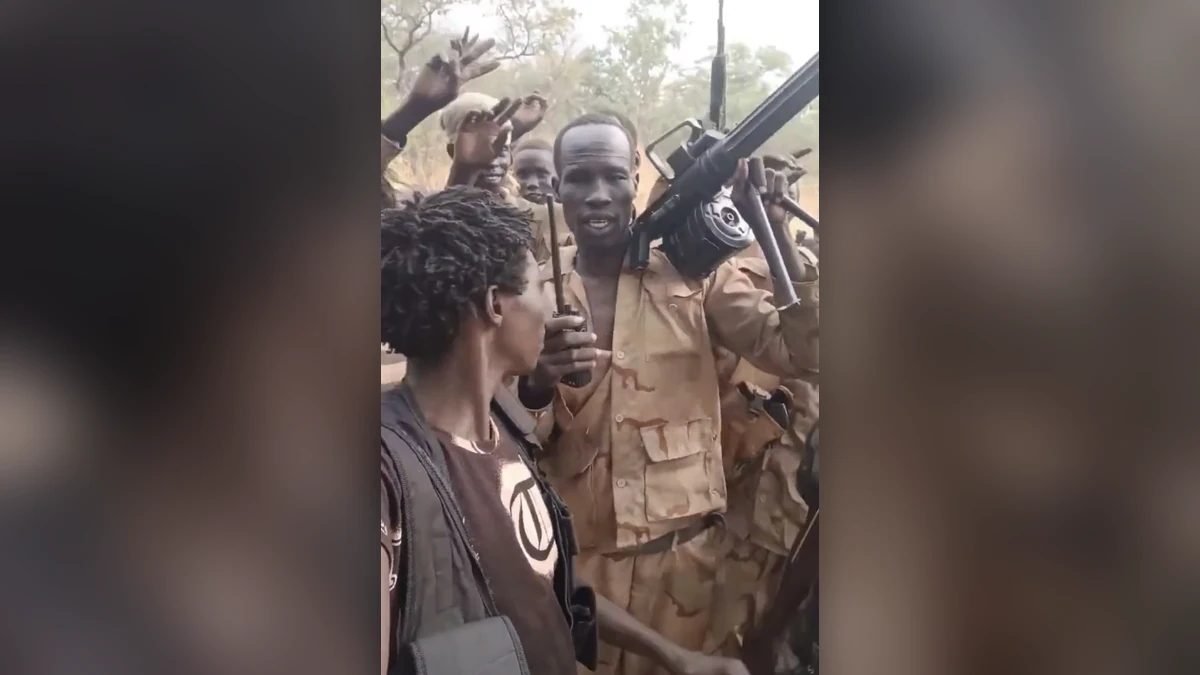
Reports concerning South Sudanese fighters operating alongside Sudan’s Rapid Support Forces (RSF) have emerged as fighting intensifies across the Blue Nile region in southeastern Sudan.
Sudanese news outlets reported on November 20, 2026, that an artillery unit described as comprising fighters from South Sudan had been targeted by Sudanese Armed Forces (SAF) drones near Bakori.
According to reports published by Shahid Ayan and Alwan, the unit was moving to reinforce RSF positions following recent clashes involving Sudan’s Fourth Infantry Division and allied military formations.
The reports described the targeted personnel as foreign fighters supporting the paramilitary organization.
However, independently verified details concerning the identities, numbers and casualties of the personnel involved have not been released.
Reports highlight South Sudanese involvement
The reported presence of South Sudanese fighters adds to longstanding concerns about foreign participation in Sudan’s civil war.
The Blue Nile region shares borders with South Sudan and Ethiopia, making it strategically important for military movements, supply routes and cross-border security.
Sudanese military-aligned sources have repeatedly described armed elements entering the region through neighbouring countries to support the RSF and its allies.
On November 8, Sudanese news outlet Al-Tabia published reports from field sources concerning two units of South Sudanese fighters allegedly targeted by Sudanese army drones near Bakori.
The latest reports from the same area have renewed attention to the role of foreign fighters on the Blue Nile front.
The exact command arrangements, nationalities and organizational affiliations of the individuals described in these accounts remain unclear.
Investigation traces RSF movements through South Sudan
An open-source investigation published by Eekad on September 29, 2026, documented travel routes used by individuals associated with the RSF through South Sudan.
The investigation examined social media videos, satellite imagery and flight-tracking records to reconstruct movements between areas under RSF influence and South Sudanese transport hubs.
Researchers identified routes connecting Sudanese territory with Aweil and Juba, including movements through smaller border crossings and regional airports.
One individual appearing among fighters on the Blue Nile front in early April 2026 was subsequently linked through social media posts to movements involving Renk, Juba and Aweil.
The investigation also examined aircraft movements and the possible use of South Sudanese airports for transporting RSF personnel between operational areas.
The findings provide evidence of cross-border movement involving RSF-associated individuals. They do not, by themselves, establish that those individuals were South Sudanese nationals or that the South Sudanese government directly organized the movements.
RSF and SPLM-N expand operations in Blue Nile
The latest foreign-fighter reports have emerged during renewed military activity involving the RSF and the Sudan People’s Liberation Movement-North (SPLM-N), led by Abdelaziz al-Hilu.
On November 19, the RSF-led Founding Sudan Alliance, known as Tasis, announced that its forces had captured the administrative headquarters of Bau locality in the Blue Nile region.
According to Sudan Tribune, government-aligned forces withdrew toward Ed Damazin before RSF and allied fighters entered the area.
The following day, the alliance announced further advances in Geissan locality, naming Khor Mak, Al-Madina 10, Al-Madina 11, Singa Nabag and Al-Taqa as areas brought under its control.
Meanwhile, the Sudanese army announced that its Fourth Infantry Division had ambushed RSF forces in Derang, destroying 28 military vehicles and capturing another 18.
The RSF and its allies published competing accounts of the fighting, claiming advances around Derang and Al-Madina 12.
The conflicting battlefield statements highlight the rapidly changing military situation across Blue Nile.
UAE support allegations remain central to conflict
The reported activities of foreign fighters have also renewed attention to allegations concerning the United Arab Emirates’ involvement in Sudan’s war.
Sudanese authorities have accused Abu Dhabi of providing military, financial and logistical assistance to the RSF.
In a November 16 report, the Associated Press quoted conflict analysts who described the UAE as one of the RSF’s principal external backers.
The report also examined military and logistical movements involving RSF-linked forces near Sudan’s border with Ethiopia.
The UAE has repeatedly rejected accusations that it provides military assistance to the RSF, maintaining that its role in Sudan focuses on humanitarian support and diplomatic engagement.
The emerging reports from Blue Nile underscore the wider regional dimensions of the conflict, including the movement of armed personnel and equipment across international borders.
Fighting triggers additional civilian displacement
The escalation has also worsened humanitarian conditions across the Blue Nile region.
According to a November 20 report by Sudan Tribune, continued fighting in Bau, Geissan and Wad al-Mahi has forced families to flee their communities.
Local humanitarian sources reported that 1,409 families had been displaced along several routes during the latest movements.
The figures included approximately 500 families from Bau, 600 from Wad al-Mahi and 309 from areas around Geissan.
Displaced communities face shortages of shelter, food, healthcare and other essential services.
The reported presence of foreign fighters, combined with competing territorial claims and growing displacement, illustrates the increasingly regional nature of Sudan’s conflict.
As military operations continue, Blue Nile remains a major battleground involving government forces, the RSF and allied armed organizations, with consequences extending toward Sudan’s borders with South Sudan and Ethiopia.