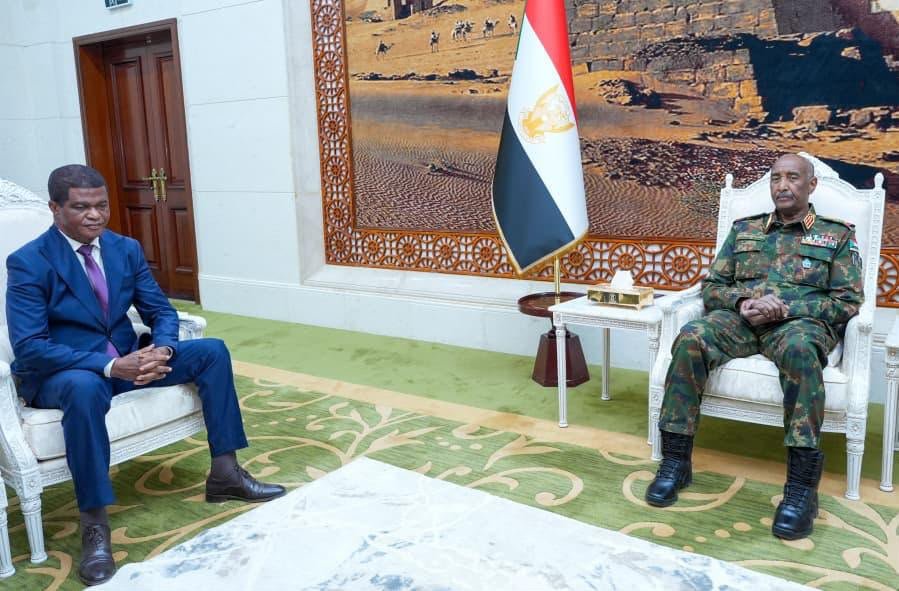
Sudan and the Democratic Republic of Congo have held high-level security talks aimed at strengthening intelligence cooperation and addressing threats affecting stability across Africa.
The meeting took place at the Republican Palace in Khartoum on Monday, November 9, 2026.
General Abdel Fattah al-Burhan, Chairman of Sudan's Transitional Sovereignty Council and Commander-in-Chief of the Sudanese Armed Forces, received Justin Inzun Kakiak, Director-General of the Democratic Republic of Congo's National Intelligence Agency.
Sudan's General Intelligence Service Director, General Ahmed Ibrahim Mufaddal, also participated in the discussions.
According to the Sudanese Sovereignty Council, the meeting reviewed bilateral relations and examined opportunities to expand cooperation in different fields.
Security coordination was a central topic, with both sides emphasizing the need for joint efforts to address regional threats and support peace and stability across the African continent.
Al-Burhan Receives Congolese Intelligence Chief in Khartoum
The discussions between Al-Burhan and Kakiak reflected continuing diplomatic engagement between Sudan and the Democratic Republic of Congo.
The two sides reviewed the development of bilateral relations and explored possible areas for further cooperation.
According to the official statement, particular attention was given to security challenges affecting the wider region.
The officials emphasized the importance of coordinating their efforts to confront security threats and contribute to continental peace.
The meeting also addressed the broader prospects for developing relations between the two countries.
However, no new intelligence-sharing treaty, joint military operation or specific security agreement was announced following the discussions.
Sudan's Intelligence Director Takes Part in Talks
General Ahmed Ibrahim Mufaddal, head of Sudan's General Intelligence Service, attended the meeting alongside the Sudanese military leader.
His participation highlighted the institutional security dimension of the visit.
The Democratic Republic of Congo was represented by Justin Inzun Kakiak, who heads its National Intelligence Agency, commonly known by its French abbreviation ANR.
Kakiak was appointed to the position in May 2024 by President Félix Tshisekedi, having previously served as the agency's director between 2019 and 2021.
He also served as the Democratic Republic of Congo's ambassador to the neighbouring Republic of Congo.
The ANR is responsible for national intelligence activities relating to internal and external security.
The presence of the two intelligence chiefs provided an opportunity for direct discussions between the countries' security institutions.
Nevertheless, the official readout did not specify what information-sharing procedures or future operational arrangements might result from the meeting.
Congolese President Sends Message to Sudan
During the discussions, Kakiak conveyed greetings from Democratic Republic of Congo President Félix-Antoine Tshisekedi Tshilombo to Al-Burhan.
He expressed the Congolese leader's wishes for Al-Burhan's continued health and wellbeing.
Kakiak also conveyed hopes for lasting security, stability and development in Sudan.
The diplomatic message demonstrated Kinshasa's continued engagement with Sudanese authorities during a period of considerable political and security challenges.
Both countries have faced prolonged armed conflicts that have affected civilians, state institutions and regional stability.
Diplomatic Relations Strengthened in August
The meeting followed an earlier diplomatic engagement involving the appointment of a new Congolese ambassador to Sudan.
On August 13, 2026, Ambassador Wabenga Kalebo Théo presented his credentials to Al-Burhan at the Republican Palace in Khartoum.
The Democratic Republic of Congo's official news agency reported that the ceremony reaffirmed both governments' intention to strengthen bilateral relations.
The ambassador conveyed greetings from President Tshisekedi and expressed a commitment to developing cooperation between the two countries.
The presentation of credentials was among the diplomatic ceremonies held at the Republican Palace after Sudanese authorities resumed major government activities in the capital.
The November intelligence meeting builds on those diplomatic contacts by bringing the countries' security institutions into direct discussions.
Sudan Expands Security Contacts With African States
The visit was not an isolated diplomatic event.
On November 1, Al-Burhan met Gérard Ongambi Ongaye, Director of Gabon's Intelligence Service, to discuss bilateral relations and regional security coordination.
That meeting was also attended by Sudan's intelligence chief Ahmed Ibrahim Mufaddal.
The officials reviewed ways to strengthen bilateral cooperation and coordinate efforts to address security challenges.
The two visits, occurring within just over one week, illustrate Sudan's ongoing engagement with intelligence officials from different African countries.
However, no announcement established that the Gabon and DR Congo meetings formed part of a newly created joint security mechanism.
African Intelligence Cooperation Remains a Priority
Sudan has also held discussions with continental intelligence and security institutions.
On July 16, Al-Burhan received a delegation from the Committee of Intelligence and Security Services of Africa (CISSA).
The meeting included General Ahmed Ibrahim Mufaddal and focused on developments in Sudan and ways to strengthen cooperation among African security agencies.
According to Sudanese official reporting, the delegation expressed support for efforts to restore security and stability and enable state institutions to resume their activities in Khartoum.
The delegation also expressed solidarity with Sudan over its conflict with the Rapid Support Forces.
The discussions highlighted the importance of continental security cooperation and closer coordination between African intelligence services.
Sudan's recent meetings with Gabon and the Democratic Republic of Congo form part of this broader pattern of security diplomacy.
Sudan's War Shapes Its Regional Security Agenda
Sudan has been engulfed in armed conflict since April 2023, when fighting erupted between the Sudanese Armed Forces and the Rapid Support Forces led by Mohamed Hamdan Dagalo, widely known as Hemeti.
The conflict has devastated large areas of the country, displaced millions of civilians and severely damaged essential infrastructure.
The Sudanese government accuses the RSF of threatening national sovereignty and territorial integrity.
Military operations in Darfur and Kordofan remain central to the country's security crisis.
Khartoum has also repeatedly raised allegations of foreign military and logistical support for the RSF.
International investigations have identified evidence concerning supply networks linked to the United Arab Emirates, although the UAE denies providing military support to the militia.
The official statement on Al-Burhan's meeting with Kakiak did not specifically mention the RSF, the UAE or foreign arms networks.
Those issues nevertheless form part of the wider security environment in which Sudan is pursuing stronger international and African relationships.
El Fasher Atrocities Remain on the African Agenda
The humanitarian consequences of the conflict have become a major subject of international diplomatic engagement.
In October 2025, RSF forces captured El Fasher, the capital of North Darfur, following a prolonged siege.
United Nations investigations subsequently documented widespread abuses, including unlawful killings, torture, sexual violence and ethnically targeted attacks against civilians.
On November 2, 2026, the African Union Peace and Security Council and the United Nations Security Council issued a joint statement condemning atrocities committed following the fall of El Fasher.
The two bodies called for independent investigations and accountability for those responsible.
They also rejected attempts to establish a parallel governing authority in territory controlled by the RSF.
Their statement reaffirmed support for Sudan's sovereignty, independence, unity and territorial integrity.
The position reflected growing international concern over the risk of prolonged fragmentation resulting from Sudan's conflict.
DR Congo Faces Its Own Armed Security Challenges
The Democratic Republic of Congo is also confronting serious security threats, particularly in the eastern provinces.
The conflict involving the March 23 Movement (M23) and other armed groups has caused significant displacement and humanitarian suffering.
Congolese authorities have repeatedly raised concerns about external interference and support for armed groups operating within the country's borders.
United Nations experts have documented violations of peace agreements and evidence of support networks connected to the conflict.
Rwanda has rejected allegations concerning its support for M23.
The security challenges faced by Sudan and the Democratic Republic of Congo are geographically distinct but share wider concerns about armed groups, civilian protection and the effects of conflict on regional stability.
However, the November 9 meeting did not publicly identify M23 or any specific operation in eastern Congo as a subject of discussion.
African Union and UN Address Both Conflicts
The security situations in Sudan and the Democratic Republic of Congo were among the issues discussed at the November 2 joint consultative meeting between the African Union Peace and Security Council and the UN Security Council.
Regarding the Democratic Republic of Congo, the two bodies expressed concern over insecurity, humanitarian conditions and abuses committed by armed groups.
They reaffirmed support for the country's sovereignty, unity and territorial integrity.
On Sudan, the participants condemned attacks against civilians and humanitarian workers, called for a cessation of hostilities and supported an inclusive political process.
The joint declaration emphasized that lasting peace in Sudan requires a political settlement led and owned by the Sudanese people.
The discussions illustrated how both crises feature prominently in African and international peace and security diplomacy.
Regional Security Cooperation Includes Arms and Mercenary Concerns
Sudan has also participated in African diplomatic initiatives addressing cross-border arms flows and foreign fighters.
In May 2025, a summit involving signatories to the Peace, Security and Cooperation Framework for the Democratic Republic of Congo and the region was held in Entebbe, Uganda.
The summit included a special declaration expressing solidarity with Sudan.
The statement supported Sudan's sovereignty and called for stronger cooperation to secure borders, prevent the movement of weapons and mercenaries, and discourage support for armed militias.
Sudan participated through a delegation led by Deputy Sovereignty Council Chairman Malik Agar.
The summit demonstrated the relevance of broader African security frameworks to Sudan's conflict.
However, no new agreement concerning arms flows or mercenary networks was announced at the November 9 meeting between Al-Burhan and Kakiak.
Sudan and DR Congo Seek Stronger Security Ties
The meeting between Abdel Fattah al-Burhan and Justin Inzun Kakiak marked another step in diplomatic engagement between Sudan and the Democratic Republic of Congo.
Both sides emphasized bilateral relations, security cooperation and the need to coordinate responses to regional threats.
The participation of Sudan's intelligence chief highlighted the institutional importance of the discussions.
The visit also followed the recent appointment of a Congolese ambassador to Sudan and a series of Sudanese meetings with African intelligence officials.
With conflict continuing in Sudan and armed insecurity affecting parts of the Democratic Republic of Congo, regional dialogue remains an important component of the two countries' foreign and security policies.
No new military support agreement, joint intelligence operation or formal security protocol was publicly announced after the meeting.
Further developments will determine whether the discussions produce specific mechanisms for cooperation between the two countries' intelligence and security institutions.