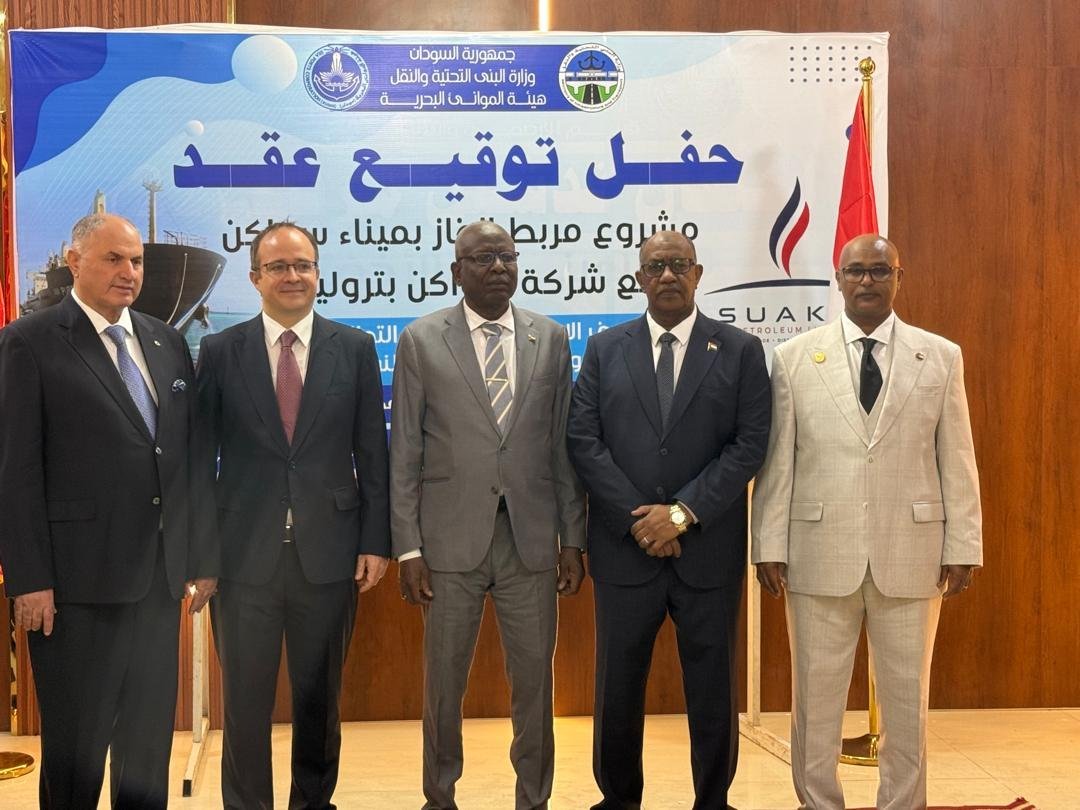
Sudan has signed a major energy infrastructure agreement with a Turkish-Sudanese joint venture to develop a specialized liquefied-gas handling and storage facility at the historic Red Sea port of Suakin.
The contract was signed on Sunday, November 8, 2026, during an official ceremony in Port Sudan.
The agreement brings together Sudan's Sea Ports Corporation and Suakin Petroleum, an investment partnership involving Türkiye's Argaz and Sudan's Petrodar.
The proposed development will include a dedicated marine berth for gas carriers, storage installations and a transport network designed to distribute supplies across Sudan.
Sudanese authorities say the project will contribute to the country's energy security, strengthen strategic reserves and create opportunities for wider regional trade.
The agreement also represents a new stage in economic cooperation between Ankara and Sudan at a time when the country is seeking investment to rebuild infrastructure damaged or disrupted by years of conflict.
Turkish Argaz and Sudanese Petrodar Form Investment Partnership
Suakin Petroleum will implement the project through a joint venture involving Turkish company Argaz and Sudanese company Petrodar.
Argaz is an established Turkish energy company specializing in liquefied petroleum gas, including imports, storage, filling, distribution and associated infrastructure services.
Founded in 1990, the company operates facilities and distribution networks across Türkiye.
Its activities also cover gas storage tank manufacturing, engineering services, technical equipment procurement and support for energy infrastructure development.
The Suakin investment is intended to combine Turkish technical experience with Sudanese investment and logistics capabilities.
However, the ownership percentages of the two partner companies and their respective financial commitments have not been publicly disclosed.
The total value of the contract also remains undisclosed.
New Marine Berth to Accommodate 5,000-Tonne Gas Carriers
Sea Ports Corporation Director General Jelani Mohamed Jelani announced the main technical specifications of the proposed terminal.
The project will include a dedicated marine berth with a water depth of 12 metres.
The facility is designed to accommodate gas carriers with a reported capacity of up to 5,000 tonnes.
Specialized equipment will be installed for the handling and transfer of liquefied gas between vessels and storage infrastructure.
A major storage installation is planned approximately 150 metres from the berth.
Earlier official announcements described the proposed storage capacity as 28,000 cubic metres.
Some reports published following the final signing instead referred to a capacity of 28,000 tonnes.
Because those figures use different measurement units, the final technical specification requires clarification.
The project is expected to incorporate appropriate safety and handling systems for the transfer and storage of liquefied gas.
Some reports describe the facility as an LNG terminal, while Argaz's established activities are in LPG. The exact gas product and associated technical specifications have not yet been independently established from the published contract documents.
Construction Expected to Take 24 Months
Sudanese officials said the implementation period for the project is expected to be 24 months.
During that period, the partners intend to construct the marine berth, storage facilities and associated distribution infrastructure.
However, the date for the commencement of physical construction has not been formally confirmed.
Jelani said the agreement followed approximately one year of negotiations involving several government institutions and technical bodies.
The negotiations covered the project's commercial, operational and legal arrangements.
Sudan's Ministry of Justice reviewed and authenticated the final contract to protect the rights of the parties involved.
The agreement marks the completion of the contract negotiation process rather than the completion of construction.
No operational opening date has yet been announced.
Project to Operate Under Build-Operate-Transfer Model
The investment will follow a build-operate-transfer, or BOT, structure.
Under this model, the project company arranges financing and constructs the facility before operating it for an agreed period.
At the end of the concession period, the infrastructure is transferred to the designated public authority under the conditions established in the contract.
The arrangement is designed to attract private-sector investment into public infrastructure while allowing the state to retain a long-term interest in the asset.
For Sudan, the model may provide access to investment capital at a time when public finances are under substantial pressure.
However, the duration of the operating concession, revenue-sharing arrangements and total project financing have not been disclosed.
The project's precise financial benefits to the government therefore remain to be determined.
Sudan Plans to Strengthen Strategic Gas Reserves
A central objective of the Suakin terminal is to improve Sudan's ability to maintain strategic reserves of liquefied gas.
Sudan's energy distribution network has faced significant disruption during the conflict that began in April 2023.
Damaged infrastructure, transport difficulties and interruptions to commercial activity have affected the movement of essential energy products.
The proposed terminal is intended to improve the capacity to receive imported gas and store supplies for subsequent distribution.
A larger storage network could help reduce the impact of delays in maritime deliveries and domestic transportation.
Sudanese officials view energy storage and port modernization as important components of the country's economic recovery.
Nevertheless, the effectiveness of the new facility will depend on reliable imports, distribution capacity and the security of inland transport routes.
Trucks and Railways to Distribute Gas Across Sudan
The development is intended to extend beyond the construction of a marine berth and storage tanks.
According to Sudan's Sea Ports Corporation, the project includes plans for an integrated transport and distribution system using road tankers and railway connections.
The infrastructure is expected to support the movement of gas from Suakin to different Sudanese states.
Authorities also intend to strengthen local technical capabilities through the manufacture and preparation of storage equipment within Sudan.
The project includes plans to transfer technical expertise to Sudanese personnel.
These provisions are intended to support domestic skills development and reduce long-term dependence on imported technical services.
The precise routes, distribution capacity and implementation schedule for the proposed transport network have not yet been announced.
Turkish Ambassador Signals Return of Investors
Türkiye's Ambassador to Sudan, Fahri Türker Oba, attended the signing ceremony and welcomed the agreement as an important development in bilateral relations.
Oba highlighted the longstanding relationship between Sudan and Türkiye and emphasized the potential for further economic cooperation.
He said Turkish businesspeople were preparing to resume or expand their investments in Sudan.
The ambassador described projects of this kind as important signals to companies evaluating opportunities in the Sudanese market.
Turkish commercial activities in Sudan have been affected by the conflict, which disrupted trade, investment and infrastructure operations.
The Suakin agreement demonstrates that Turkish private-sector companies continue to explore opportunities in the country's energy and logistics sectors.
However, no comprehensive timetable for the return of additional Turkish investors was announced.
Infrastructure Minister Highlights Economic Recovery
Sudan's Minister of Infrastructure and Transport, Saif Al-Nasr Al-Tijani Haroun, described the agreement as an important addition to the country's maritime infrastructure.
He emphasized the role of modern ports in supporting economic recovery and strengthening essential services.
Haroun said investment in energy infrastructure was important for the development of Sudan's economy.
The minister also highlighted the country's strategic position on the Red Sea and the opportunity to improve its role in regional trade.
He presented the project as an example of cooperation between state institutions and private investors.
Sudanese authorities expect the new terminal to support energy supplies and contribute to wider infrastructure development.
Red Sea State Governor Welcomes Investment
Red Sea State Governor Mustafa Mohamed Nour also attended the signing ceremony.
Nour described the development as an example of a partnership between public institutions and the investment sector.
He said the project could generate employment opportunities, stimulate commercial activity and contribute to local infrastructure development.
The governor expressed the state's readiness to facilitate implementation in accordance with Sudan's investment regulations.
He also voiced hopes that the terminal would encourage other investors to explore opportunities in Red Sea State.
The number of jobs expected to be created and the projected local economic impact have not yet been published.
Suakin Petroleum Chairman Outlines Regional Ambitions
Suakin Petroleum Chairman Mohamed Darwish Dabbagh described the agreement as an important step in Turkish-Sudanese economic cooperation.
He said the project was intended to strengthen Sudan's liquefied-gas supply infrastructure and support the country's energy requirements.
Dabbagh also emphasized the ambition to develop Suakin into a regional energy distribution center on the Red Sea.
The company intends to work with Sudanese port authorities to establish facilities capable of supporting both domestic requirements and future commercial opportunities.
He thanked the Sudanese institutions involved in preparing and finalizing the agreement.
Investment Proposal Dates Back to October 2025
The project has been under consideration for more than a year.
According to Sudan's Sea Ports Corporation, the investment proposal was initially submitted on October 5, 2025.
Government committees subsequently evaluated the proposal and prepared recommendations concerning its implementation.
On July 15, 2026, Sudanese port authorities signed a memorandum of understanding with Turkish company Argaz concerning the development of a specialized gas terminal at Suakin.
The initial announcement referred to a proposed storage capacity of 28,000 cubic metres.
At that stage, officials emphasized the need to expand Sudan's gas-handling infrastructure and reduce bottlenecks associated with imports and storage.
The memorandum of understanding was followed by further technical and legal negotiations.
The November 8 agreement establishes the contractual framework for advancing the investment.
Turkish Energy Minister Confirms Wider Sudan Talks
The signing took place shortly after Turkish Energy and Natural Resources Minister Alparslan Bayraktar discussed plans to expand cooperation with Sudan.
Speaking to international media representatives at the Istanbul Financial Center on November 6, Bayraktar said Türkiye was holding discussions with Sudanese officials on mining, oil, natural gas and electricity generation.
He also expressed expectations that Turkish companies would increase their activities in Sudan.
The remarks reflected Ankara's interest in expanding economic engagement across several energy-related sectors.
The Suakin terminal provides a concrete example of Turkish-Sudanese cooperation in energy infrastructure.
However, the agreement should not be interpreted as confirmation that all proposed mining, oil and electricity projects have already been finalized.
Suakin Could Become a Regional Energy Distribution Hub
Sudanese authorities hope the terminal will eventually serve markets beyond the country's borders.
Suakin's position on the Red Sea provides access to maritime transport routes connecting northeastern Africa with international shipping networks.
The port authority has identified potential opportunities to supply neighboring African countries and serve landlocked states through regional transport corridors.
The planned truck and railway distribution network could support these ambitions if completed and integrated into existing logistics systems.
However, no confirmed export contracts with individual neighboring countries have been announced.
The development of a regional energy hub will depend on the completion of the infrastructure, the availability of gas supplies and commercially viable distribution arrangements.
War Creates Challenges for Investment and Implementation
Sudan remains affected by the conflict between the Sudanese Armed Forces and the Rapid Support Forces, which began in April 2023.
The fighting has caused widespread displacement, economic disruption and severe damage to public and private infrastructure.
Energy, transport and industrial operations have been affected across different parts of the country.
Against this background, investments in ports and energy infrastructure have become important to government efforts to restore economic activity.
The Suakin project is intended to mobilize private investment and expand Sudan's capacity to handle and distribute essential energy supplies.
Nevertheless, financing conditions, security risks, supply-chain disruptions and implementation costs may affect the project's timetable.
The successful construction and operation of the terminal will depend on the availability of resources and compliance with the required technical and safety standards.
Türkiye–Sudan Energy Partnership Enters New Stage
The November 8 contract represents a significant development in Sudan's efforts to expand energy infrastructure through cooperation with Türkiye.
Suakin Petroleum, backed by Turkish company Argaz and Sudanese partner Petrodar, is expected to develop a dedicated marine berth, storage facilities and distribution infrastructure.
Sudanese officials have emphasized the importance of strategic gas reserves, port modernization and regional trading opportunities.
Türkiye's ambassador has highlighted the potential for additional Turkish investment as economic engagement between the two countries continues.
The next key developments will be the confirmation of the project's financing arrangements, the start of construction and clarification of its final technical specifications.
For Sudan, the project offers a potential route toward stronger gas supply infrastructure and improved logistics.
For Türkiye, it represents an opportunity to expand private-sector participation in energy infrastructure and economic cooperation along Africa's Red Sea coast.