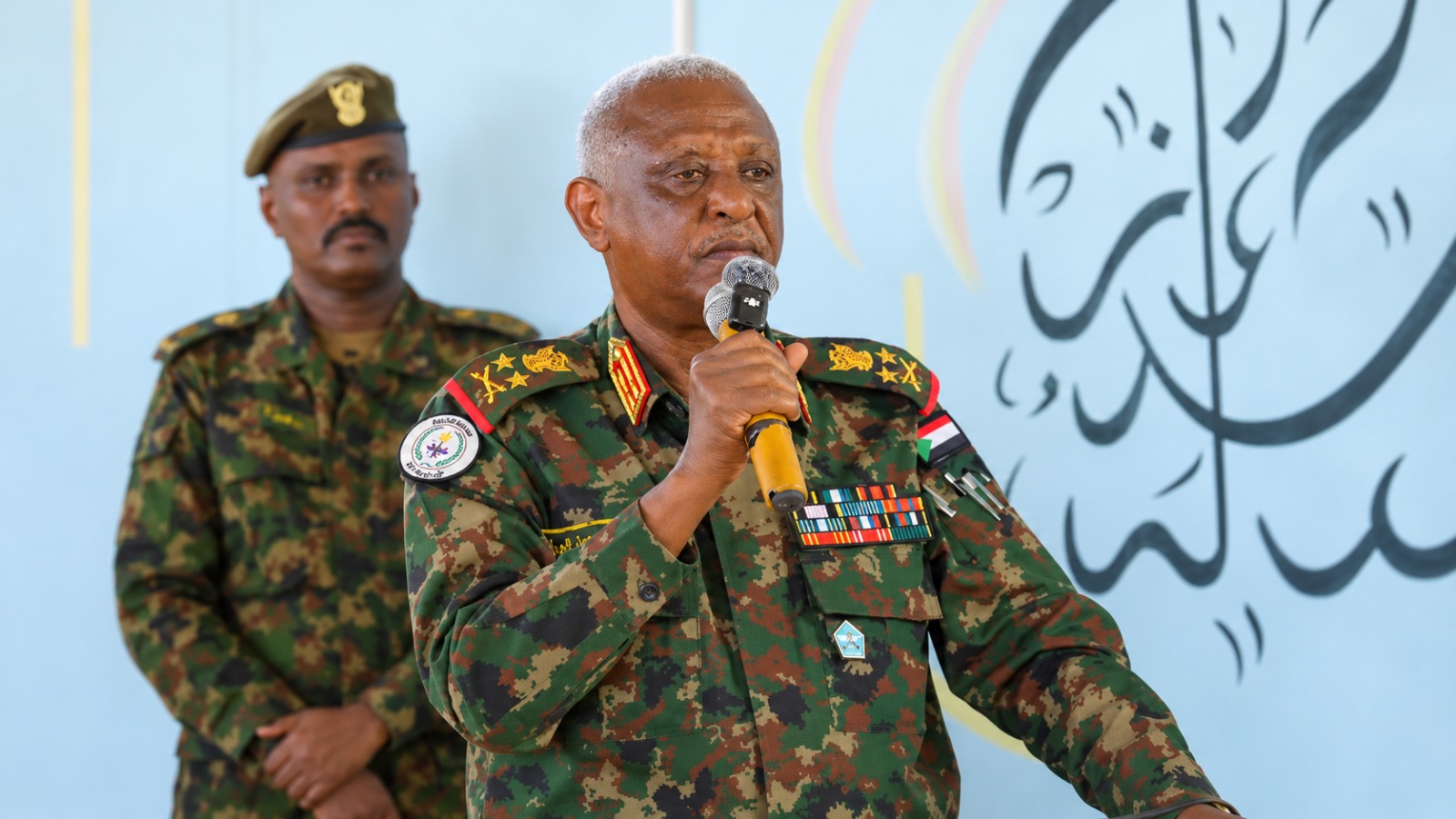
Sudan's Chief of Staff and Transitional Sovereignty Council member General Yaser Abdelrahman al-Atta delivered a forceful address to military personnel in Khartoum on Sunday, November 1, 2026.
In remarks circulated by the Sudanese Armed Forces, al-Atta discussed the ongoing war against the Rapid Support Forces, repeated attacks on civilian infrastructure and the military's plans to continue operations in Darfur and Kordofan.
He said the destruction of electricity and water facilities would not weaken the army's determination to defeat the RSF and restore government control over Sudanese territory.
The army chief also addressed allegations of foreign involvement in the conflict and the position of communities living in the country's war-affected regions.
Attacks on Infrastructure Will Not Stop Army Operations
Al-Atta focused part of his address on the recent escalation in drone strikes against electricity installations, water services and other critical infrastructure.
He said the military would continue its operations despite the destruction of facilities essential to civilian life.
The army chief described the attacks as an attempt to undermine Sudan's resilience and interfere with the government's efforts to restore services.
However, he insisted that the strikes would strengthen the government's determination to rebuild infrastructure and improve the delivery of public services.
Al-Atta reiterated that the armed forces intended to continue their campaign against the RSF and restore state authority across the country.
His remarks came during a period of serious disruption to Sudan's national electricity network.
New Drone Attacks Hit Al-Dabbah and Abu Hamad
Two additional electricity facilities were struck by drones on November 1.
The attacks targeted Al-Dabbah in Northern State and Abu Hamad in River Nile State.
Local authorities reported that both towns suffered electricity outages after their substations were damaged or destroyed.
According to the Associated Press, the Al-Dabbah substation suffered extensive destruction, and a security guard identified as Mohammed al-Nour was killed.
In Abu Hamad, the local security committee said the main substation had been rendered inoperable but reported no casualties.
Emergency Lawyers, a Sudanese rights group documenting the attacks, attributed the strikes to the RSF.
The organisation reported that at least 15 electricity substations had been targeted since the beginning of October.
The RSF had not issued a detailed, independently verifiable response to the latest allegations.
Power Grid Faces Extensive Damage
The latest attacks followed a series of strikes against electricity infrastructure in several Sudanese states.
Facilities affected during recent operations include the Um Dabakir thermal power station in White Nile State, the main substation in Shendi and energy infrastructure in Haya in Red Sea State.
At Um Dabakir, an attack reportedly destroyed four transformers and damaged three generating units.
The facility, which had a capacity of 500 megawatts, was taken out of service, affecting electricity supplies in White Nile and North Kordofan.
In Haya, drones reportedly struck an electricity transformer station and an oil pumping facility connected to the pipeline carrying crude toward the Red Sea.
Sudan's Minister of Energy and Petroleum, Mu'tasim Ibrahim, said on November 1 that preliminary assessments indicated approximately 14 electricity and fuel-related installations had been targeted.
He said the government was examining repairs and measures to strengthen physical and electronic protection around essential infrastructure.
The widespread damage has disrupted water supplies, hospitals, dialysis services, bakeries and agricultural irrigation.
Sudanese residents have also faced growing difficulties obtaining fuel for backup generators.
Al-Atta Pledges Continued Operations in Darfur and Kordofan
The chief of staff also addressed the army's military objectives in western and central Sudan.
Al-Atta said the Sudanese Armed Forces intended to continue advancing toward Darfur and Kordofan to confront RSF forces and foreign fighters operating alongside them.
He presented the recovery of territory controlled by the RSF as a central objective of the military campaign.
Large parts of Darfur remain under RSF control, while military operations continue across Kordofan.
According to Sudan Tribune, the army and allied forces have regained several areas and important supply routes in Kordofan over recent months.
These developments have affected transport and supply connections between RSF positions in Kordofan and Darfur.
However, the military situation remains fluid, and the army has not established full control over either region.
Al-Atta's comments reinforced the military leadership's intention to continue operations rather than announce a new ceasefire initiative.
Chief of Staff Addresses Darfur and Kordofan Tribes
In another important section of his remarks, al-Atta said the army's campaign was not directed against specific Sudanese tribes or ethnic communities.
He stressed that Darfur and Kordofan were integral parts of Sudan and that their communities remained important to the country.
The army chief specifically named the Rizeigat, Hawazma, Habbaniya and Beni Halba communities.
He said the military was not heading into the two regions to fight those tribes or take revenge against civilians for abuses committed during the conflict.
Instead, al-Atta said the army's declared objective was to confront armed RSF personnel and foreign fighters.
The statement was delivered amid longstanding concerns about ethnically motivated violence and attacks against civilian populations in Darfur and Kordofan.
While al-Atta framed the army's objectives in national rather than tribal terms, the protection of civilians remains a legal obligation for every party involved in the conflict.
Foreign Fighters and Cross-Border Recruitment Allegations
Al-Atta also accused the RSF of relying on foreign fighters recruited from outside Sudan.
He referred to personnel from Niger, South Sudan, Ethiopia, northern parts of Somalia and Colombia.
The chief of staff alleged that these fighters had been brought into the conflict through networks supported by external actors.
He directly accused the UAE leadership of involvement in the recruitment and deployment of foreign personnel.
The participation of foreign combatants in Sudan has been examined in previous investigations by international organisations and human rights groups.
However, al-Atta did not present a new independent accounting of the number of foreign fighters from each location or the specific arrangements under which they had been recruited.
His remarks therefore represent an official military assessment and accusation, rather than a comprehensive verification of every nationality and recruitment route mentioned.
UAE and Israeli Intelligence Accused of Interference
Al-Atta used some of his strongest language when discussing the international dimensions of the war.
He accused the United Arab Emirates and Israel's intelligence agency, Mossad, of involvement in activities aimed at undermining Sudan.
Referring to UAE President Mohamed bin Zayed Al Nahyan, he alleged that foreign actors were supporting the RSF and influencing the continuation of the conflict.
The general said Sudan's armed forces were fighting not only the RSF but also what he described as external efforts directed against the country's stability and independence.
Sudan's government has repeatedly accused the UAE of supplying weapons, financing and military assistance to the RSF.
The UAE has consistently denied arming or providing military support to the paramilitary force.
Abu Dhabi maintains that it supports diplomatic efforts, a ceasefire and humanitarian assistance for Sudan.
No independently verified evidence establishing the specific Mossad involvement alleged in al-Atta's speech was presented alongside the remarks.
Sudan Accuses Ethiopia of Facilitating Drone Operations
The army chief's address also followed renewed accusations from Sudan's Foreign Ministry concerning drone attacks allegedly launched from Ethiopian territory.
During a diplomatic briefing in Port Sudan on October 31, Foreign Ministry Undersecretary Muawiya Osman Khalid said Assosa in western Ethiopia had become an important location for military support networks assisting the RSF.
Sudanese officials alleged that some drones targeting electricity, water and other infrastructure had been launched from Ethiopian territory.
The government presented material it described as technical evidence, including drone wreckage and information collected by security agencies.
Sudan said it was pursuing diplomatic efforts while reserving its right to respond to attacks under international law.
The allegations have not yet been conclusively established by an independent international investigation.
Nevertheless, they form part of the increasingly strained relationship between Sudan and neighbouring Ethiopia.
UN Condemns Escalating Drone Attacks
The United Nations issued a separate warning on October 31 concerning the growing use of drones in Sudan's conflict.
UN Secretary-General António Guterres condemned attacks carried out by the parties to the war and their devastating consequences for civilians.
The UN said drone strikes had killed hundreds of civilians, including women and children, across Sudan and Abyei.
Guterres expressed particular concern over attacks against hospitals and other essential civilian infrastructure.
He urged all parties to protect civilians, respect international humanitarian law and agree to a cessation of hostilities.
The UN's statement addressed the conduct of all parties to the conflict rather than assigning responsibility for every reported drone attack to one side.
The intensification of aerial warfare has increased threats to civilian communities far beyond the main ground battlefronts.
Sudanese Military Reaffirms Its Campaign
Al-Atta's November 1 address brought together several of the most important issues currently shaping Sudan's conflict.
The army chief insisted that attacks on electricity and water infrastructure would not deter the military from pursuing its operations.
He reaffirmed the intention to continue fighting in Darfur and Kordofan while declaring that the campaign was not directed against the regions' tribes and civilian communities.
His accusations against the UAE and Israeli intelligence also reflected the Sudanese military leadership's interpretation of foreign involvement in the war.
At the same time, the destruction of energy infrastructure is creating serious challenges for hospitals, water networks, agriculture and essential public services.
The immediate consequences of the strikes are being felt by civilians already struggling with displacement, damaged infrastructure and years of conflict.