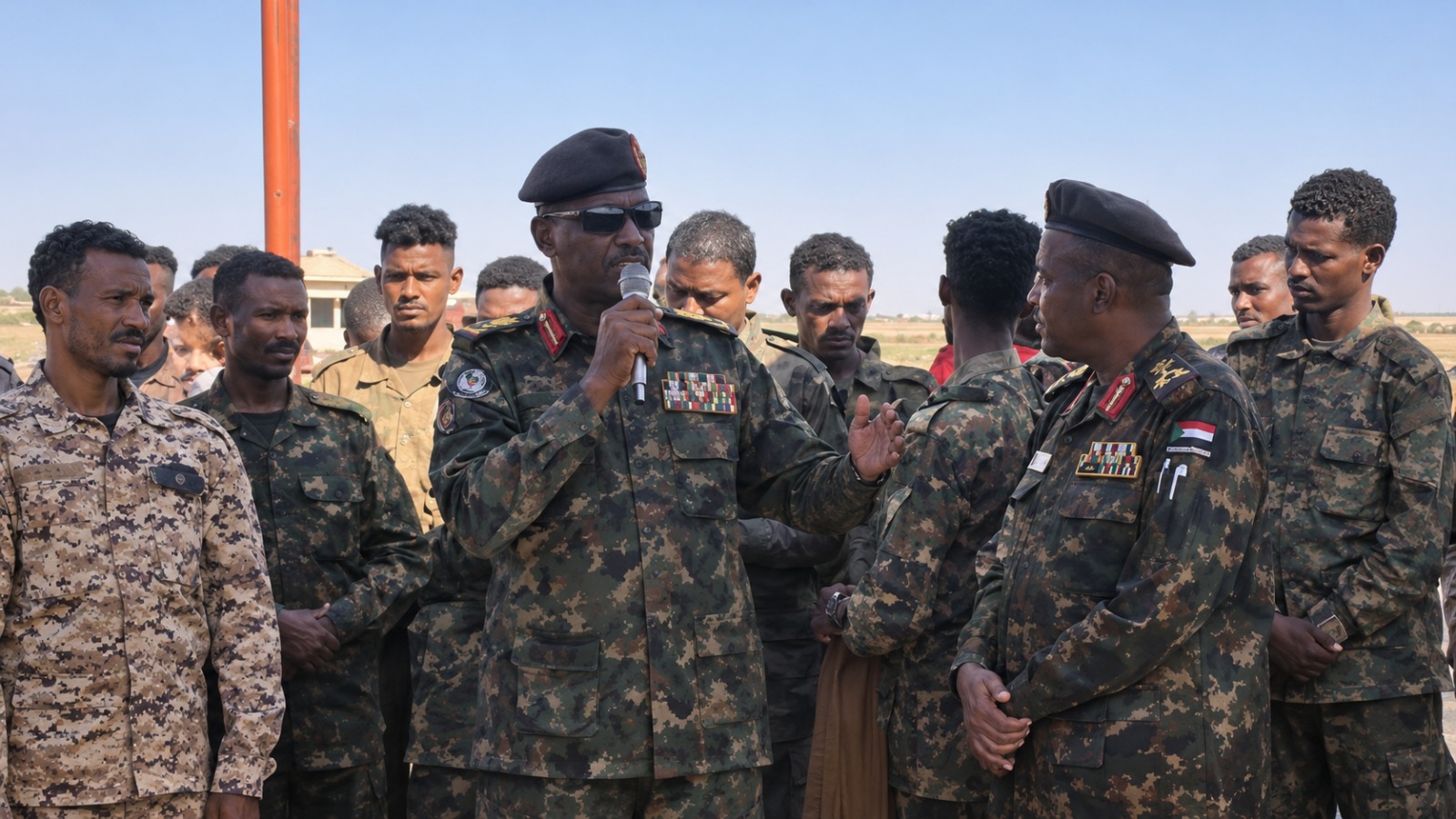
Sudan Shield Forces commander Major General Abu Aqla Keikel has announced plans to send several battalions outside Sudan, marking a significant development in the relationship between his armed group and the Sudanese Armed Forces.
Speaking to a gathering of his fighters in a video circulated on social media on November 22, 2026, Keikel said members of the Sudan Shield Forces had received official military service numbers, allowing them to receive salaries through the army's formal payment system.
He explained that the administrative arrangements would also enable personnel to be deployed abroad under the authority of the Sudanese military.
The announcement follows Keikel's return from Saudi Arabia on November 19 and comes amid renewed fighting between Sudanese government forces and the Rapid Support Forces in Blue Nile.
Sudan Shield fighters receive official military service numbers
During his address, Keikel said Sudanese Armed Forces Commander-in-Chief Abdel Fattah al-Burhan had approved the issuance of official service numbers to members of the Sudan Shield Forces.
The commander emphasized that these numbers would allow fighters to receive their salaries through the military's established personnel and payroll procedures.
He also said foreign deployments would be arranged using the same military identification system.
The development is significant because the Sudan Shield Forces have previously operated as a separate armed formation allied with the regular army.
The formal registration process could strengthen administrative coordination in personnel management, salary payments and military assignments.
However, the Sudanese Armed Forces have not separately published the complete administrative arrangements governing the group's future command structure or its integration into the regular military.
Keikel announces plans to deploy battalions abroad
Keikel said preparations were underway to send several battalions outside the country under instructions from the commander-in-chief.
He described the anticipated deployment as recognition of the service and sacrifices made by Sudan Shield fighters during the conflict.
According to his remarks, the personnel would be eligible for foreign assignments once their official military registration procedures were completed.
Keikel did not specify the exact number of battalions involved, the destination country or the timetable for their movement.
He also explained that he had initially intended to keep the arrangements confidential because of restrictions on filming military activities.
Nevertheless, he decided to share the information with his troops as an expression of appreciation for their contribution.
Saudi Arabia and Yemen emerge as possible destinations
Keikel's remarks have attracted particular attention because they followed his recent visit to Saudi Arabia.
The Sudan Shield commander returned to Khartoum on November 19 after spending several days in the kingdom.
Sudanese media reported that supporters and members of his forces welcomed him at Khartoum International Airport.
The Sudanese military already maintains personnel stationed in Saudi Arabia, raising questions about whether the latest arrangements could involve additional deployments to the kingdom.
Sudanese news outlet Al-Zawiya interpreted Keikel's announcement as referring to a planned deployment to Saudi Arabia, potentially involving participation in military operations associated with the Saudi-led coalition in Yemen.
Other reports also discussed the possibility of Sudan Shield personnel replacing or supplementing Sudanese units that had previously participated in the Yemen conflict.
However, the destination was not explicitly identified in the version of Keikel's remarks reported by Sudan Tribune.
No joint announcement from the Sudanese and Saudi governments has confirmed the precise scope or mission of any new deployment.
Reports of a larger force generate debate
The possible overseas deployment has prompted discussion about the number of fighters who might be involved.
According to a November 23 report by The Sudan Times, some Sudanese sources have discussed an initial deployment of approximately 2,000 fighters, with the total potentially reaching 10,000 personnel over 18 months.
Other reports have referred to around 6,000 fighters who could be deployed along the Saudi-Yemeni border.
The different figures have not been established through official troop deployment orders or a publicly released bilateral agreement.
Details concerning the proposed assignments, compensation arrangements and duration of service remain unclear.
The prospect of sending Sudanese fighters to another conflict has also generated criticism among some Sudanese commentators, particularly while the country continues to face a prolonged domestic war and a severe humanitarian crisis.
Sudan's previous military involvement in Yemen
Sudan's military relationship with Saudi Arabia has included participation in the conflict in Yemen.
In 2015, under former President Omar al-Bashir, Sudan joined the Saudi-led military coalition operating against the Houthi movement.
Sudanese regular military personnel and, at different stages, fighters associated with the Rapid Support Forces participated in coalition activities.
The arrangements changed over time as Sudan experienced major political transitions and growing internal security challenges.
When fighting erupted between the Sudanese Armed Forces and the RSF in April 2023, the two organizations became opposing parties in Sudan's civil war.
Keikel's latest announcement has therefore renewed discussion about whether Sudanese formations currently fighting alongside the army could also be assigned to external military operations.
Sudan Shield's changing role in the war
The Sudan Shield Forces were established in 2022 under the leadership of Abu Aqla Keikel.
The group's fighters have largely been drawn from communities in Al Jazirah state and surrounding areas of central Sudan.
During the early stages of the current conflict, Keikel operated alongside the Rapid Support Forces.
In October 2024, however, he broke with the RSF and joined the Sudanese Armed Forces.
Following the change in allegiance, Sudan Shield units participated in government military operations across Al Jazirah state.
They played a role in the army's campaign to regain Wad Madani and surrounding areas in early 2025, before participating in operations around Khartoum and North Kordofan.
An October 2026 assessment by the European Union Agency for Asylum estimated the Sudan Shield Forces' strength at between 35,000 and 75,000 personnel.
The broad range reflects the difficulty of establishing the exact size of the armed formation.
Keikel remains subject to international sanctions
The Sudan Shield Forces' growing relationship with the regular military also comes amid continued international scrutiny of the group's conduct.
On February 5, 2026, the United Kingdom imposed sanctions on Keikel over suspected involvement in serious violations of international humanitarian law in Sudan.
The British government specifically linked the Sudan Shield Forces to abuses against Kanabi communities in Al Jazirah state.
The European Union subsequently included Keikel in sanctions measures announced in October 2026.
EU documentation described him as the leader of a militia affiliated with the Sudanese Armed Forces.
These sanctions form part of the wider international response to abuses attributed to armed actors involved in Sudan's conflict.
Keikel announces deployment toward Blue Nile
Alongside the overseas deployment plans, Keikel also announced that Sudan Shield units would move to Blue Nile to fight the Rapid Support Forces.
The commander made the announcement on November 22 while attending a condolence gathering for Lieutenant Colonel Osama al-Sadiq in the East Nile area of Khartoum.
The planned movement follows an escalation of military operations in southeastern Sudan.
The RSF and its allies in the Sudan People's Liberation Movement-North faction led by Abdelaziz al-Hilu have intensified military activities in Blue Nile, particularly around Bau, Kurmuk and Geissan.
The security situation has raised concerns about possible threats to Ed Damazin, the regional capital.
Sudanese army reinforces positions around Ed Damazin
On November 22, the Sudanese Armed Forces' 4th Infantry Division announced that reinforcements were being prepared for deployment to the front lines in Blue Nile.
The division's media office released footage showing military vehicles moving through Ed Damazin ahead of planned operations.
Government forces have been attempting to secure key routes and prevent further advances by the RSF and its allies.
The rival alliance announced territorial gains around Bau on November 19, while the Blue Nile regional government said on November 20 that military reinforcements and equipment were being mobilized in response.
The fighting has increased the importance of securing Ed Damazin and the surrounding transport corridors.
Keikel's announcement indicates that Sudan Shield units are expected to reinforce the regular army's operations in the region.
The group could therefore be involved in domestic combat assignments while preparations continue for possible overseas deployments.
New chapter in Sudan Shield's military organization
Keikel's latest remarks point to changes in the administrative and operational relationship between the Sudan Shield Forces and the Sudanese Armed Forces.
The provision of official service numbers and the inclusion of fighters in the military payroll system represent important steps toward closer institutional coordination.
The proposal to send several battalions abroad also raises questions about the future operational role of the group and Sudan's wider military relationships.
Nevertheless, the destination, number of personnel, deployment schedule and specific duties of the overseas contingents have not yet been formally detailed.
Meanwhile, the expected deployment of Sudan Shield units to Blue Nile reflects their continuing involvement in Sudan's domestic military operations amid intensifying fighting in the southeastern region.