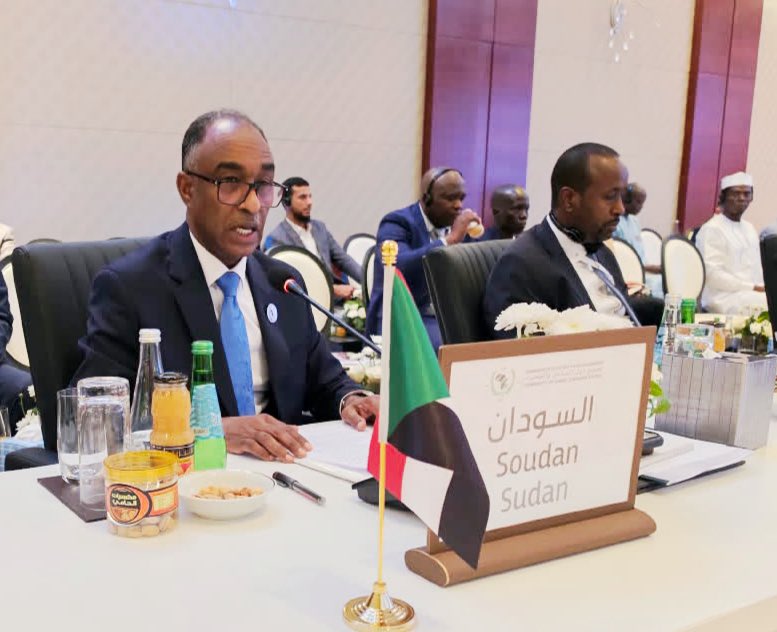
Sudan has urged African governments to increase diplomatic pressure on the Rapid Support Forces and take measures to restrict the external military support networks linked to the paramilitary organization.
The appeal was delivered by Ambassador Muawiya Othman Khalid, Undersecretary of Sudan's Ministry of Foreign Affairs and International Cooperation, during the 22nd Ordinary Session of the Executive Council of the Community of Sahel-Saharan States in Tripoli on Saturday, November 7.
Khalid led the Sudanese delegation at the gathering, which brought together foreign ministers, senior officials and representatives of the organization's member states.
In his address, the Sudanese diplomat called for the RSF to be designated a terrorist organization and urged member countries to prevent their territories from being used to transport weapons, mercenaries and logistical supplies to the group.
The appeal came amid continuing international scrutiny of atrocities committed during Sudan's civil war and the involvement of foreign recruitment and supply networks in the conflict.
Sudanese Delegation Raises RSF Issue in Tripoli
Ambassador Muawiya Othman Khalid presented Sudan's position during the opening session of the CEN-SAD Executive Council.
He described the war as a major threat to Sudan's national institutions, security and territorial integrity.
Khalid accused the RSF of launching a destructive rebellion against the state and carrying out military activities that have damaged essential infrastructure and cultural heritage.
He also alleged that certain regional powers had contributed to sustaining the conflict through external assistance.
According to the Sudanese representative, the consequences of the war extend beyond the battlefield and have affected the country's social, economic and institutional structures.
Khalid urged the participating African governments to recognize the seriousness of the situation and strengthen their collective response.
Khartoum Seeks Terrorist Designation for RSF
The central demand of Sudan's address was the designation of the Rapid Support Forces as a terrorist organization.
Khalid called on CEN-SAD member states to condemn atrocities attributed to the RSF and support stronger measures against the paramilitary group.
The Sudanese government has repeatedly accused the RSF of attacking civilian communities, destroying infrastructure and undermining the country's national institutions.
The latest appeal seeks to move those accusations into a broader regional diplomatic framework.
However, the designation requested by Sudan has not been announced as an adopted CEN-SAD decision.
The organization's published meeting outcomes focused on institutional reform, regional cooperation, security coordination and counterterrorism.
No specific decision formally designating the RSF as a terrorist organization was disclosed.
Member States Asked to Block Weapons and Mercenaries
Sudan's appeal also focused on the movement of military equipment and foreign personnel across regional borders.
Khalid called on member states to prevent their territories from being used as transit routes for weapons, foreign fighters and logistical assistance intended for the RSF.
The proposal reflects Sudan's efforts to disrupt the supply chains that help sustain the group's military operations.
The Sudanese government argues that the RSF's ability to conduct prolonged operations has been strengthened by outside assistance.
Khalid emphasized that neighboring countries and other African governments should not allow logistical networks supporting the conflict to operate through their territories.
His statement did not publicly identify a specific foreign government responsible for the alleged assistance.
Instead, it referred more broadly to regional powers that Sudan accuses of supporting the war.
Ethnic Cleansing and Starvation Allegations
The Sudanese representative accused the RSF and foreign mercenaries of involvement in campaigns of ethnic cleansing and the systematic starvation of civilians.
Khalid said Sudanese communities had suffered widespread abuses during the war, including attacks on vital facilities and the destruction of infrastructure.
His accusations come against the background of extensive international investigations into violence committed in Darfur.
United Nations human rights investigators have documented serious violations involving the RSF and allied armed groups, including mass killings, sexual violence, torture and the obstruction of humanitarian assistance.
The findings have intensified calls for accountability for those involved in attacks on civilian populations.
Sudan's latest demand seeks regional political action alongside ongoing international human rights investigations.
UN Findings on El Fasher Atrocities
The scale of the violence associated with the RSF has been documented in United Nations investigations concerning El Fasher, the capital of North Darfur.
In a report published on February 13, 2026, the UN Human Rights Office detailed atrocities committed during the RSF offensive that captured the city in October 2025.
The investigation documented more than 6,000 killings during the first three days of the offensive.
At least 4,400 people were killed inside El Fasher, while more than 1,600 others died along routes used by civilians attempting to escape.
The report identified widespread attacks on civilians, summary executions, sexual violence, abductions, torture, pillage and the use of starvation as a method of warfare.
UN investigators concluded that several documented acts amounted to war crimes and could constitute crimes against humanity.
A separate UN fact-finding report published in February 2026 identified indicators of genocidal conduct during the RSF takeover of El Fasher.
These investigations provide a significant international context for Sudan's latest diplomatic demands.
Foreign Recruitment Networks Examined by UN Investigators
Foreign fighters and military supply networks have become another major focus of international investigations into Sudan's conflict.
On September 3, 2026, the UN Independent International Fact-Finding Mission for Sudan reported that transnational networks had recruited, trained and deployed foreign personnel in support of RSF operations.
The investigation documented the deployment of up to 2,000 former Colombian military contractors who participated in operations involving combat drones, artillery and advanced weapon systems in Darfur and Kordofan.
Investigators also identified reasonable grounds to believe that private entities, intermediaries and recruiters connected to several countries used transit points in Chad, southeastern Libya and Somalia to support RSF operations.
The networks examined included entities operating from Colombia and the United Arab Emirates.
The UAE has denied allegations that it provides military support to the RSF.
The UN mission also found evidence that the Sudanese Armed Forces used foreign-supplied drones in operations that harmed civilians and civilian infrastructure.
Its findings highlighted the contribution of external military assistance to the intensification of the conflict and called for stronger measures against illicit weapons transfers.
Why CEN-SAD Matters to Sudan
The Community of Sahel-Saharan States brings together 25 African countries in a regional organization established in Tripoli in 1998.
Its membership includes Sudan, Libya, Chad, Niger, Mali, Egypt, Somalia and Djibouti, among other states.
The organization provides a diplomatic framework for cooperation on regional security, economic integration and political coordination.
Its geographical reach covers important transport and commercial networks across North Africa, the Sahel and other parts of the continent.
For Sudan, cooperation among these countries is particularly relevant to concerns about cross-border weapons trafficking and the movement of foreign fighters.
The call for stronger measures against RSF-linked supply networks therefore seeks to place Sudan's security concerns within the wider framework of regional cooperation.
However, the participating governments have not announced a collective decision endorsing Sudan's specific terrorist-designation request.
CEN-SAD Agrees on Institutional Reforms
The November 7 meeting concluded with several decisions intended to strengthen CEN-SAD's institutions and improve regional coordination.
The final document was signed by Chadian Foreign Minister and Executive Council President Ahmed Kougri and Libya's Acting Foreign Minister Taher Al-Baour.
The council approved the appointment of an interim executive secretary for a four-month period, with the official expected to operate from Tripoli.
Member states also reached an agreement concerning the return of the organization's Executive Secretariat to its original headquarters in the Libyan capital.
The proposal is expected to be submitted to the next summit of heads of state and government, scheduled to take place in N'Djamena, Chad, in 2027.
The meeting's conclusions addressed counterterrorism, organized crime, irregular migration, political consultation and economic integration.
Libya is also expected to host the organization's following summit in 2028.
Despite these institutional decisions, no separate resolution designating the RSF as a terrorist organization was announced.
Sudan Seeks Stronger Regional Pressure on RSF
Sudan's intervention in Tripoli represents another step in its efforts to increase international pressure on the Rapid Support Forces.
The government is seeking both political recognition of its accusations against the RSF and practical measures to restrict the international networks supporting the group's operations.
Its demands include preventing weapons transfers, limiting the movement of foreign mercenaries and encouraging regional governments to condemn atrocities committed during the war.
The appeal also reflects growing international attention to the role of external actors in sustaining Sudan's conflict.
Although the CEN-SAD Executive Council did not announce the requested terrorist designation, Sudan's intervention brought the issue before a regional forum involving countries across the Sahel, North Africa and the Horn of Africa.
The Sudanese government is expected to continue pursuing regional and international diplomatic measures aimed at restricting RSF support networks and securing accountability for abuses committed during the conflict.