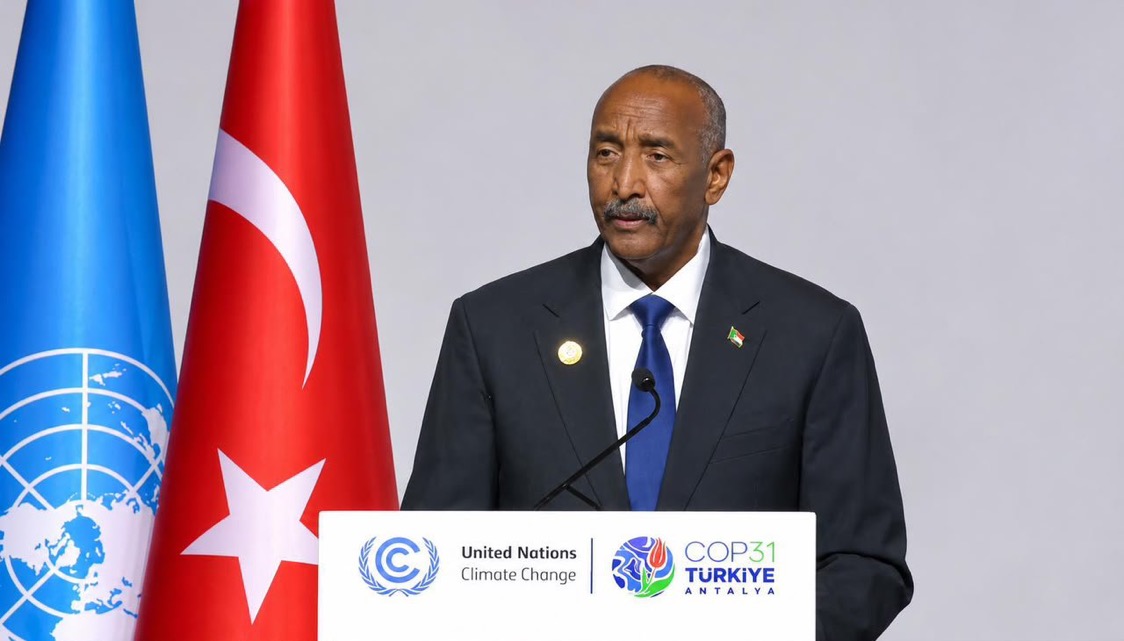
Sudan’s Transitional Sovereignty Council Chairman and army chief, General Abdel Fattah al-Burhan, addressed world leaders at the 31st United Nations Climate Change Conference (COP31) in Antalya, Türkiye, on Wednesday, November 11, 2026.
Speaking during the high-level segment of the summit hosted by Turkish President Recep Tayyip Erdoğan, al-Burhan highlighted Sudan’s climate challenges and the impact of the country’s ongoing armed conflict on environmental resilience.
He emphasized that Sudan contributes relatively little to global greenhouse gas emissions but remains highly exposed to the consequences of climate change.
The Sudanese leader called for international climate financing mechanisms to become more accessible to developing countries, particularly those affected by armed conflict.
War compounds Sudan’s environmental challenges
Al-Burhan said Sudan was experiencing increasing risks from droughts, floods, desertification, land degradation and water shortages.
He warned that these developments were undermining agricultural and livestock production while threatening food security and rural livelihoods.
The war that began in April 2023 had further intensified these problems, he explained.
According to al-Burhan, the fighting has damaged infrastructure, disrupted public services and weakened the ability of communities and institutions to respond to climate-related emergencies.
He accused the Rapid Support Forces of waging war against Sudan’s population and resources, alleging that the paramilitary group receives support from certain regional countries.
He argued that addressing climate change in Sudan could not be separated from peace, food and water security, sustainable development and resilience.
Call to double climate adaptation financing
A central part of al-Burhan’s speech focused on the need for fairer international climate financing.
He urged developed countries to double their financial contributions toward climate adaptation, particularly for least-developed countries and states affected by conflict.
Al-Burhan stressed that climate finance should not remain an unfulfilled international commitment or be restricted by political considerations.
Instead, he called for funding to become available through predictable, transparent and accessible mechanisms.
He also highlighted the importance of strengthening national institutions so developing countries could effectively use international climate financing.
The Sudanese leader urged governments and international institutions to consider the specific circumstances of countries facing both armed conflict and environmental emergencies.
Sudan highlights renewable energy and agriculture potential
Despite the challenges created by the war, al-Burhan said Sudan possessed considerable opportunities for sustainable development.
He identified renewable energy, particularly solar power, as one of the country’s promising investment sectors.
Other priorities included climate-resilient agriculture, water resource management, sustainable pastoral systems, ecosystem restoration and combating desertification.
Al-Burhan also emphasized early-warning systems and disaster risk management as essential components of national adaptation efforts.
He invited international partners to help transform Sudan’s natural resources and development plans into practical investments, scalable projects and employment opportunities.
Such cooperation, he said, could strengthen the country’s resilience while contributing to long-term economic recovery.
Sudan reaffirms climate commitments in Antalya
At the beginning of his speech, al-Burhan thanked the Turkish government for hosting COP31 and facilitating dialogue among participating countries.
He reaffirmed Sudan’s support for the common negotiating positions of the African Group, Arab Group, Group of 77 and China, and the Least Developed Countries.
Al-Burhan also outlined Sudan’s continuing work under international climate reporting requirements.
He said the country had submitted its Third National Communication and Biennial Update Report in April 2025.
Preparations were underway for Sudan’s Fourth National Communication and first Biennial Transparency Report, despite the challenges affecting state institutions.
The COP31 conference, taking place in Antalya from November 9 to 20, brings together governments and international organizations to discuss climate financing, adaptation and the implementation of global commitments.
For Sudan, al-Burhan’s participation provided an opportunity to highlight the combined effects of conflict and climate vulnerability while seeking increased international cooperation and investment.
His message emphasized that climate adaptation should contribute not only to environmental protection but also to peace, development, food security and economic stability.