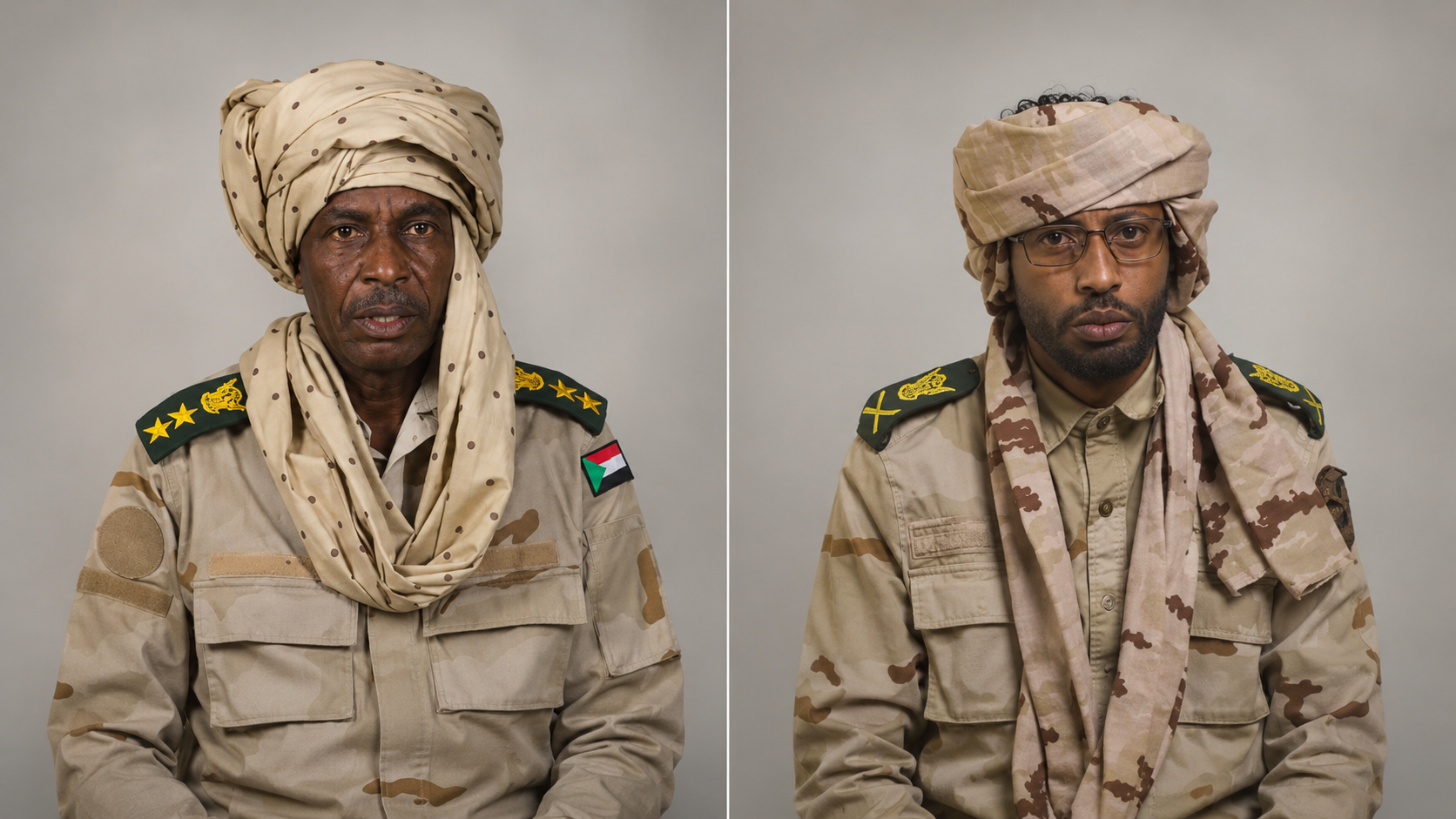
Two senior figures from Sudan's Third Front Tamazuj movement have announced that they are breaking their alliance with the Rapid Support Forces and aligning themselves with the Sudanese army.
The development was reported on Tuesday, November 10, 2026, nearly three and a half years after the outbreak of war between the Sudanese Armed Forces and the RSF.
The commanders were identified as Major General Hamdan Bashir Hamed and his deputy, Colonel Omar Awad Haroun.
According to reports carried by Al Arabiya and regional media, Bashir announced his separation from the RSF in a recorded video statement.
He declared his allegiance to the Sudanese Armed Forces and apologized to the Sudanese people for mistakes associated with his previous alliance.
Haroun separately confirmed his decision to abandon the RSF and support the army.
Their announcements come as Sudan's conflict continues to reshape the military and political alliances formed by armed movements in Darfur, Kordofan and other parts of the country.
Hamdan Bashir apologizes for RSF alliance
Major General Hamdan Bashir Hamed announced in a recorded statement that he was severing his ties with the Rapid Support Forces.
Bashir said he had decided to support the Sudanese Armed Forces after previously maintaining an alliance with the RSF during the ongoing conflict.
He also issued an apology to the Sudanese people for errors committed during the period of his association with the paramilitary group.
His remarks represented a public reversal of the military alignment he had maintained since the early stages of the war that began on April 15, 2023.
Bashir urged other fighters to reconsider their positions, leave the RSF and join the Sudanese army.
However, the announcement did not specify how many combatants were under his command or whether any organized military units had already followed him.
No detailed information was released concerning his previous areas of deployment, the equipment controlled by his forces or arrangements for integrating personnel into the regular army.
The immediate operational significance of his decision therefore remains unclear.
Deputy commander Omar Awad Haroun also breaks away
Colonel Omar Awad Haroun, identified as Bashir's deputy within the Third Front Tamazuj structure, also declared his departure from the RSF alliance.
Haroun announced his support for the Sudanese army, joining his senior commander in abandoning their previous military alignment.
Regional reports also identified Haroun as a local mobilization leader associated with the Misseriya community.
The Misseriya have an important presence in parts of Sudan's Kordofan region, where social and tribal networks have played a significant role in the country's political and military developments.
Haroun's position gives his announcement relevance beyond an individual change of allegiance.
Nevertheless, no verified figures have been published concerning the number of fighters who may follow his decision.
It also remains unclear whether Haroun has formally entered a Sudanese army command structure or whether his announcement represents a declaration of political and military support pending further arrangements.
Tamazuj's alliance with RSF dates back to 2023
The Third Front Tamazuj movement was among the armed groups that signed Sudan's Juba Peace Agreement in October 2020.
The agreement was intended to bring several armed movements into a political transition process and establish arrangements for security integration and power-sharing.
However, the war between the Sudanese army and the RSF in April 2023 significantly altered the political and military environment.
On August 17, 2023, Tamazuj formally announced that it would fight alongside the RSF against the Sudanese Armed Forces.
A statement signed by the movement's then-leader, Mohamed Ali Qureshi, instructed affiliated fighters in Darfur and Kordofan border areas to join RSF positions.
The decision established Tamazuj as one of the armed movements publicly aligned with the paramilitary force during the conflict.
The November 2026 announcements by Bashir and Haroun mark a departure from that earlier alliance by two senior figures associated with the movement.
However, their decision should not be interpreted as confirmation that the entire Tamazuj organization has switched sides.
Internal divisions have affected the movement
The Tamazuj movement has experienced significant internal disagreements over political representation, leadership and military alliances.
In 2025, some of its representatives sought a greater role within the Sudan Founding Alliance, known as Tasis, an RSF-aligned political coalition.
The movement's different factions subsequently disputed leadership authority and representation within the alliance.
In April 2026, one Tamazuj faction rejected claims made by a rival leadership associated with Mohamed Ali Qureshi.
Further divisions became visible in September when a separate group identifying itself as the Third Front Tamazuj's Correcting the Course faction announced its support for the Sudanese Armed Forces.
That faction criticized the movement's previous leadership and declared its intention to align with the army.
These developments demonstrate that the organization has not maintained a uniform political position throughout the war.
The departure of Bashir and Haroun adds another development to that history of internal fragmentation.
It does not, by itself, establish a unified position among all Tamazuj factions.
New defections follow a series of RSF departures
The announcements come amid an expanding pattern of commanders and fighters leaving the RSF.
On August 13, Sudanese authorities reported that 21 commanders and approximately 270 fighters had defected to the army with 37 military vehicles.
Another group of 318 personnel, including four commanders, was reported to have defected later that month.
In September, commander Al-Tayeb al-Wahidu announced that he had left the RSF and joined the Sudanese army alongside approximately 50 fighters.
On October 8, Lieutenant Colonel Mohammed Azraq al-Fanjari, a commander associated with the RSF's Special Tasks Group, announced his departure together with approximately 300 personnel and 30 military vehicles.
Another senior commander, Siddiq Ander, announced his separation from the organization in late October.
Ander accused the RSF leadership of allowing internal family networks to dominate financial resources, military appointments and operational decisions.
The RSF has not publicly confirmed all the allegations made by defecting commanders.
Although multiple groups have announced their departure, the total number of personnel who have successfully joined the Sudanese army has not been independently verified.
Further senior defections reported on November 10
The Tamazuj commanders' announcements coincided with reports that other senior RSF figures had also changed allegiance.
Lieutenant General Khalid Nour al-Daim Bireish, who had reportedly served in the RSF for approximately 13 years, was identified as another commander who declared support for the Sudanese Armed Forces on November 10.
Bireish was a former regular army officer who joined the RSF in 2013 and subsequently served in senior administrative, security and operational roles.
His departure attracted attention because of his long association with the paramilitary organization's institutional development.
Separately, Sudan's official government spokesperson platform announced that a force led by Jado Mohammed Hamed Shawqar had joined the Sudanese army.
Shawqar accused the RSF leadership of losing control over its forces and alleged that foreign actors had influenced its operations.
He also referred to reported abuses against civilians as a reason for his decision to leave.
Those accusations have not all been independently verified.
The departures involving Bireish and Shawqar are separate from the Tamazuj commanders' announcements, although all were reported during the same period.
Fragmentation raises questions about RSF alliances
Sudan's prolonged conflict has placed growing pressure on armed coalitions, military command networks and local alliances.
The Armed Conflict Location & Event Data Project (ACLED) has examined how disagreements within the RSF and its allied groups have developed amid shifting territorial control and competition over military resources.
Its analysis identified the importance of local loyalties, disputes over access to resources and tensions between commanders from different communities.
Such pressures may influence whether commanders remain within existing alliances or seek new arrangements.
The Tamazuj announcements are particularly relevant because the movement was not originally part of the RSF's core command structure but an allied armed organization.
The departure of commanders from such groups may indicate changes in the wider network of alliances supporting the RSF.
However, the military impact of individual defections depends on the actual number of fighters involved, the equipment transferred and the strategic importance of the positions previously controlled.
No verified assessment has established that the Tamazuj announcements have produced a measurable change in battlefield control.
Accountability remains an important issue
The Sudanese army has repeatedly encouraged RSF fighters and commanders to abandon the paramilitary organization.
However, the acceptance of former armed-group commanders has also raised concerns about accountability for abuses committed during Sudan's war.
In June 2026, Human Rights Watch called on Sudanese authorities to ensure that defecting commanders were investigated where credible allegations of serious violations existed.
The organization emphasized that changing allegiance should not provide immunity from responsibility for international crimes.
The broader debate has become particularly relevant as commanders associated with different armed groups seek to join the regular military.
No specific findings establishing criminal responsibility for Bashir or Haroun were presented in the reports of their November 10 announcements.
Their future roles, the status of any fighters under their command and the arrangements for their possible integration into the Sudanese Armed Forces have not yet been publicly clarified.
For now, the confirmed development is that two senior figures from the Third Front Tamazuj have publicly announced their break with the RSF alliance and their support for the Sudanese army.